

Latest Posts
Jojo Galvan Mora, CHM Digital Humanities Fellow, writes about the significance of Claudia Sheinbaum Pardo being elected president of Mexico, how Chicago’s Mexican community both influenced and is impacted by it, and the community’s importance in local, national, and international politics.
As midnight drew closer on June 2, 2024, Mexican voters on both sides of the US-Mexico border witnessed history when that year’s presidential election was called in favor of Claudia Sheinbaum Pardo, cementing her place in history as Mexico’s 66th president and as the first woman and first Jewish person to hold the nation’s highest office. Sheinbaum succeeded Andrés Manuel López Obrador (AMLO), continuing the leadership of the progressive National Regeneration Movement (MORENA) over Mexico for another six years. Chicagoans with Mexican citizenship played their role in a historic moment of their own: the 2024 election marked the first time that Mexicans living abroad in the US could vote in person at the Mexican Consulate on the Near West Side.
Mexican nationals wait to cast their vote in the Mexican presidential election at the Mexican consulate in Chicago on June 2, 2024. Photo by KAMIL KRZACZYNSKI/AFP via Getty Images
According to data from Mexico’s Instituto Nacional de Eleccciones (National Elections Institute or INE) more than 10,000 Mexican citizens registered to vote in Illinois. The Mexican consulate in Chicago reported 1,500 in-person voting slots.
A Mexican national fills in her ballot for the Mexican presidential election at the Mexican consulate in Chicago on June 2, 2024. Photo by KAMIL KRZACZYNSKI/AFP via Getty Images
Sheinbaum was born in Mexico City to a Jewish family with Eastern European roots. Both of Sheinbaum’s parents were scientists, her father a chemist, while her mother worked as a biologist. This upbringing led Sheinbaum to the sciences, and she earned a PhD in energy engineering at the National Autonomous University of Mexico (UNAM) in 1995. Sheinbaum first entered politics in 2000 when AMLO, then Head of Government for Mexico City, named her Environmental Secretary.
In 2015, the largest borough in Mexico City, Tlalpan, elected Sheinbaum as mayor. Riding a wave of local popularity, Sheinbaum went on to win the election for the Head of Government in Mexico City in 2018, the same year that her longtime mentor, AMLO, secured the Mexican presidency. Her time in office was marked by a science-forward approach to the COVID-19 pandemic and policy reforms focused on addressing gender violence, outdated public infrastructure, and initiatives to make education available to all. Sheinbaum’s popularity as the leader of the largest urban metro area in all of North America made her a logical choice to succeed AMLO after the conclusion of his six-year presidential term. She won close to 60% of the vote at home and from Mexicans abroad, and carrying 31 out of 32 states in the country. She was inaugurated in October of that year, and her leadership has been defined by policies focused on energy reform, nationwide passenger rail modernizations, and social welfare programs designed to support children and mothers.
New president of Mexico Claudia Sheinbaum Pardo receives the presidential sash during the investiture ceremony as part of the presidential inauguration on October 1, 2024, in Mexico City, Mexico. Photo by Manuel Velasquez/Getty Images
In Chicago, Sheinbaum represents an aspirational figure for thousands of people with Mexican heritage in the metro area. According to data from a report published by University of Illinois Chicago’s Great Cities Institute in 2024, as of 2022, Mexicans made up at least 50% of the population across 15 neighborhoods in the city, and about one-fifth (roughly half a million) of the city’s entire population.
Sheinbaum’s ascension to the presidency also highlights the resounding impact of women in both local and transnational politics, especially in a city like Chicago, where women with Mexican ancestry are increasingly visible as business owners, educators, and political leaders. As an international figure, Mexican president Claudia Sheinbaum represents a milestone in the history of women achieving high leadership roles, and also the undeniable importance of Chicago’s Latine community as constituents in both local and international politics.
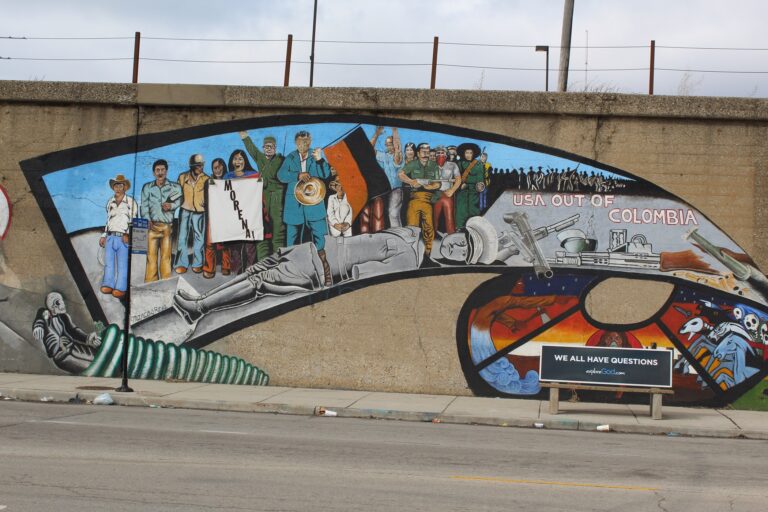
This photograph of “Fallen Dictator,” from Marcos Raya’s (b. 1948) mural Prevent World War III (1980) is currently on view in Aquí en Chicago. The banner depicted in the mural reads “MORENA” (Sheinbaum’s political party) and previously depicted a red and black portrait of Cuban revolutionary Che Guevara, remnants of which can still be seen in the outline behind the current banner. Photograph courtesy of Mario Hernandez, 2024
For more about Chicago’s Latine history, visit Aquí en Chicago, open until November of 2026.
For more on the history of Mexican political movements in Chicago, read Making Mexican Chicago: From Postwar Settlement to the Age of Gentrification by Mike Amezcua, available in our Abakanowicz Research Center.
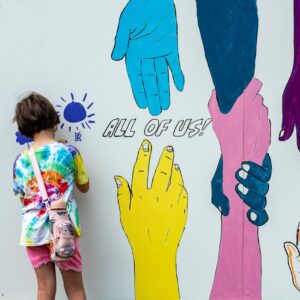
How can we help shape our communities and country for the better? By Using our Civic Superpowers!
Made by Us developed Civic Superpowers for their annual Civic Season, and CHM staff has applied them to develop this classroom activity. Students examine Amplifiers, Connectors, Nurturers, and Defenders from history to see how these powers and their actions have shaped our democracy. Explore the lesson and how your students can discover their own Civic Superpowers.
Download the Civic Superpowers Activity Guide Download the Civic Superpowers posters (11″ x 17″)In recognition of Women’s History Month, we share excerpts from a forthcoming Chicago History article by Ann Saunders on her mother Doris E. Saunders, a librarian, author, editor, businesswoman, and professor, perhaps best known in Chicago for her work with Johnson Publishing Company, which published Ebony and Jet magazines and empowered Black self-representation.
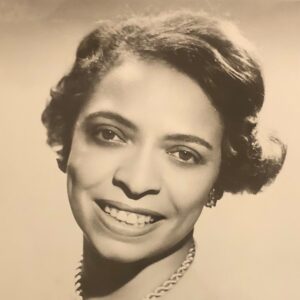
Promotional image of Doris E. Saunders for her radio show, The Doris Saunders Show, which broadcast on WBEE, c. 1966. Courtesy of Ann Saunders
In Chicago’s Bronzeville neighborhood, there were businesses to establish and manage, newspapers like the Chicago Defender to keep up with and contribute to, and churches and religious institutions that offered both refuge and responsibility. Within this vibrant world, my mother, Doris E. Saunders (1921–2014), lived and thrived. A hidden figure in the story of Black Chicago and beyond, she left behind a legacy that few know, but one that deserves a place in the city’s historical memory.
Early Life and Literary Roots
An only child born to an only child, my mother grew up without siblings or cousins. She craved family—and with it, the stories, kinship, and culture that connect generations. Books became her extended family. As an early young reader and precocious, she found companionship in books like Heidi (published in 1821). I was named after the heroine in Anne of Green Gables (published in 1908). By age twelve, she was reading the poetry of Paul Laurence Dunbar and Scott’s Official History of the American Negro in the World War (1919) by Emmett Jay Scott, which were permanent fixtures on her grandmother’s library table.
Her education unfolded in Chicago’s public integrated schools and its libraries, especially the Hall Branch Library, which opened in 1932 in Bronzeville. Named after Dr. George Cleveland Hall, a surgeon and cofounder of the Association for the Study of Negro Life and History with Carter G. Woodson, the Hall Branch was created, my mother said, because Hall believed his community deserved a first-class library. I think my mother drew resourcefulness and agency from books.
In 1935, my mother met Charlemae Rollins, the Hall Branch’s children’s librarian, who would become a lifelong mentor and friend. Rollins introduced her to the canon of Black literature—Langston Hughes’s poetry, W. E. B. Du Bois’s essays, James Weldon Johnson’s The Autobiography of an Ex-Colored Man (1905), Nella Larsen’s fiction, and The Negro in Chicago (1922), Charles S. Johnson’s landmark study of the 1919 race riot. My mother had grown up hearing about that riot in family conversations, and reading Johnson’s analysis gave her a context for those memories.
Johnson Publishing and the Innovative Information Management
Encouraged by Rollins, my mother wrote a letter to John H. Johnson, publisher of Ebony magazine, proposing something that had not been done before: a special in-house library designed specifically to house reference materials by and about Black people. This was an opportunity to realize a long-held concept, now with a focus on supporting the editorial and advertising work of Johnson Publishing Company (JPC). When interviewed, she was hired on the spot.
John H. Johnson established his company in Chicago in 1941 with his first publication, Negro Digest (later renamed Black World). He began publishing Ebony in November 1945. Ebony became the company’s flagship magazine. Ebony shared stories, news, and information about African American life. The company and all its publications fostered social, cultural, economic, and political awareness and development among generations of people of African descent across the globe.
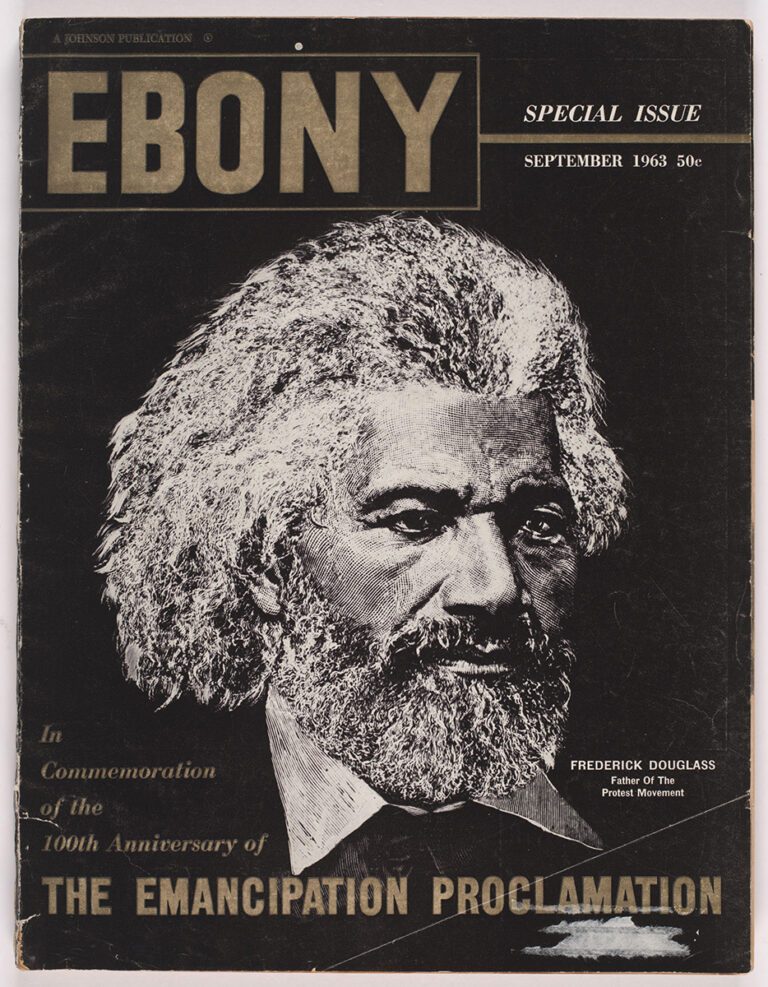
Ebony Special Issue: The Emancipation Proclamation, cover designed by Herbert Nipson and Norman Hunter, Johnson Publishing Company, Chicago, September 1963. CHM, ICHi-183267
So, in 1949, at 27, my mother began creating a groundbreaking corporate library—the first of its kind—organized around the Black experience as its primary focus. Because the library was Mom’s concept, she established the initial parameters of its scope by defining the library’s position in the corporate structure. Unlike many other corporations where the library was in the lower echelons of the corporate structure, this library was on the same level as other departments, including advertising, editorial, circulation, and subscriptions.
* * * *
But she was more than a librarian. She was, in her words, an “information and marketing manager.” In an era before computers, PDFs, internet access, mobile phones, or even electric typewriters, she became the living interface for JPC’s information infrastructure. Working with carbon paper, mimeograph machines, manual typewriters, and landline telephones, she built a system that revolutionized how JPC accessed, analyzed, and archived information. Her design served every department across the company, providing a responsive, interdisciplinary model of information management tailored to JPC’s mission and markets.
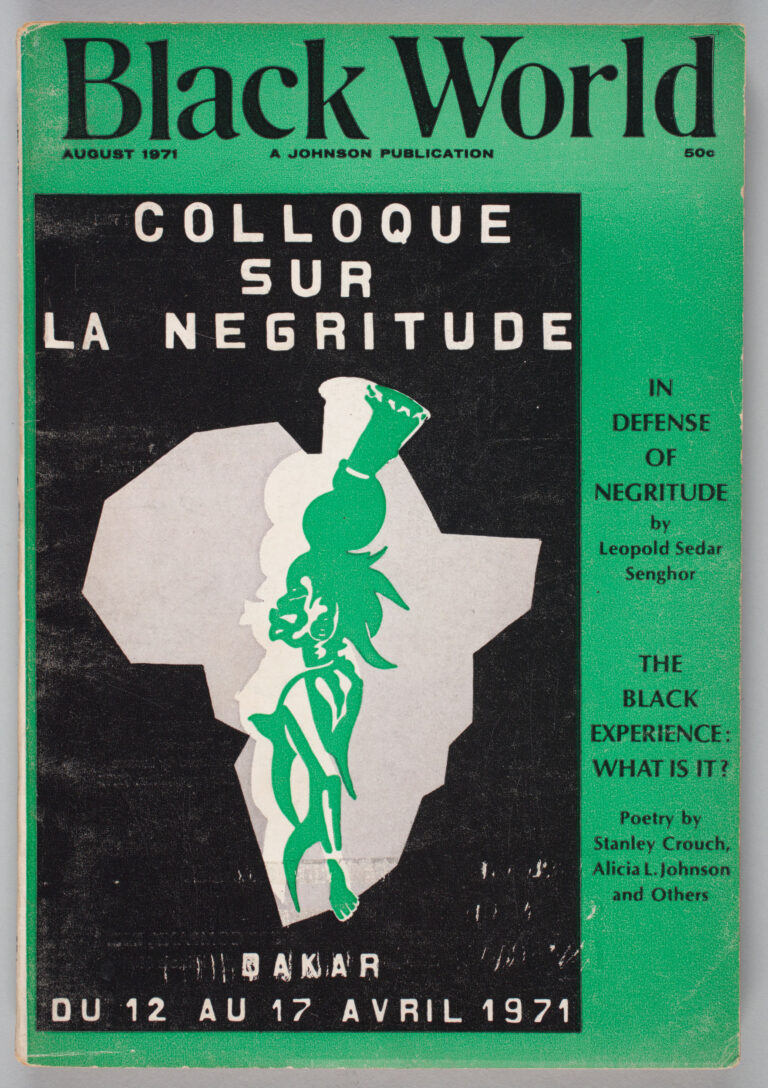
Black World, edited by Hoyt Fuller with cover designed by Herbert Temple, Johnson Publishing Company, Chicago, August 1971. CHM, ICHi-182539
From the start, she established associations, memberships, subscriptions, and networks with organizations whose publications and data would underpin her work, supporting JPC’s advertising staff. In her first few years, she collaborated closely with the company’s New York advertising office, led by William P. Grayson. Her pioneering marketing research verified what Black newspapers already knew, but what most mainstream advertisers had failed to realize or accept: the existence of a vibrant, $16 billion “Negro market.” Her research helped persuade national advertisers to buy ad space in Ebony, driving the company’s financial success.
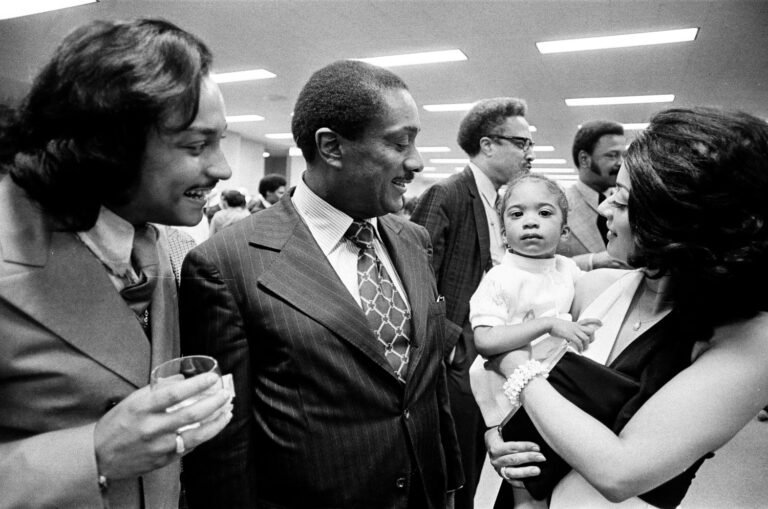
People enjoying an open house for the new Johnson Publishing Company building, 820 South Michigan Avenue, May 16, 1972. ST-70004694-0042, Chicago Sun-Times collection, CHM
This was not guesswork. My mother’s ability to extrapolate, interpret, and organize census, demographic, and business data had been honed during her year in the Social Science and Business Division at the Chicago Public Library. By the end of 1955, Ebony could point to advertising revenue, rather than circulation alone, as the marker of its success. This shift also helped open new avenues in the broader media landscape, including commercial photography, advertising, and publishing directed at Black audiences. By 1970, other media companies were launching books and magazines targeting Black consumers, once it became clear just how profitable the market was.
Learn More
- Subscribe to Chicago History magazine by becoming a Museum member.
- See more works published by Johnson Publishing Company in our exhibition Designing for Change: Chicago Protest Art of the 1960s–70s.
- Find publications from Johnson Publishing Company in the Abakanowicz Research Center.
- Explore the Doris E. Saunders papers at the Chicago Public Library, Woodson Regional Library, Vivian G. Harsh Research Collection of Afro-American History and Literature.
As part of our Aquí en Chicago exhibition, which traces the lives of Latino/a/e communities in Chicago, our blog post series by guest authors highlights countries of Latin American heritage. In this post, Dr. Rafael Núñez-Cedeño, Professor Emeritus in Hispanic and Italian Studies at the University of Illinois Chicago, founder and chair of the Dominican-American Midwest Association (DAMA), and an advisor on Aquí en Chicago writes about the history of Chicago’s Dominican community.
Tell us about the Dominican community in Chicago. How big is it? How long have Dominicans lived here?
Chicago may not be the first city people associate with Dominican immigration, but for nearly 60 years, it has been home to a dynamic Dominican community. While Dominican migration to New York began in the 1940s and surged after 1963, Chicago became a significant destination thereafter. As economic conditions in the Dominican Republic continued to deteriorate and job opportunities in New York declined during the 1970s, many Dominicans moved westward. They found new opportunities in Chicago and subsequently contributed to the city’s social, economic, and cultural life.
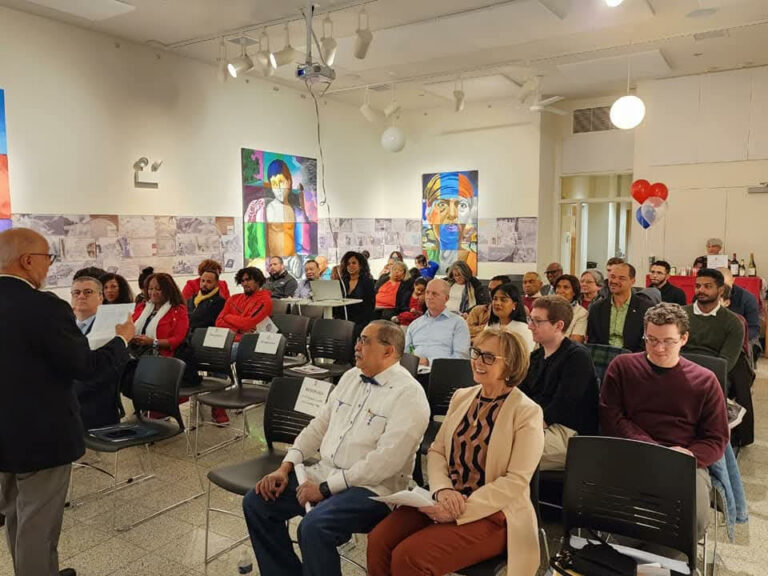
Dominicans celebrating Dominican Independence Day at the Puerto Rican Arts Alliance, February 2024. All photographs courtesy of Rafael Nuñez-Cedeño
According to oral histories and Dominican Consular records, Dominicans found employment across industrial, service, and professional sectors. They often felt welcomed in a city with established Puerto Rican and Cuban communities. Shared Caribbean histories and common cultural traditions eased their integration into Chicago’s northwest neighborhoods, while professionals settled in the suburbs.
Officials failed to count Dominicans in census statistics for many years. They were not identified separately in 1980, but passport records suggest that as many as 4,000 first-generation Dominicans lived in Chicago at the time. Consular estimates today place the population at approximately 7,500.

DAMA delivered school supplies and presented financial awards to students in Santo Domingo, June 2024.
The 1990s marked a turning point in community organization and visibility. A group of Dominicans founded Casa Dominicana in 1991, a grassroots organization that promoted culture, history, and identity. In 1998, Cook County Commissioner Roberto Maldonado recognized its impact by sponsoring a resolution honoring the Dominican contribution. Around the same time, the Chicago City Council honored Dominican physician Ramón García-Camilo for his humanitarian service by naming a section of Kedzie Boulevard after him.
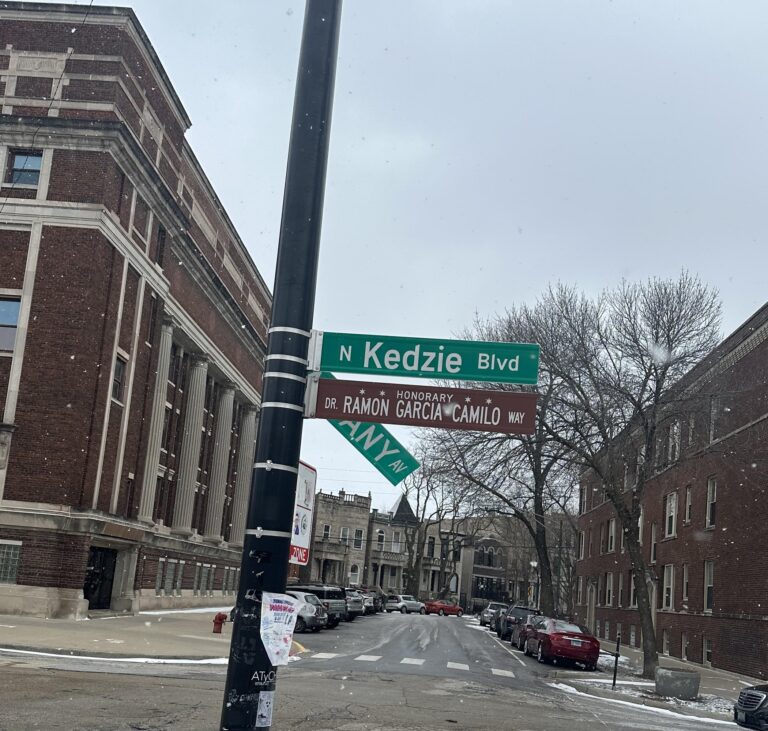
Honorary street named after Dr. Ramon Camilo Garcia, Logan Square, December 2025.
The demise of Casa Dominicana also marked the emergence of professional leadership through the culturally and educationally oriented Dominican American Midwest Association (DAMA) and Unidad Dominicana. The former’s founding board reflected the community’s professional depth and included figures such as Dr. Samuel Castillo, a humanitarian and gastrointestinal specialist; Dr. César Herrera, an expert in cardiac radiology; Dr. Bernadette Sánchez, a clinical psychologist and university professor; Rita Simó, founder of the People’s Music School of Chicago; Kenneth Greene-Vélez, an artistic photographer and the first Dominican elected to public office in Illinois in 2000, Yulissa Nunez-deLeon, a Berwyn’s award-winning school teacher, and Idanes and Rhina Sánchez, community activists.
Is there an activity/location related to the Dominican community that every Chicagoan should experience?
With DAMA leadership, cultural expression flourished alongside civic engagement. In the late 1990s and beyond, Dominican folklore, merengue music, and visual arts were introduced to Chicago’s museums, schools, libraries, and parks. Mi Galería, founded by surgeon Dr. Rafael Pérez Guerra, became the city’s first space dedicated to Dominican artists and sculptors.
Entrepreneurship further anchored the community, as Dominicans opened agencies, beauty salons, automotive shops, construction firms, appliance stores, restaurants, and nightclubs—creating jobs and contributing to Chicago’s small-business economy. Many of these establishments also became cultural gathering spaces.
Is there a food/meal/dish related to the Dominican community that every Chicagoan should try?
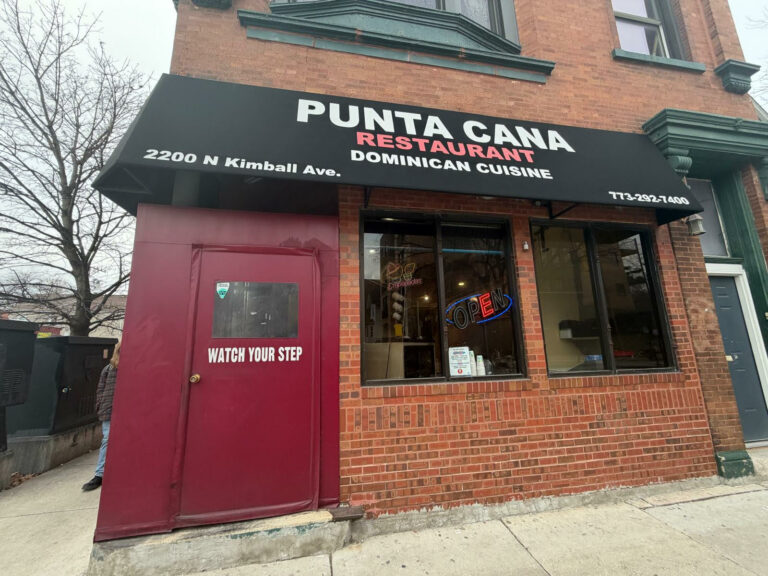
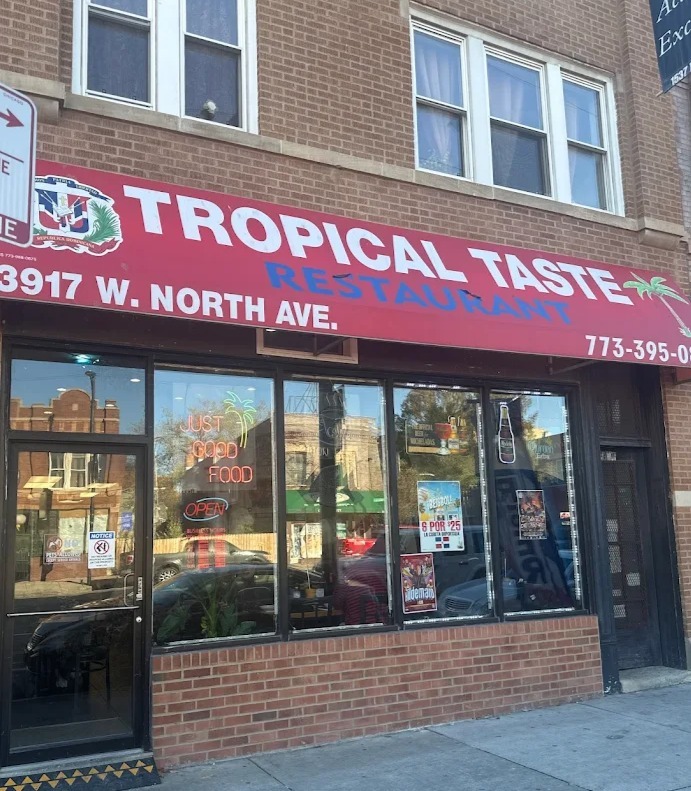
Punta Cana and Tropical Taste restaurants in the Logan Square community area, November 2025.
To enjoy an authentic Dominican culinary experience, visitors can sample la Bandera Dominicana, the national staple of rice, beans, and meat; los tres golpes, featuring mangú with fried eggs, cheese, and salami; or a hearty sancocho, a traditional stew made with a variety of roots and meats. In the Humboldt Park area, several restaurants offer these classic dishes, including Punta Cana and Tropical Taste The experience often continues with music and dance at LV Night Club, a popular venue for lively merengue and bachata rhythms.
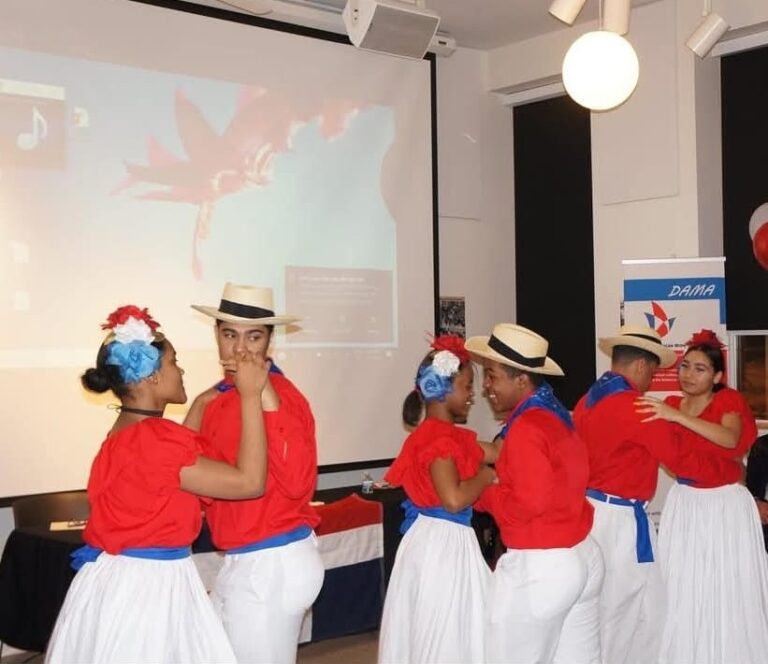
Dominicans perform merengue at the Puerto Rican Arts Alliance, February 2018.
Is there a prominent person in the Dominican community you would like to highlight?
In medicine, professionals such as Drs. Max Brito, Ramón García (a Chicago Cultural Alliance honoree), and Frank Morales have made lasting contributions. Others, including corporate leaders Pedro de Jesús, José Colón, and Alexandra Nelson, rose to top executive positions in finance and mortgage lending.
Today, the Dominican community in Chicago exemplifies strength, cultural pride, and transnational connections.
Hannah Simmons is a student at Northwestern University and the Black Metropolis Research Consortium graduate assistant at our Abakanowicz Research Center (ARC). As part of her work, she is writing a series of blog posts related to the Chicago Covenants Project.
Racially restrictive covenants justified anti-Black violence in Cicero, a working-class, primarily Southern and Eastern European immigrant community neighborhood in Chicago, years before the anti-Black violence that came to be called the “Cicero Race Riot of 1951.” In July 1944, the Federation of Chicago Neighborhoods lamented in their publication, Restrictive Covenants, how “unjust” it would be for white soldiers to come home only to find that their “homes have been taken over by negroes.” The paper claimed that if African Americans moved in, these once-nice neighborhoods would become slums. The Federation’s overall argument conveyed a mindset that justified racial segregation and reinforced the commonly held fallacy that African American residents drove down property values.
Furthermore, the Federation’s argument completely omitted African American soldiers’ involvement in the war, ignoring the fact that when African American soldiers came home, they were forced back into segregated housing, despite their sacrifice and fight for democracy abroad. In other words, though African American soldiers were pivotal in the victory against fascism abroad, the Federation still painted them as enemies to the progress of the domestic housing market. This mindset, fallacy, and disregard for African American servicemen’s sacrifice all fueled the Cicero Race Riot.

An example of racial violence against Black veterans in Chicago, c. 1947. This map indicates the locations of the homes of persons arrested for participation in racial violence in the Fernwood Park area, where Black veterans were housed in the Fernwood Housing Project. CHM, ICHi-183577, Chicago Council Against Racial and Religious Discrimination, creator
On July 11, 1951, a woman cheered with the crowd as the furniture of the Clark family sailed through a shattered window, landing with a crash three stories below. “It’s a shame,” she stated, watching as someone set the furniture on fire, “Our boys are fighting and dying in Korea for democracy and look what’s happening here. Is this civilized?”(1)

Cicero police arrest a youth, Cicero, Illinois, 1951. DN-N-7947; Chicago Daily News collection, CHM
To this woman, and the hundreds of Cicero, Berwyn, and Chicago residents who watched and participated in the destruction of the Clark family’s property, it wasn’t civilized for the Clarks, an African American family, to move into all-white Cicero. Yet, there was nothing uncivilized about destroying the Clarks’ property and causing $50,000 (today, approximately $623,000) in property damage to the apartment building. As the building was damaged and the Clarks’ property was destroyed, the police stood by and watched, arresting no one.
Though rumors had spread that the Clark family was part of a larger ploy to integrate Cicero, the Clark family was simply looking for a place to live. At the time, Veteran Harvey E. Clark Jr., a graduate of Fisk University, was a CTA bus driver trying to find an affordable place for him and his wife, Johnetta Clark, also a Fisk University graduate, to raise their two young children, Michele Elaine Clark, age eight, and Harvey Evans Clark III, age six. However, racial prejudice stood in the way of the Clark family and the home they sought to raise their family in. Despite the Clark family’s simple desire to find an affordable place to live, the prejudice of their would-be neighbors made this simple desire for housing and a place to raise their family into a controversy. A controversy that bloomed into a race riot that the police were called in to quell.
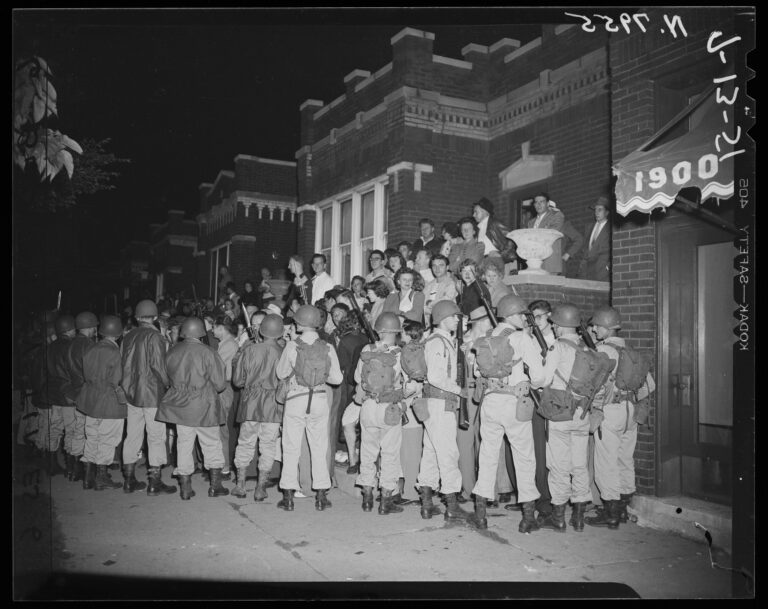
National Guardsmen form a cordon around a mob during the race riot in Cicero, Illinois, July 13, 1951. DN-N-7955; Chicago Daily News collection, CHM
Though he was called to quell the riot, Cook County sheriff John E. Babb did not want the Clarks to move in. Observers mentioned that he had told the crowd that he was on their side.(2) However, even he knew that the mob had gone too far. So, on July 12, he asked Governor Adlai Stevenson II to summon the National Guard to quell the rioters and protect the building. In the evening, crowds clashed with the National Guard, Cook County police, and Cicero police. The crowd threw bricks, flares, and torches, injuring National Guardsmen and starting a fire near the apartment. By 12:51 a.m., the National Guard and police had pushed the crowd from the building. Around 70 people were arrested that evening, and over a dozen were injured.
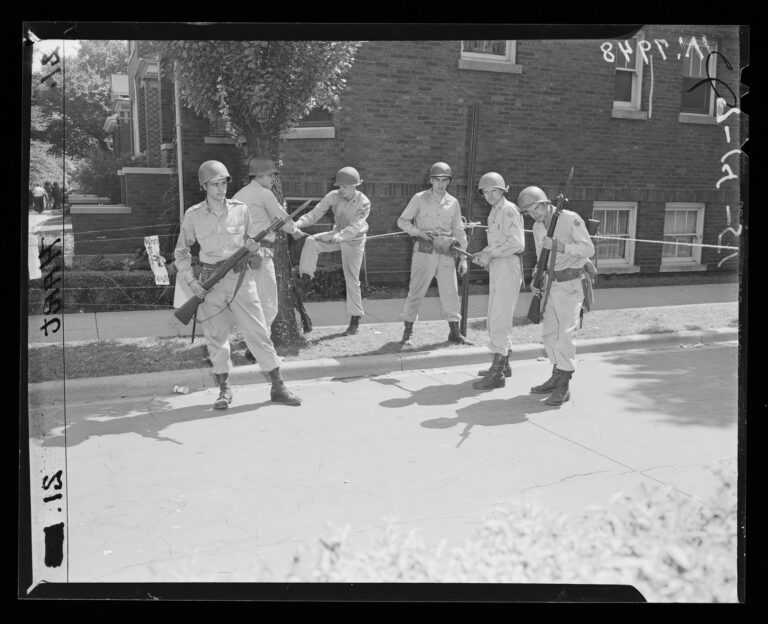
National Guardsmen stringing a wire barricade at the scene of the race riot in Cicero, Illinois, July 14, 1951. DN-N-7948; Chicago Daily News collection, CHM
Over the next few days, as the mob continued, 117 people were arrested. Most of them were let go. It wasn’t until September 18, 1951, that people were indicted, and none of those individuals had been involved in the riot.
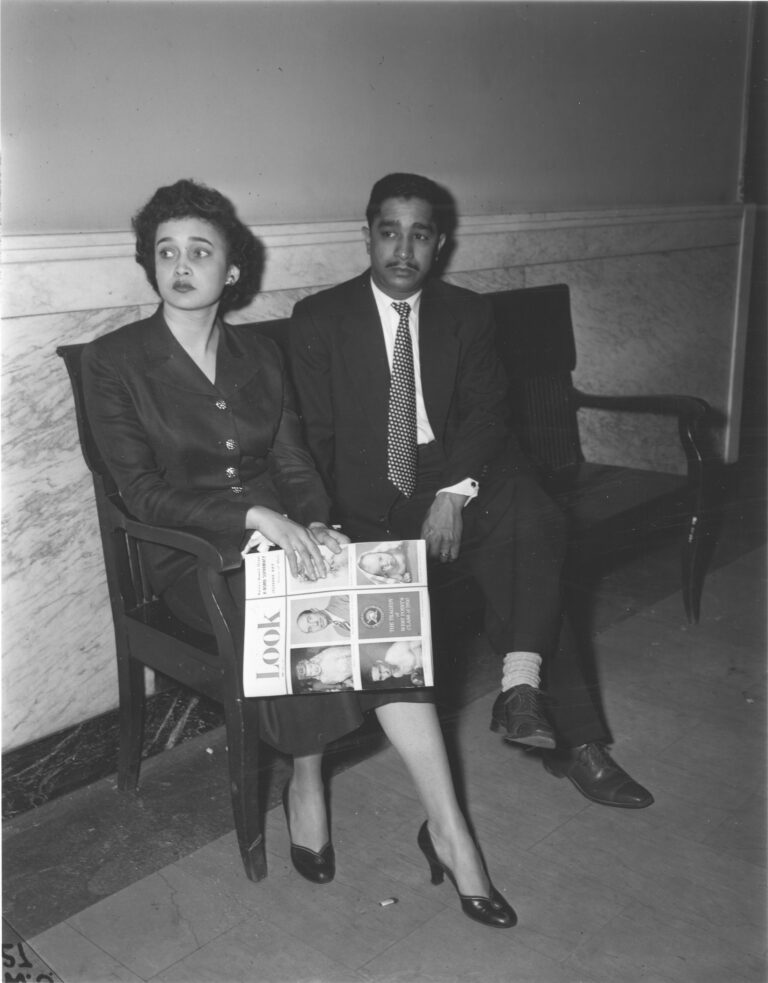
Harvey E. Clark and his wife, Johnetta, seated on a bench during the Cicero Race Riot trial, Chicago, c. 1951. ADN-0000064, Chicago Daily News/Chicago Sun-Times collection, CHM
On September 18, 1951, a Cook County grand jury indicted the former owner of the building, Camille De Rose, George C. Adams, De Rose’s lawyer, George Leighton, an NAACP attorney, and Charles Edwards, the real estate agent, for conspiracy to injure property by causing “depreciation in the market selling price” by selling to a Black family. As a result of vigorous protests from groups like the Chicago Council Against Racial and Religious Discrimination, a federal probe was launched. In 1952, the police chief, two policemen, and the village attorney of Cicero were indicted for the race riot, and charges against De Rose, Adams, Leighton, and Edwards were dropped.
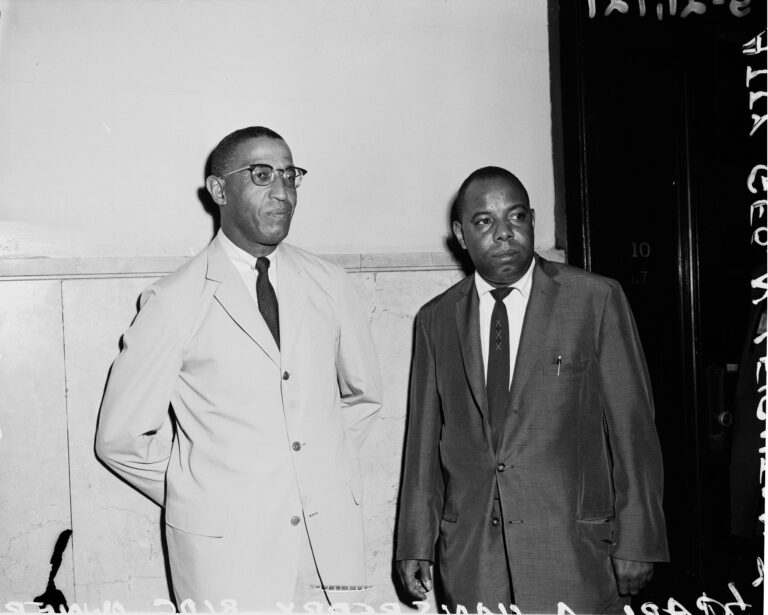
An undated photograph of George N. Leighton (left) with his client Carl A. Hansberry during their legal challenge of racially restrictive covenants, Chicago. ADN-0000067, Chicago Daily News/Chicago Sun-Times collection, CHM
The Cicero Race Riot of 1951 show the enduring legacy of racial segregation and anti-Black violence. Furthermore, although the indictment of four Cicero officials and three policemen showed the potential for justice, none of the actual violent actors were ever indicted. This lack of indictment leaves questions about whether justice was truly served in Cicero.
Notes
- Camille De Rose, The Camille De Rose Story, 180.
- “Cicero Riots, 1951, Including Activities of Bayard Rustin in Chicago, Planned Purchase of Cicero Property, Housing Discrimination of Minorities, Communism in Cicero, Federal, State, and City Housing Policies, Dave McNamara’s Work in Cicero, Indictments of George N. Leighton and Others by Cook County Grand Jury, Need for Education Relating to Minority Housing, Reconciliation Efforts and Presence of National Guard,” 3. Bayard Rustin Papers; Alphabetical Subject File 1951.https://www.proquest.com/archival-materials/cicero-riots-1951-including-activities-bayard/docview/2900590824/se-2.
Additional Resources
- Read more about George Leighton’s life and the role he played in defending the Clarks
- Learn about CHM’s critical analysis of riot terminology within our descriptive metadata in our blog post “Riot or Uprising? A Reflection on Race and Language in the Contested City”
- Stop by the Abakanowicz Research Center to read Camille DeRose, The Camille DeRose Story
- Listen to Studs Terkel’s interview with Lorraine Hanberry in which she discusses A Raisin in the Sun
On February 17, 2026, American civil rights activist, politician, and minister Jesse Jackson passed away at the age of 84. In his passing, Chicago lost a tireless worker for civil and social rights, but his devotion to care and uplift continues to call new generations to join the fight. In this photo essay, CHM director of education and curatorial affairs Erica Griffin-Fabicon describes Rev. Jackson’s extraordinary life and legacy accompanied by a selection of photographs from our collection that capture his indelible impact on Chicago and beyond.
Civil rights and religious leader and politician Rev. Jesse L. Jackson Sr.’s 60-year commitment to activism and social change began while he was a student at North Carolina Agricultural and Technical State University in the early 1960s. His leadership and organizational skills caught the attention of Rev. Dr. Martin Luther King, Jr. and the Southern Christian Leadership Conference (SCLC). Following his graduation from college in 1964, Rev. Jackson marched with Dr. King and the SCLC from Selma to Montgomery, Alabama, in 1965.
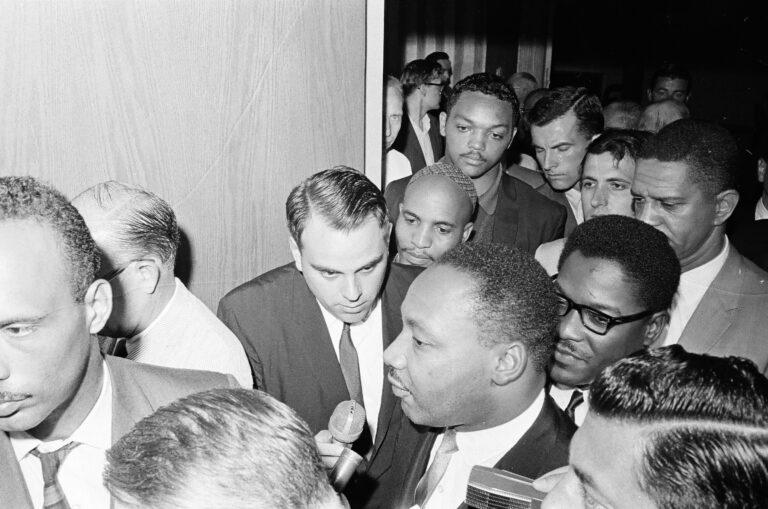
Martin Luther King Jr. speaks to the media during a summit meeting on open occupancy housing with Chicago mayor Richard J. Daley at St. James Cathedral, 65 East Huron Street, Chicago. Jesse Jackson looks on in the center background. August 17, 1966. ST-10104142-0001, Chicago Sun-Times collection, CHM
Rev. Jackson became deeply involved in the Chicago Freedom Movement after moving to Chicago to attend the Chicago Theological Seminary. Jackson had a key role in the efforts to mobilize African American religious leaders to support the Movement’s goal to address the rampant racial and economic injustices plaguing Black Chicago neighborhoods.
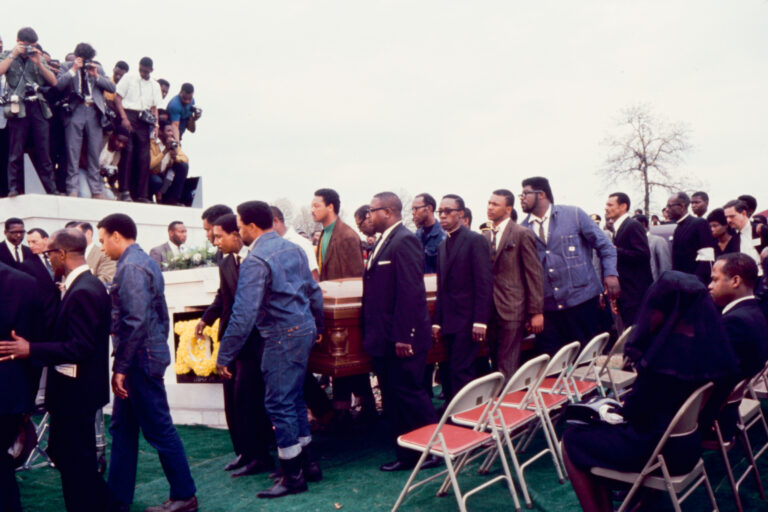
Pallbearers carry the casket of Dr. Martin Luther King Jr. during his burial service in Atlanta, April 9, 1968. Jesse Jackson stands behind the casket in a green shirt and brown blazer. CHM, ICHi-173458; Declan Haun, photographer
Dr. King appointed Jackson as the director of Operation Breadbasket, the economic arm of SCLC. Breadbasket focused on securing employment opportunities for Black people. Under his leadership, Operation Breadbasket targeted grocery stores chains with a large presence in the Black community. Through pickets, protests, and data collection, Breadbasket activists demanded that these companies hire more community members in both entry-level and management positions, provide shelf space for products made by Black-owned businesses, and end the selling of spoiled meat and produce in their stores.
re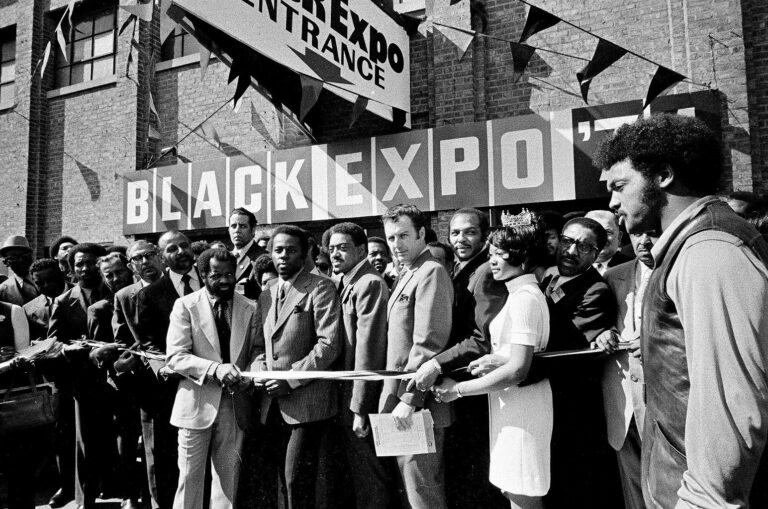
Rev. Jesse Jackson and others officially open the 1971 Black and Minorities Business and Cultural Expo, Chicago, September 29, 1971. ST-19031751-0015, Chicago Sun-Times collection, CHM
The Black Expo was a successful extension of Operation Breadbasket. First held in 1967 in Chicago, the Expo promoted Black excellence. This multi-day event highlighted Black-owned businesses and connected them with large corporations, which would hopefully purchase their products.
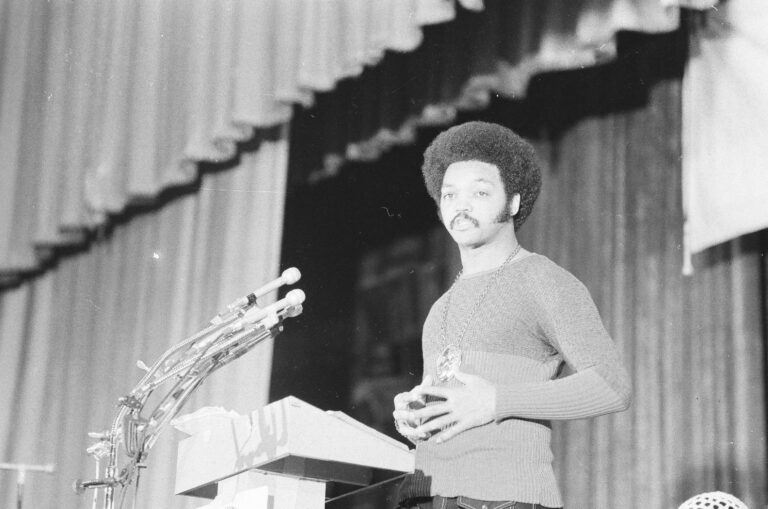
Jesse Jackson addresses an Operation Breadbasket meeting as a guest speaker after being suspended as leader of the organization, 7941 South Halsted Street, Chicago. December 4, 1971. ST-12005694-0005, Chicago Sun-Times collection, CH
Following difficult conversations with SCLC leaders over resource allocation, Rev. Jackson decided to separate himself from the SCLC, resigning from the organization in December 1971. Rev. Jackson named his new organization PUSH, an acronym for People United to Save Humanity (later revised to People United to Serve Humanity).
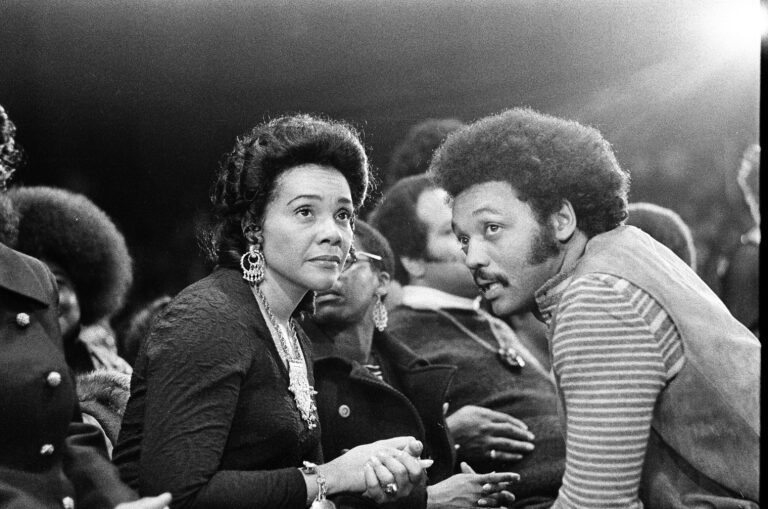
Jesse Jackson speaks with Coretta Scott King at the First National Black Political Convention at West Side High School in Gary, Indiana, March 11, 1972. ST-19031772-0013, Chicago Sun-Times collection, CHM
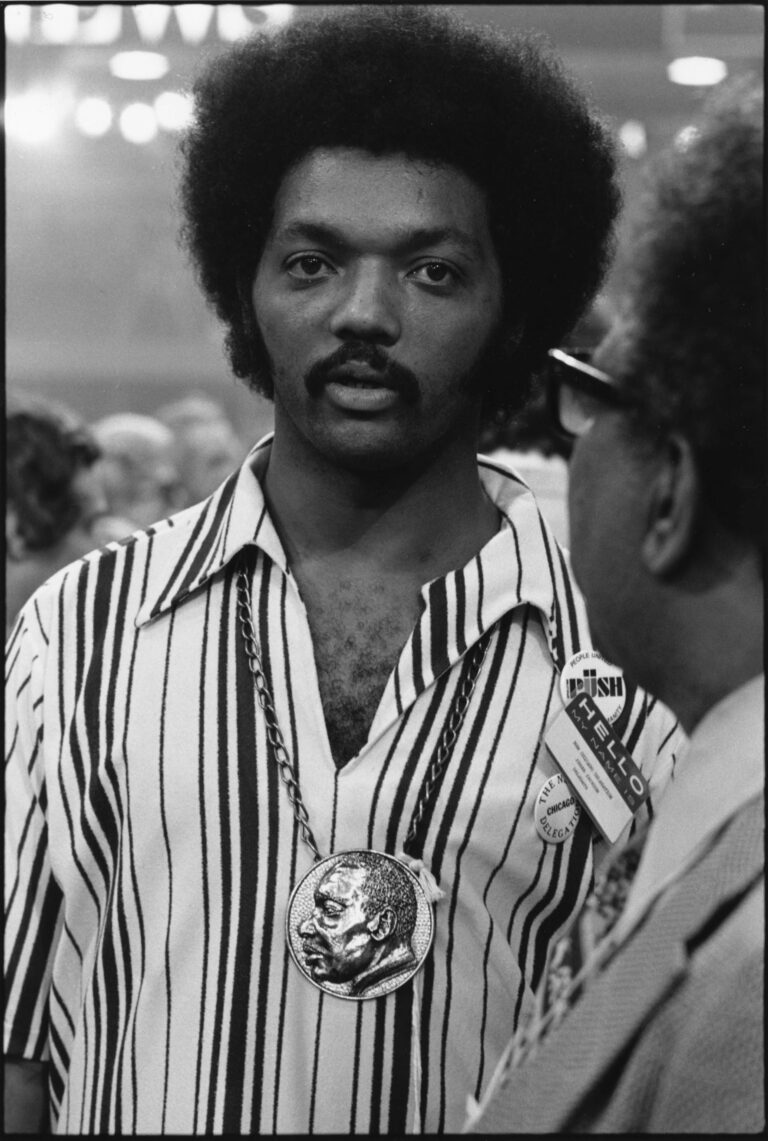
Jesse Jackson at the New Chicago Delegation, Chicago. Jackson is wearing a commemorative Dr. King medallion. At this meeting, Rev. Jackson became part of the New Chicago Delegation, which supported Sen. George McGovern’s candidacy at the 1972 Democratic National Convention. CHM, ICHi-038704; Declan Haun, photographer
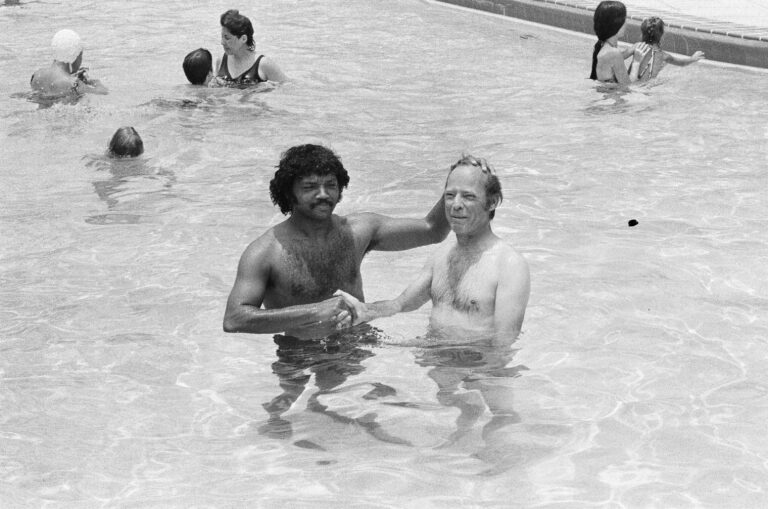
Jesse Jackson relaxes with delegates in a pool after the opening sessions conclude for the 1972 Democratic National Convention, Miami Beach, Florida, July 15, 1972. ST-19033571-0003, Chicago Sun-Times collection, CHM
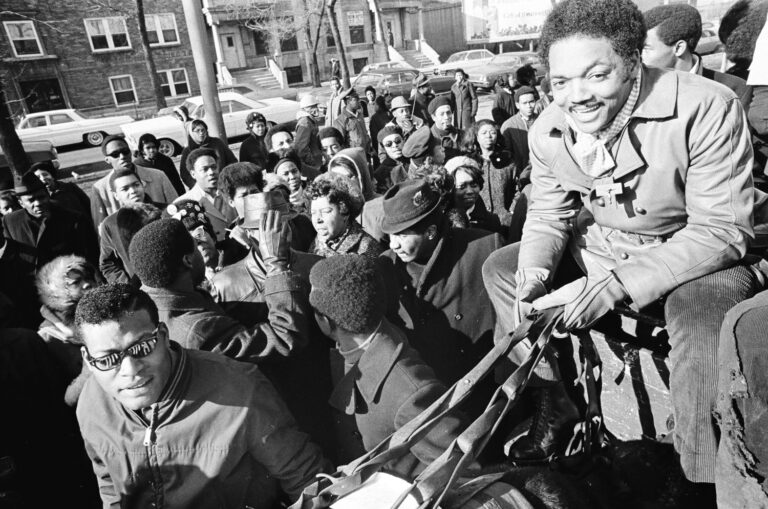
Jesse Jackson participates in the South Side Christmas Parade, Chicago, December 7, 1972. ST-30004480-0035, Chicago Sun-Times collection, CHM
PUSH’s early activities followed the Operation Breadbasket model. All of Breadbasket’s materials, resources, staff, and board members followed Jackson to PUSH. PUSH would address varied issues from housing to education to voting rights for Black people over the following decades.
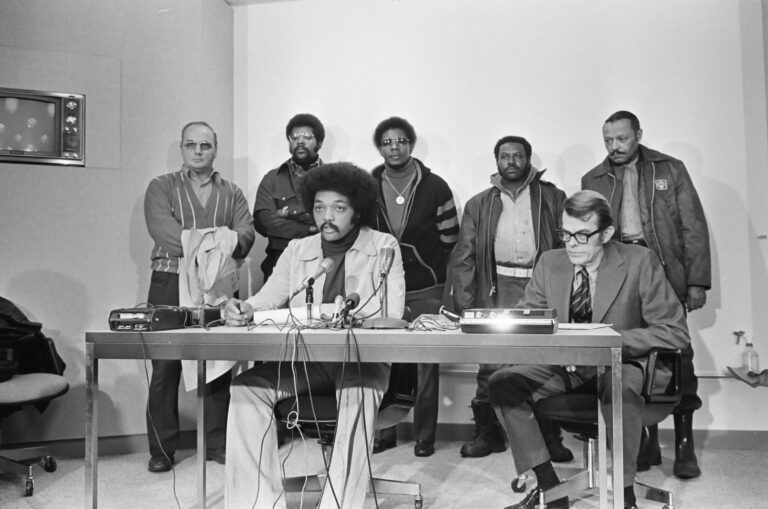
Jesse Jackson discusses gasoline issues at the Standard Oil Building, Chicago, January 2, 1974. Standard Oil agreed to investigate Jackson’s claims that Black gasoline dealers were receiving less gasoline and paying more for it than white dealers. ST-50004976-0037, Chicago Sun-Times collection, CHM
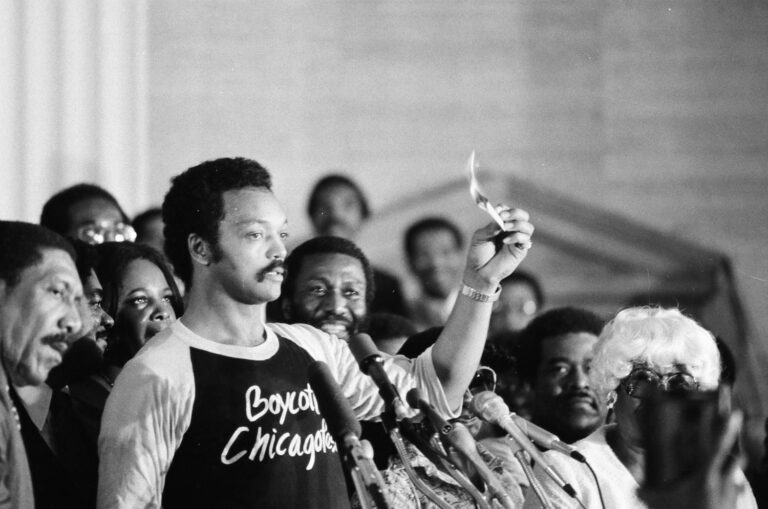
Rev. Jesse Jackson burns a set of Chicagofest tickets in protest of Chicago mayor Jane Byrne’s nomination of three white board members to the Chicago Housing Authority, at Operation PUSH headquarters, 930 East 50th Street, Chicago, July 31, 1982. ST-12001917-0015, Chicago Sun-Times collection, CHM
In 1984, PUSH merged with the National Rainbow Coalition, an outgrowth of Rev. Jackson’s presidential campaign. Rev. Jackson was inspired by the philosophy of Fred Hampton, president of the Illinois Chapter of the Black Panther Party. Hampton’s Rainbow Coalition linked varied marginalized people together to advocate collectively against shared systems of oppression. Rev. Jackson would build on this model, giving voice to varied communities and their concerns for economic and social equality.
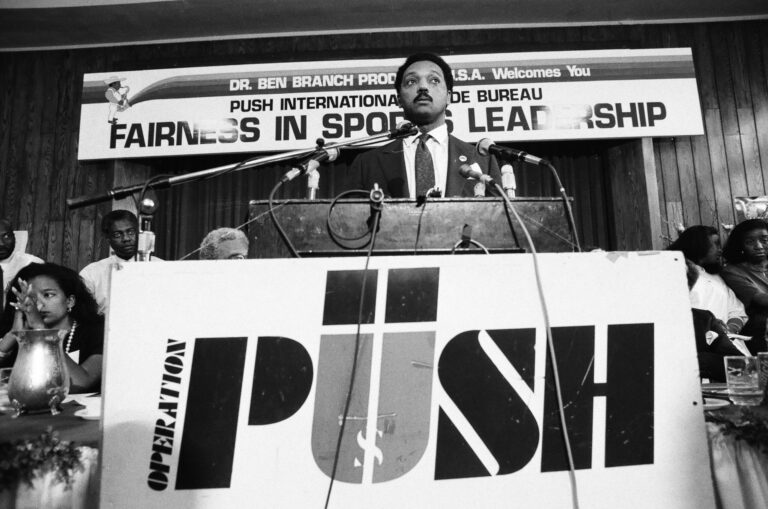
Retired sports stars and Jesse Jackson participate in the ‘Fairness in Sports Leadership’ conference to address need for minorities in coaching and front-office positions in major league sports, at Operation PUSH headquarters, 930 East 50th Street, Chicago, May 29, 1987. ST-12002798-0062, Chicago Sun-Times collection, CHM
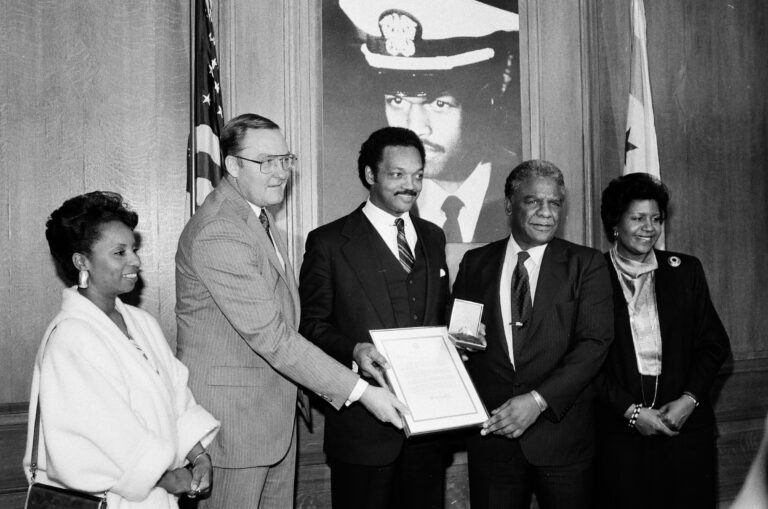
Jesse Jackson receives a commemorative gift from Mayor Harold Washington after returning to Chicago from freeing a captured Navy airman from Syria, January 10, 1984. ST-30002916-0001, Chicago Sun-Times collection, CHM
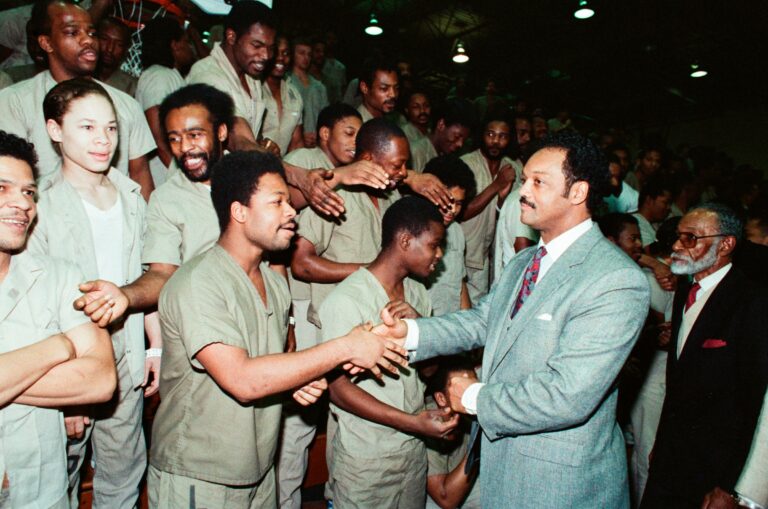
Jesse Jackson speaks to imprisoned people during his annual Christmas visit to the Cook County Jail, sponsored by Operation PUSH, Chicago, December 25, 1989. ST-30002138-0012, Chicago Sun-Times collection, CHM
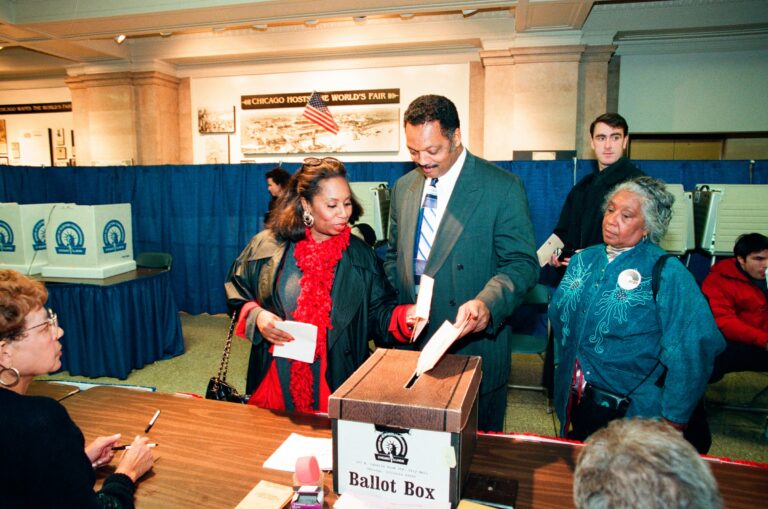
Rev. Jesse Jackson and his wife Jacqueline Jackson vote by absentee ballot, Chicago, November 1, 1996. ST-12001577-0024, Chicago Sun-Times collection, CHM
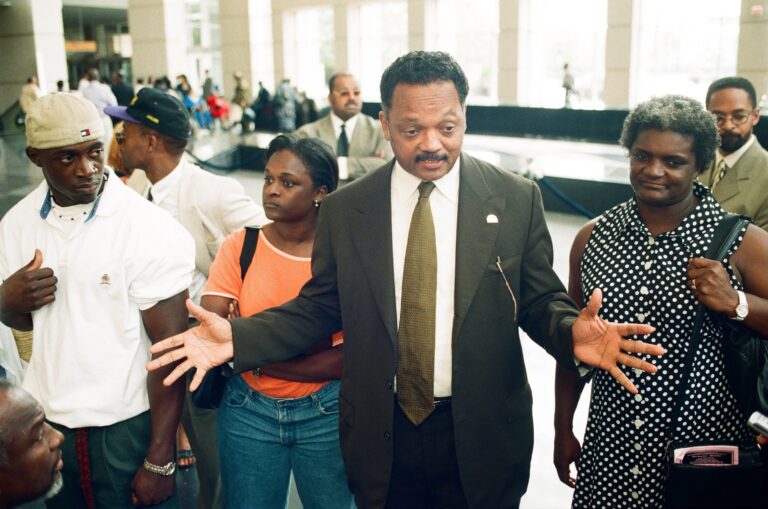
Rev. Jesse Jackson and other activist leaders participate in a Rainbow/PUSH organization conference on Africa at McCormick Place, 2301 South King Drive, Chicago, July 29, 2000. ST-10002320-0142, Chicago Sun-Times collection, CHM
Rev. Jackson would continue to advocate for varied causes centering collaboration and advancement across marginalized groups. Rev. Jackson’s words, actions, and steadfast devotion to a safe and well society stands to remind us that we are all “somebody,” and if we “keep hope alive,” the fight for justice continues for another day.
To explore Rev. Jackson’s contributions to the city of Chicago and the nation, visit the online resources below.
Additional Resources
- Peruse more images of Jesse Jackson at CHM Images
- View our Google Arts & Culture stories on Jesse Jackson: Jesse Jackson’s Operation PUSH and Religion, Civil Rights, and the Ongoing American Transformation
- Learn more about The Jackson Oral History Project with the Chicago Theological Seminary
- Listen to Studs Terkel interview author Barbara Reynolds about her book Jesse Jackson: The Man, the Movement, the Myth
PRIMARY SOURCE TYPE: 2D OBJECTS, 3D OBJECTS, DOCUMENTS
Recommended for grades 6—12
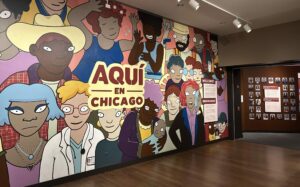 In 2019, students from Instituto Justice and Leadership Academy in Pilsen protested CHM for the lack of Latino/a/e representation. In doing so, they stood on the shoulders of past Latino/a/es and allies who fought against cultural erasure and systemic racism.
This field trip guide introduces the Aquí en Chicago exhibition and the “Resistance Toolkit,” which are a set of actions or practices people use to support their communities and push back against injustice and erasure. The Resistance Toolkit symbols are featured throughout the exhibition. Included within the field trip guide is a gallery graphic organizer that students can use onsite during your visit, recommendations for other exhibitions to see during your field trip, and pre- and post-visit activities for your classroom.
Download the Aquí en Chicago Field Trip Guide Download the Field Trip Graphic Organizer – English Download the Field Trip Graphic Organizer – SpanishCHICAGO – Producers John Davies, Reid Brody, Raymond Lambert and Brian Kallies announce the screening of their critically acclaimed documentary “Phunny Business: A Black Comedy” on the occasion of its 15th anniversary for Black History Month on Saturday, February 21, 12:30 p.m., at the Chicago History Museum.
“Phunny Business” answers the question, “What do you get when you mix comedy, race and politics in Chicago?” The film is as relevant today as it was in 2011 and was critically acclaimed by “The New York Times,” “The Hollywood Reporter,” Richard Roeper and Roger Ebert, who called it “one of the best documentaries of the year.” The 84-minute film tells the story of the rise and fall of All Jokes Aside, Chicago’s first Black-owned comedy club and features most of the important Black comedians of the day including:
STEVE HARVEY • DAVE CHAPPELLE • JAMIE FOXX • CEDRIC THE ENTERTAINER SHERYL UNDERWOOD • CRAIG ROBINSON • DEON COLE • BERNIE MAC • CHRIS ROCK • LAVELL CRAWFORD • JB SMOOVE • MIKE EPPS • BILL BELLAMY • D.L. HUGHLEY • ADELLE GIVENS and many others.
In the early 1990s, three Black entrepreneurs, Raymond Lambert, Mary Lindsey and James Alexander, launched All Jokes Aside, a predominantly Black comedy club located on Chicago’s South Wabash Street. With virtually no experience in the comedy business, or club business for that matter, they turned All Jokes Aside into a wildly successful Mecca for rising Black comedians.
Sadly, after almost a decade, All Jokes Aside closed. Like other clubs across the country, it had fallen victim to the stand-up comedy craze on television, but there were other more disturbing reasons for its demise. Local white businessmen, their potential new neighbors, thwarted the owners’ attempt to move the club north to the more “diverse,” upscale, entertainment district. Turning to Chicago politicians for help seemed logical, but white politicians were indifferent, and Black politicians were unsympathetic or wanted “consideration.” One infamous Black alderwoman actually professed her loyalty to one of Chicago’s more dominant white comedy institutions. That hostile environment and mounting legal bills spelled the end for All Jokes Aside.
The film is narrated by former stand-up comedian John Ridley. Ridley is an in-demand Hollywood showrunner, screenwriter, novelist and Academy Award winner for his adaptation of “Twelve Years a Slave.” “Phunny Business” was directed by John Davies, written by Davies and Raymond Lambert and produced by Davies, Reid Brody, Raymond Lambert and co-producer by Brian Kallies, who also served as editor and director of photography.
“Phunny Business” premiered at the Santa Barbara International Film Festival, was an opening night selection at Ebertfest, premiered in Canada at The Montreal Just For Laughs Film Festival, in New York at The New York Friar’s Comedy Film Festival and was the closing night selection at Chicago’s Black Harvest Film Festival.
Link to electronic press kit here – where you can find bios, synopsis, artwork, photos, video clips and more.
Link to event webpage here – where you can RSVP for the screening.
Contact: John Davies (310) 849-4867 or [email protected]
###
ABOUT THE CHICAGO HISTORY MUSEUM
The Chicago History Museum is situated on ancestral homelands of the Potawatomi people, who cared for the land until forced out by non-Native settlers. Established in 1856, the Museum is located at 1601 N. Clark Street in Lincoln Park, its third location. A major museum and research center for Chicago and U.S. history, the Chicago History Museum strives to be a destination for learning, inspiration, and civic engagement. Through dynamic exhibitions, tours, publications, special events and programming, the Museum connects people to Chicago’s history and to each other. The Museum collects and preserves millions of artifacts, documents, and images to assist in sharing Chicago stories. The Museum gratefully acknowledges the support of the Chicago Park District on behalf of the people of Chicago.
As we recognize US at 250 at the Chicago History Museum, CHM director of exhibitions Paul Durica shares the memorable but exaggerated life of David Kennison, whose story connects Chicago (and CHM) to the American Revolution.
Chicago’s connection to the American Revolution achieved physical permanence with the dedication of a granite boulder on the western edge of Lincoln Park in December 1903. A plaque set within the stone identified the ground below as the final resting place of David Kennison, whose body had been left behind when so many others had been disinterred in the 1860s as a city cemetery transformed into the public park we have today.
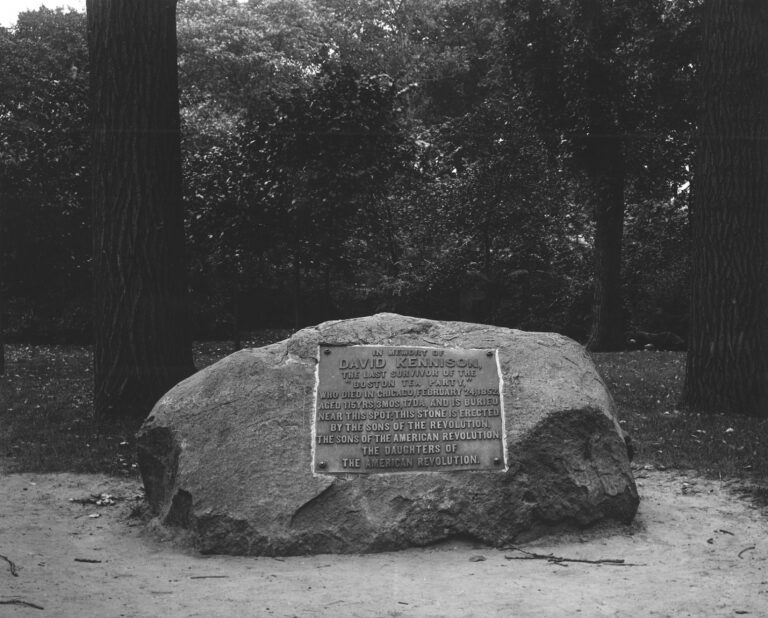
David Kennison memorial boulder in Lincoln Park, Chicago, c. 1909. CHM, ICHi-040901
Who was David Kennison? Why did organizations like the Sons and Daughters of the American Revolution see fit to fund the placement of this large boulder? Back in late February 1852, the large crowd that had gathered at that same spot, or close to it, for a military funeral, paid for by the city, knew the man and why he should be memorialized.
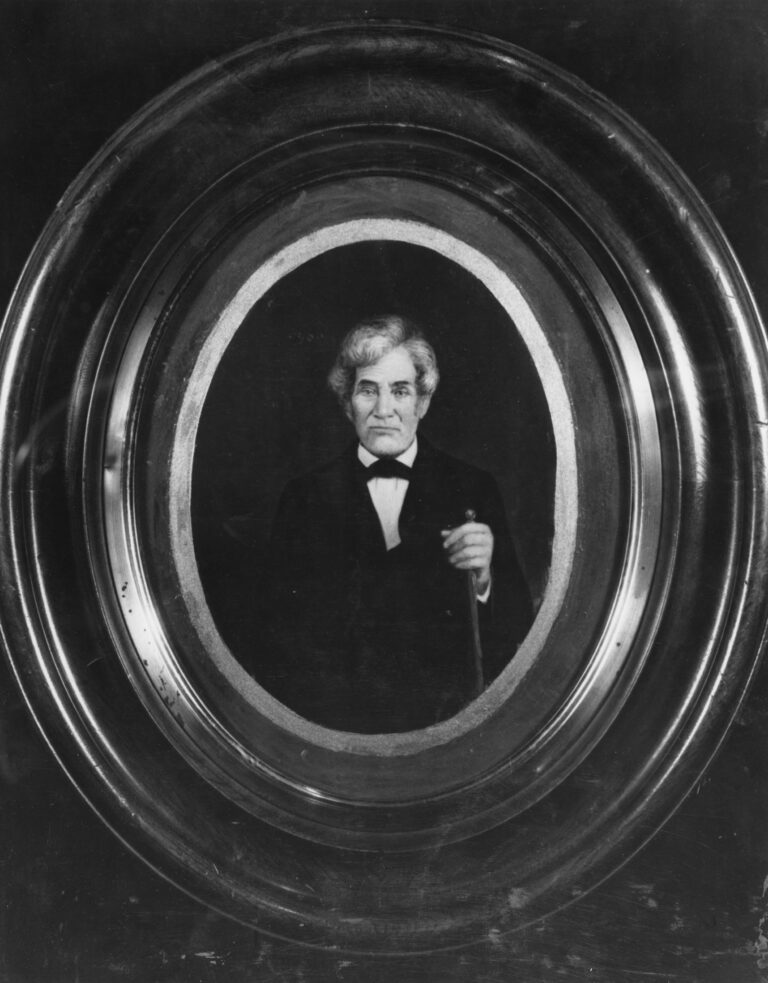
Portrait of David Kennison. The donor received this portrait from her grandfather, Dr. Aaron Gibbs, an early physician of Chicago, who was one of the chief benefactors of Kennison. CHM, ICHi-030498
Until his passing at the improbable age of 115, Kennison had been the last surviving participant in the Boston Tea Party. He had served with distinction in the American Revolution and the War of 1812, when he’d happened to be stationed, for a time, at Fort Dearborn, the military base around which Chicago grew.
His life connected the creation of the country to what was surely destined to become its largest, most important city. Everyone in 1852, it seemed, believed this. Anyone who left an account of the early years of Chicago in the archives of CHM mentions Kennison and his funeral.
He had lived in the city for seven or so years before his passing, surviving on a modest pension from service in two wars, supplementing it with odd jobs. In 1848 he began to work for a P. T. Barnum-esque museum on Lake Street where he told his life story to visitors. He also took out an advertisement in a newspaper in November of that year, around the time of what he said was his 112th birthday, asking the public to attend on that day and provide the aged veteran with whatever they thought appropriate.
In 1848 the Illinois and Michigan Canal opened; the first railroad arrived; the Board of Trade formed. What better time for Chicago to reflect upon the glories of the past when future greatness seemed ensured?
That November Kennison had a relic of sorts to share alongside his story. Before five witnesses, in a signed statement, he pledged upon his “sacred honor” that the “tea in this [glass] vial” he now produced contained “a portion saved . . . from cargoes thrown into the sea from ships in the early evening of the 15th of November in the year 1773.” That he got the date of the Boston Tea Party wrong was of little matter—he was 112, after all, and could be forgiven such a small error.
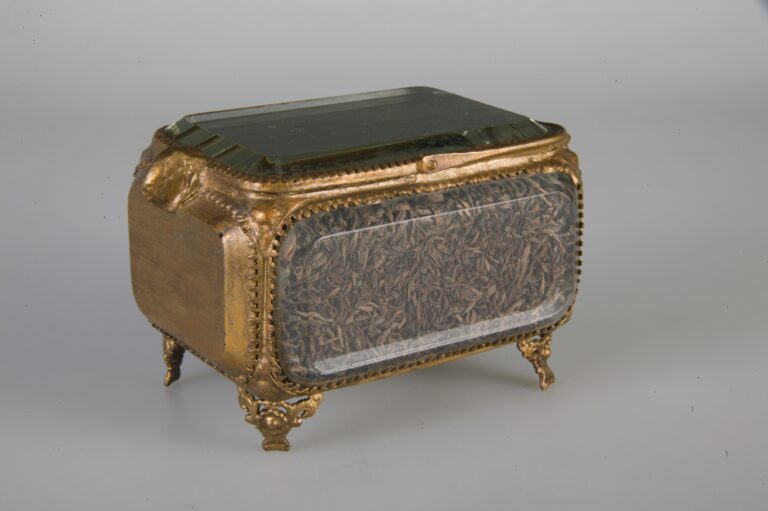
Kennison’s brass tea caddy that supposedly contains tea leaves from the Boston Tea Party. CHM, ICHi-066833
Among the five witnesses was Fernando Jones, an early resident of the city, who decades later helped identify Kennison’s final resting place in Lincoln Park. Jones helped get the memorial boulder placed there and donated that vial of Boston Tea Party leaves, as well as the affidavit signed by himself and the other witnesses, to the Chicago Historical Society.
The details of Kennison’s life can be traced to two sources, the above-mentioned November 1848 newspaper advertisement and other articles that appeared in the same paper, the Chicago Democrat, and The Pictorial Field-Book of the American Revolution from 1850.
The book’s author, illustrator, and amateur historian Benson J. Lossing had traveled across the United States collecting firsthand accounts of the American Revolution from those who’d lived through it. Despite taking great care in his research, Lossing appears to have found Kennison’s story credible. It would be repeated in countless newspaper and magazine stories well into the 20th century and become part of Chicago lore.
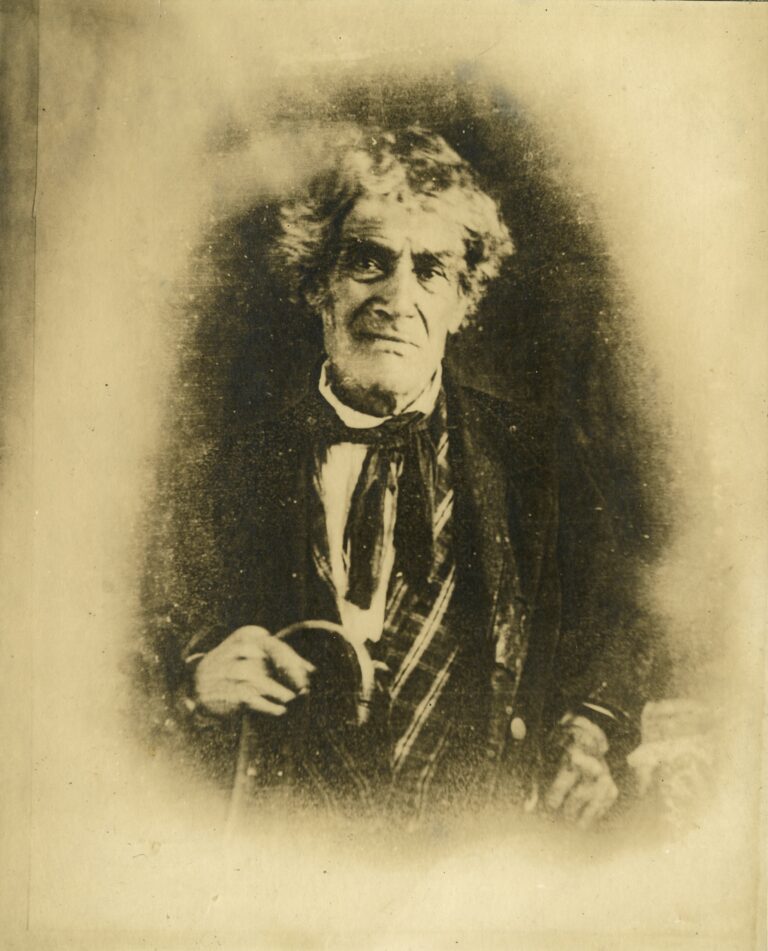
Undated daguerreotype of Kennison. CHM, ICHi-040899
Kennison claimed to have been born in 1736 in present-day Maine. A poor, manual laborer, he found common cause with the American patriots fighting for the equality of all men. After taking part in the Boston Tea Party, Kennison fought in seemingly every significant battle in the American Revolution from Lexington through Yorktown. When hostilities with Great Britain broke out in 1812, he enlisted again, despite being in his 70s, and received a wound from which he never fully recovered. Barely surviving on his pensions from service in two wars, he arrived in Chicago having passed the century mark, where he became a valuable member of the community, a link to the nation’s past.
The Museum acquired its copy of Lossing’s Field-Book in August 1914. In late July of that year, Dr. Charles J. Lewis gave a talk entitled, “David Kennison: The Last Survivor of the Boston Tea Party,” before the Borrowed Time Club, a group whose membership was restricted to those over 70, in Oak Park. In the talk, Lewis questioned Kennison’s story.
As a doctor, Lewis valued facts, so he wrote to various government agencies to learn more about Kennison’s pensions and military service. The records he received indicated that Kennison had attempted to enlist when he was about 17 in 1780 but had been denied on account of his size. The records suggested that he was born around 1764 and, thus, would have been about 9 at the time of the Boston Tea Party, too young to have participated. He did serve in the War of 1812, but he lied about his age—in his late 40s, he was too old—when he enlisted. Rather than 115, he was likely in his late 80s when he died in Chicago.
An Oak Park paper covered Lewis’s talk, but otherwise its typed pages in CHM’s collection were ignored. In the early 1970s, Albert G. Overton followed a similar line of research and reached the same conclusion as Lewis. Even then, the legend of Kennison persisted well into the 21st century, his memorial boulder in Lincoln Park becoming a rallying point for various self-proclaimed patriots opposing perceived governmental overreach.
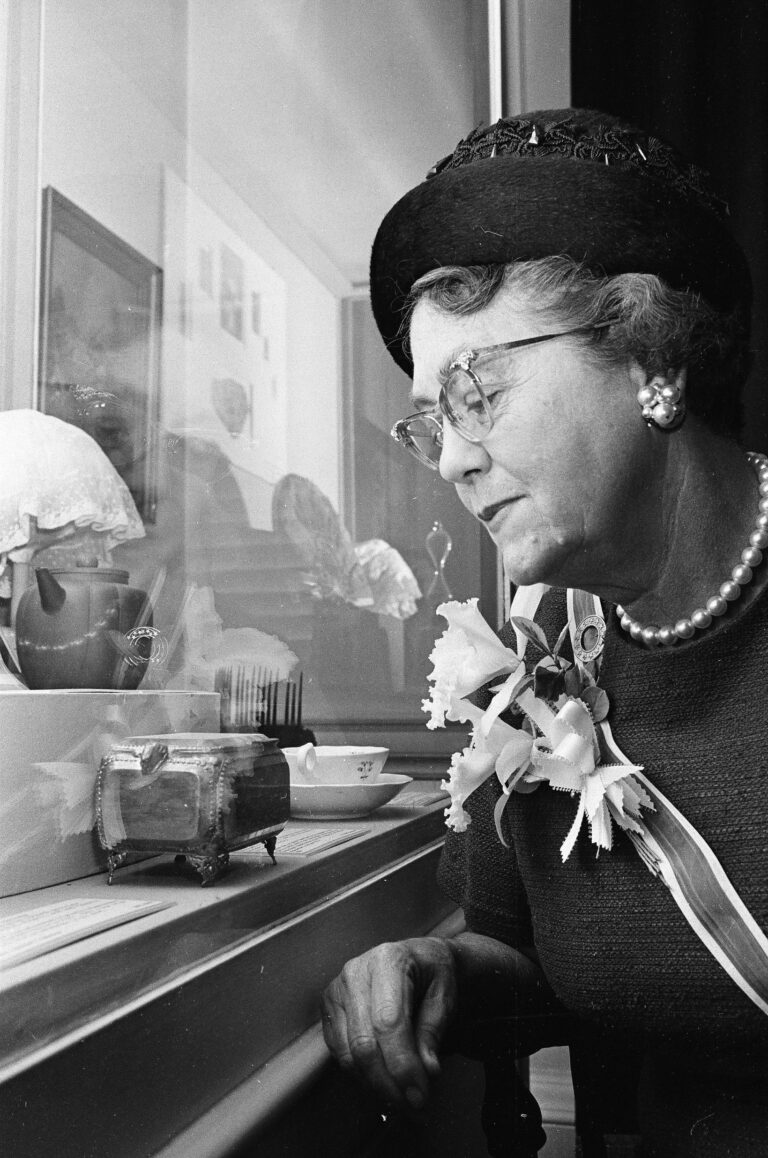
The tea caddy was on display in the then Chicago Historical Society, September 17, 1964. It was on display again in the 1987 exhibition We the People: Creating a New Nation 1865–1920. ST-19031900-0003, Chicago Sun-Times collection, CHM
“I think that the people in Chicago when he came here were so anxious to be connected to this great national event, to have this real Revolutionary War hero living in their midst, that that they wanted to believe this person,” said the late Russell Lewis, then the director of collections and research at CHM, in a Chicago Tribune story responding to the Tax Reform Coalition protesting at Kennison’s memorial in 2003. “And I think there are a lot of people today that still don’t want to believe that he was a fake.”
Charles Lewis was kind to Kennison’s memory in the conclusion of his talk in 1914. Kennison may not have been part of the Boston Tea Party or have served in the Continental Army, Lewis concluded, but he did live through that period of American history and had attempted to fight for his country while still a teenager. As an older man, when the opportunity arose again in 1812, he lied in order that he might take part in the nation’s defense. His personal deceptions in many ways mirrored the willful blindness of his adopted home, Chicago—both seem to have arisen from a very human desire to be part of something larger than oneself, of something meaningful and memorable.
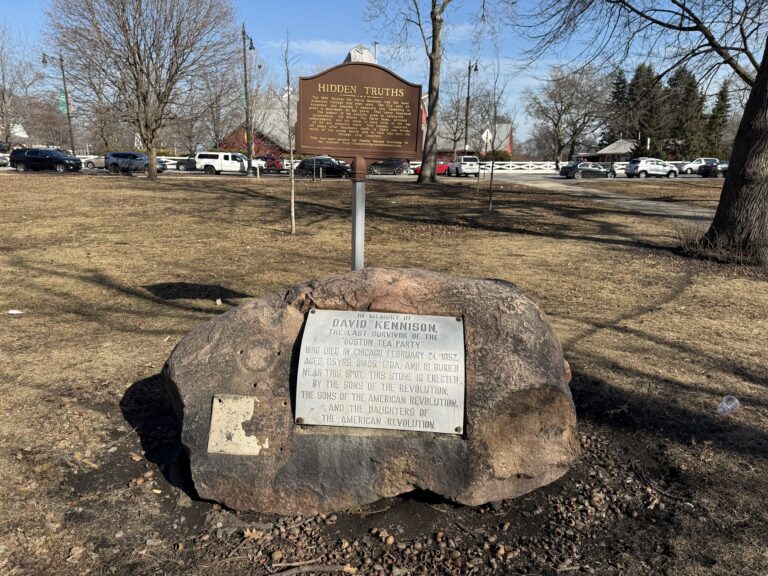
The boulder honoring David Kennison, 2026. Photograph by CHM staff
And if Lossing is to be believed, Kennison used the public belief in his story to draw attention to the unfinished business of the American Revolution. “At a public meeting, in the summer of 1848, of those opposed to the extension of slavery,” Lossing writes. “Mr. Kinnison [sic] took the stand and addressed the audience with marked effect. He declared that he fought for the ‘freedom of all’ . . . and closed by exhorting his audience to do all in their power to ABOLISH SLAVERY.”
Sources
- Clarence R. Bagley Papers, February 8–March 6, 1922, Chicago History Museum
- Lester Curtis Papers, 1935–1947, Chicago History Museum
- Rex W. Huppke, “Con Man Became City’s Hero,” Chicago Tribune, August 31, 2003, N_A1
- David Kennison Papers, 1848–1852, Chicago History Museum
- Charles Josiah Lewis, “David Kennison: The Last Survivor of the Boston Tea Party,” read at Oak Park, IL, July 30, 1914
- Benjamin John Lossing, The Pictorial Field-Book of the Revolution (New York: Harper & Bros., 1859 [c. 1850])
- A. E. Ormes, “Chicago’s Revolutionary Hero,” Chicago Magazine, vol. 2 (Sept. 2011): 594–97
- Albert G. Overton, “David Kennison and the Chicago Sting,” typed manuscript in collections record, Chicago History Museum.
- Alexander S. Prentiss Letter, 1852 Feb 25, Chicago History Museum
- Scrapbook of Clippings on David Kennison, Chicago History Museum
- William Hay Williamson, “David Kennison Spills a Ship of British Tea,” Chicago Today, vol. 2, no. 2 (Jan. 1928)
In honor of the anniversary of parishioners successfully saving St. Francis from destruction, Rebekah Coffman, Curator of Religion and Community History, and Elena Gonzales, Curator of Civic Engagement & Social Justice, tell the history drawing from CHM collections such as the Chicago building clearance photographs, 1939–58, and the documentary film No Abandonarémos a San Francisco de Asís, interviews with parishioners, and local scholarship.
In Chicago, Catholic parishes form a kind of visual marker and place maker for Latinidad, though their architecture may not always speak to this heritage at first. The geography of Chicago has been deeply influenced by Catholic parishes, with wave after wave of immigrants finding spiritual and communal refuge within church walls as the Archdiocese of Chicago defined parish boundaries and established church buildings based on ethnic identities and spoken languages. Many churches that initially served European congregations are today majority Latine in attendance. Most hold Spanish language services in addition to masses in English, Polish, and other European languages. These social layers of use by different communities through time serve as windows into the world of Latine migration to and presence within the city.
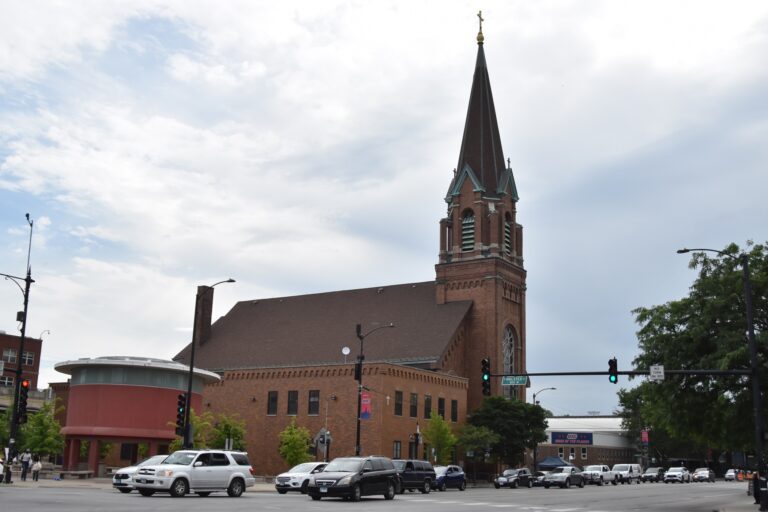
Exterior of St. Francis of Assisi Catholic Church, 813 West Roosevelt Road, Chicago, 2024. Photograph by Jojo Galván Mora
On the Near West Side, St. Francis of Assisi Catholic Church stands as a testament to how people make change through coordinated resistance. Originally founded as a German Catholic church in 1853, it became known as la catedral mexicana as the neighborhood’s Mexican community grew through the 1920s and into the 1950s, with a separate Spanish-language service starting in 1925.
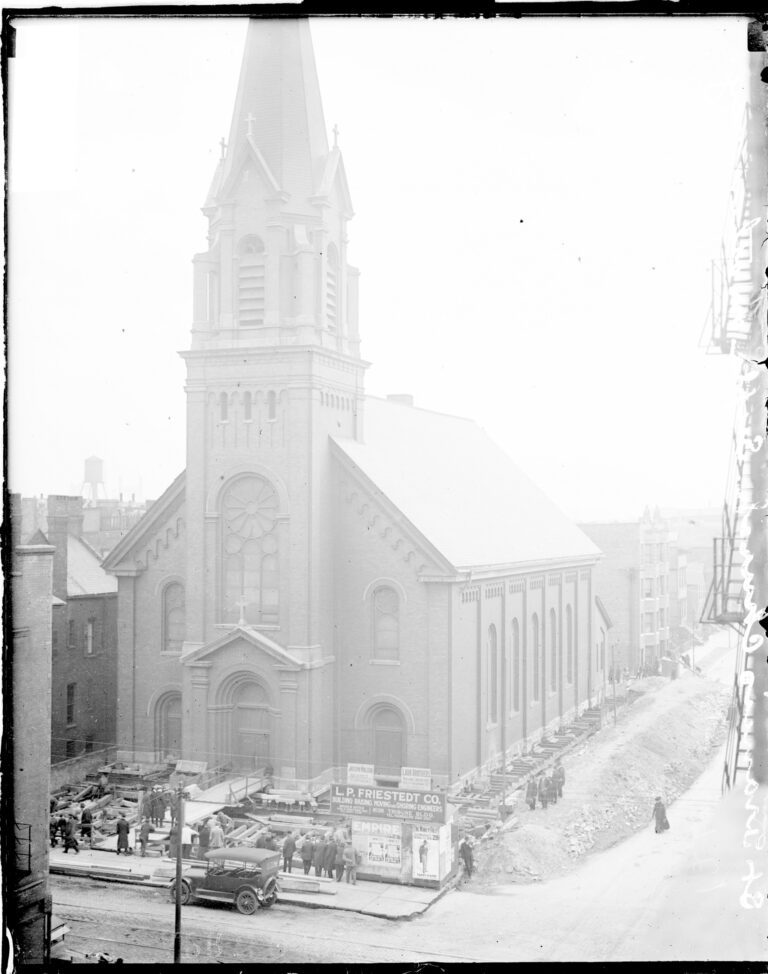
Exterior view of St. Francis of Assisi Catholic Church, Chicago, 1917. DN-0067872, Chicago Daily News negatives collection, CHM
At its peak, 5,000 parishioners attended each Sunday. In 1961, the neighborhood was decimated by vast building clearances in preparation for the University of Illinois Chicago campus. St. Francis remains an important hub for weekend services, but the neighborhood was forever changed.
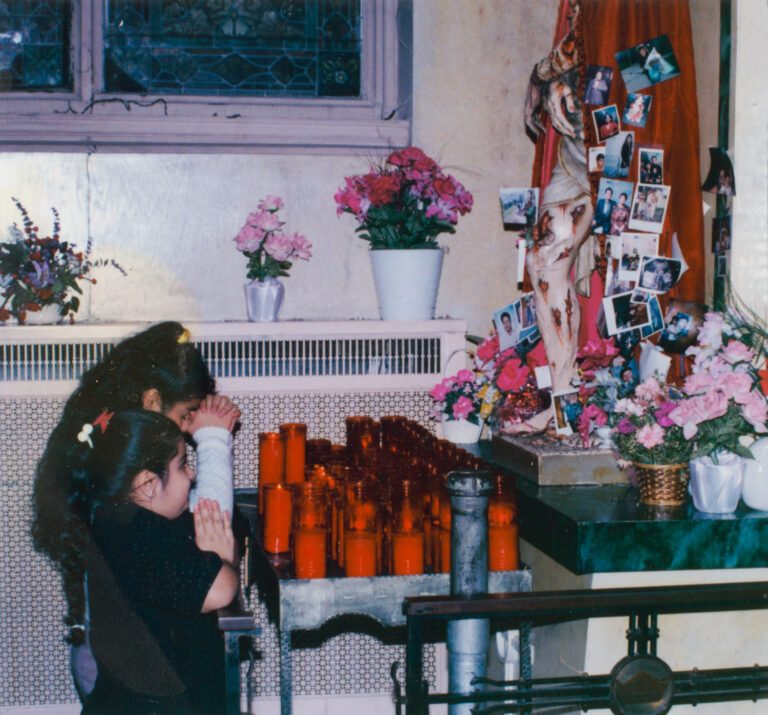
Two girls praying at an altar after lighting candles for St. Francis at St. Francis of Assisi Catholic Church, Chicago, c. 1993. CHM, ICHi-183466; Gregg Mann, photographer
Despite strong attendance, the Catholic archdiocese proposed closing St. Francis in late 1993, with a public announcement in January 1994. Congregation members immediately began organizing in opposition, forming the St. Francis of Assisi Preservation Committee. They protested in front of the cardinal’s mansion and signed petitions, gaining media attention.
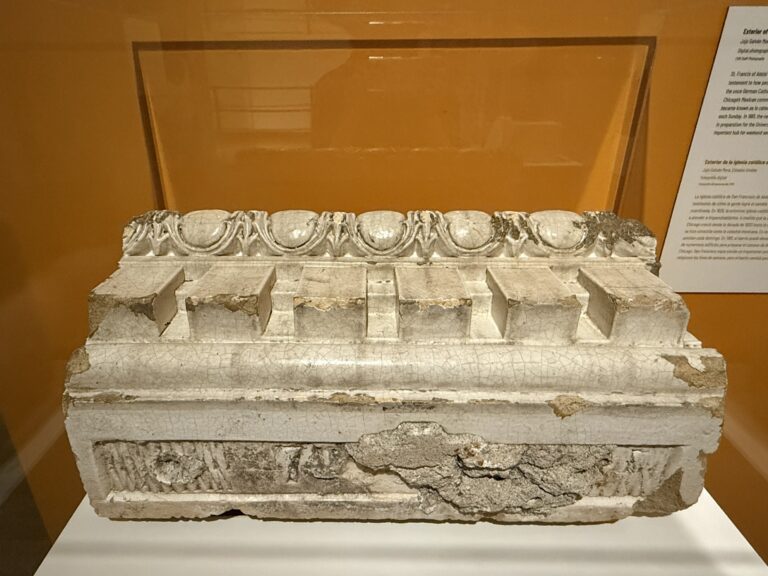
This architectural fragment of glazed terra-cotta (c. 1918) shown in Aquí en Chicago was salvaged from the renovation of the rectory and is a reminder of this important fight to remain. Courtesy of Margarita and Carlos Villaseñor
The doors to St. Francis were officially closed November 1994, and workers began dismantling the church’s fixtures and decorative elements. Protests and vigils continued through 1995, and later that year the iconic stained-glass windows were removed and eventually repurposed at St. Paul Chong Hasang Korean congregation in Des Plaines, Illinois.
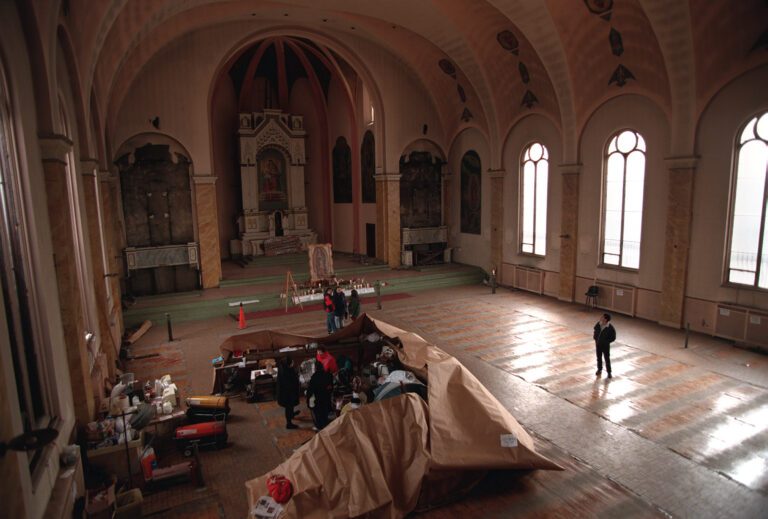
St. Francis of Assisi parishioners occupy the church, February 6, 1996. Note the empty window frames. STM-000011223, Chicago Sun-Times photograph collection, CHM
On January 29, 1996, structural demolition work began. The preservation committee went into action, calling news media and local government officials. As a final resort, parishioners, including Carlos and Margarita Villaseñor, began occupying the church on Sunday, February 4, 1996, in a frigid cold snap with the wrecking ball parked outside. The church was unheated, and parishioners made makeshift tents and placed cardboard over open doorways to keep warm. They stayed until the following Tuesday, when the archdiocese’s Bishop John Manz hand-delivered a letter declaring the church would not be torn down and demolition equipment was removed. St. Francis was officially reopened on April 6, 1996, and remains a sacred refugio today. The replacement stained-glass windows document this history and the parishioner’s fight to save their church.