


To mark the centennial of the establishment of U.S. Route 66, Jojo Galvan Mora, CHM Digital Humanities Curator, gives a brief history of the “Mother Road.”
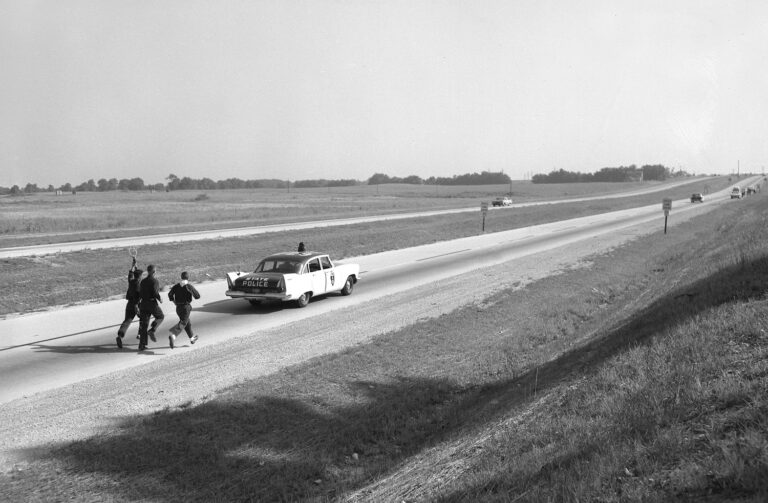
The battery-powered friendship torch of the Pan American Games is carried north toward Chicago by Boy Scouts along Route 66, 1959. ST-17500161-E1, Chicago Sun-Times collection, CHM
November 11, 2026, marks the 100thth anniversary of the establishment of U.S. Highway 66, widely referred to as Route 66. Route 66 is a highly well-known, reported on, and mythologized roadway. When it was fully operational, it stretched roughly 2,400 miles starting in Chicago’s Loop and extending all the way to the shores of the Pacific Ocean in Santa Monica, California. Route 66 itself represents the golden age of the American automobile industry, and the travel culture it subsequently birthed. Despite its official decommission in 1985, the collective memory around the highway has also served to capture the aspirations and anxieties, and the creation of emblematic cultural movements, of an entire generation of Americans, providing historians with a powerful tool to better understand not just local stories, but transcontinental narratives.
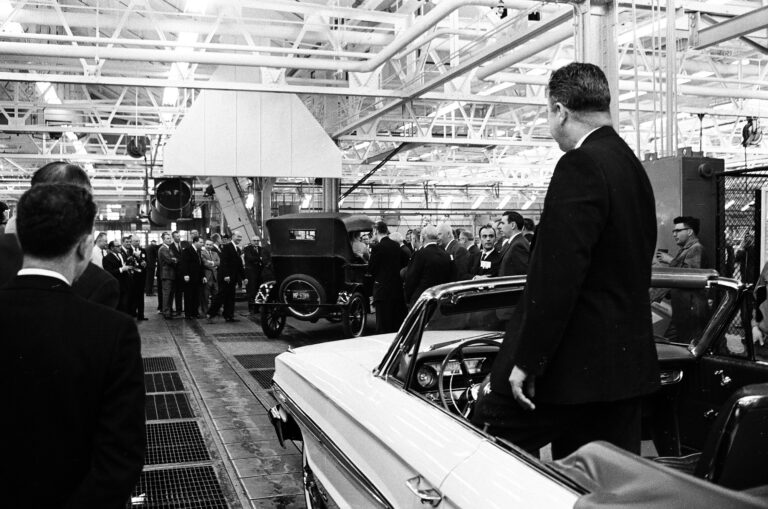
The Ford Motor Company hosts an event to celebrate 50 years of assembling vehicles in Chicago, March 19, 1964. A 1924 Model T rolls off the assembly line to recognize 40 years of manufacturing at the 12600 South Torrence Avenue plant. ST-20003087-0001, Chicago Sun-Times collection, CHM
Route 66 served an important role when it was established by the Bureau of Public Roads in 1926: it brought together a disjointed system of state and national roads under a single name, making it easier for crosscountry motorists to plan trips, for businesses (and eventually government agencies) to ship goods, and for businesses to promote their offerings, whether that be food, lodging, or local attractions. What began in the 1920s and ’30s as a project designed to standardize the expanding roadway system in the United States became a cultural behemoth by the 1940s and ’50s as personal vehicle ownership exploded after World War II.
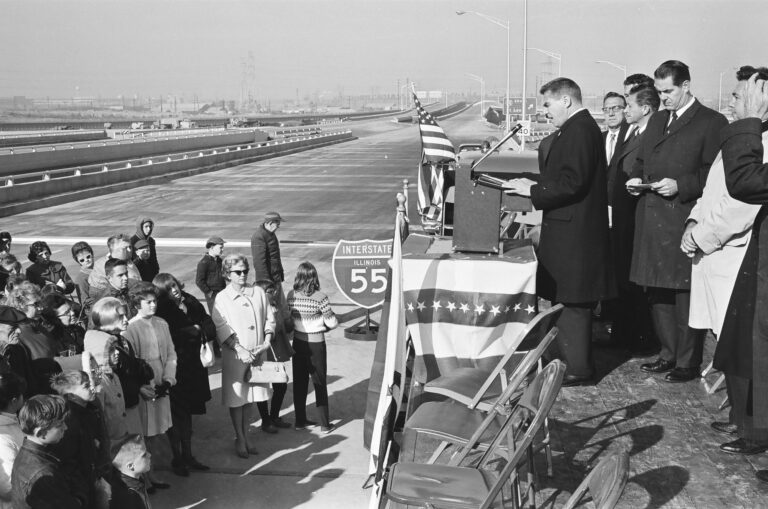
Mayor Richard J. Daley and other city, state, and federal officials at ribbon cutting and opening ceremony for the Southwest Expressway (I-55, later Stevenson Expressway), at Damen Avenue interchange, Chicago, October 24, 1964. ST-11005198-0004, Chicago Sun-Times collection, CHM
Nonetheless, the spirit of the mother road remains alive and well through American pop culture in movies, music, and tourism. Author John Steinbeck named Route 66 “The Mother Road” in The Grapes of Wrath, while Jack Kerouac’s storytelling in On the Road defined it as a counterculture movement. Bobby Troup’s “Route 66,” sung by Nat King Cole reached the top of the charts when it was released in 1946. It has since been covered by other artists such as Chuck Berry and the Rolling Stones. Other songs that draw from the road’s legacy include Bruce Springsteen’s “Cadillac Ranch” (1980) and “Take it Easy” (1972) by the Eagles. On the silver screen, the accolades are just as numerous. In 1960, CBS produced a four-season-long show simply called Route 66 that followed two young men in a Chevrolet Corvette as they traversed the highway in pursuit of themselves and adventure. Stretches and landmarks along the road also appear in films like Easy Rider (1969), Rain Man (1988), Little Miss Sunshine (2006), and RV (2006). The year 2006 was great for Route 66. Apart from the aforementioned films (the former even featured the late Robin Williams), an entirely new global generation would be reintroduced the history of the “Mother Road,” through Disney’s release of Cars, a global phenomenon directly inspired by the golden age of American car culture, grossing over $485 million worldwide.
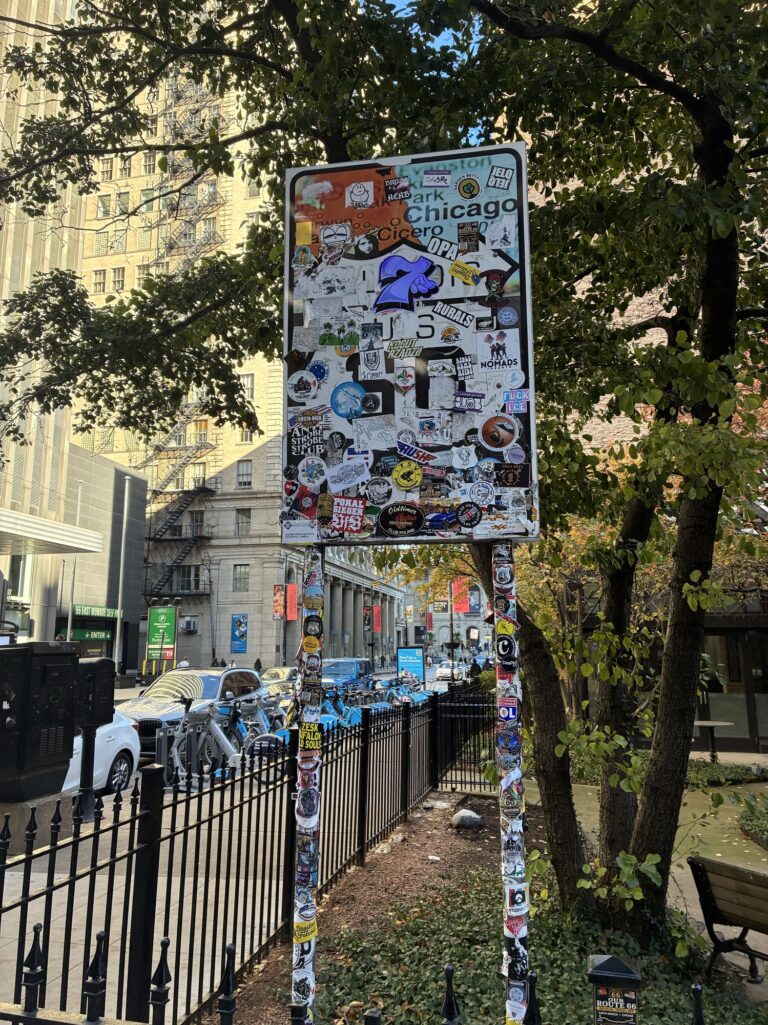
A Route 66 sign at Adams Street and Wabash Avenue covered with stickers, Chicago, 2026. Photograph by Jojo Galvan Mora
Many stretches of the highway have been conserved through independent initiatives and organizations, including a preservation program administered by the National Parks Service dedicated to maintaining the roadway’s important legacy and culture alive. Illinois motorists interested in showing their support for this history have the option of purchasing special Route 66 license plates, which provide a portion of every plate renewal fee to the Illinois Route 66 Heritage Project Fund.
Additional Resources
- “The Mother Road Trip: Route 66 History and Activities,” Library of Congress, July 29, 2022
- “Route 66: The Writing of an American Icon,” American Writers Museum, February 18, 2026