

This year marks the centennial of the 28th International Eucharistic Congress, which was held in Chicago from June 20 to 24, 1926. In this blog post, Rebekah Coffman, Curator of Religion and Community History, writes about the event and how public spaces in Chicago have been adapted into temporary sacred spaces.
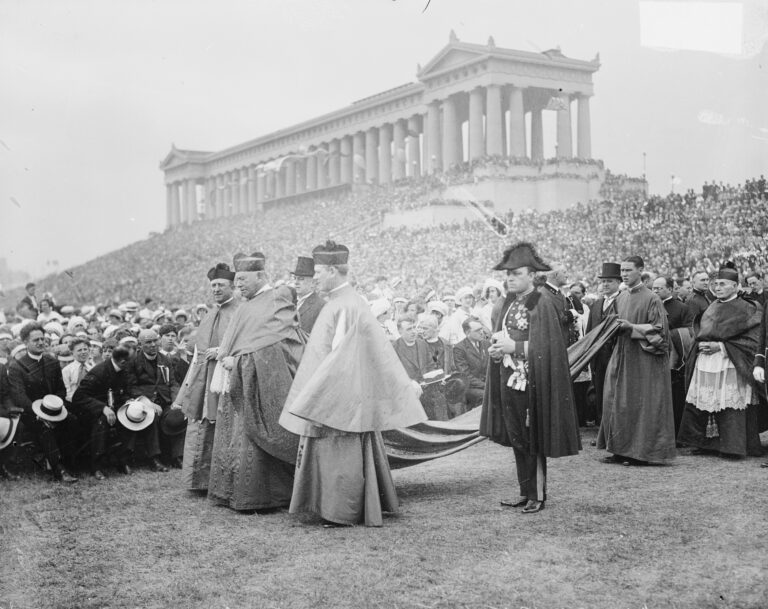
Clerical procession during the International Eucharistic Congress at Soldier Field, 1926. DN-0081753, Chicago Sun-times/Chicago Daily News Collection, CHM
You may have seen recent news from Chicago mayor Brandon Johnson and his entourage traveling to the Vatican to visit Pope Leo XIV, the first Pope hailing from the United States. As part of his visit, Mayor Johnson invited him to celebrate a mass in Grant Park, recalling Pope John Paul II’s visit to Chicago in 1979.
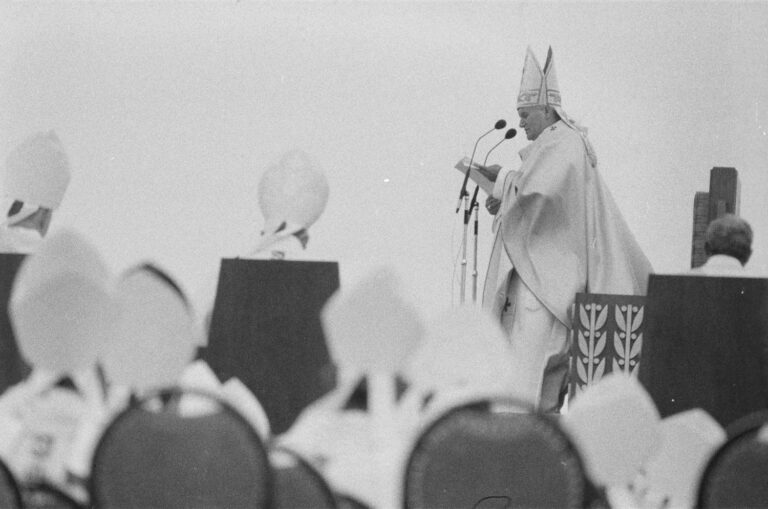
Pope John Paul II, along with local bishops, gives mass to crowd in Grant Park, Chicago, October 5, 1979. ST-19070082-0016, Chicago Sun-Times Collection, CHM
Pope John Paul II, born Karol Wojtyła in Wadowice, Poland, had taken the world by storm as the first non-Italian pope elected in 500 years. At the time of his 1979 visit, Chicago was the largest Catholic diocese in the country and claimed one of the largest Polish diasporas outside of Poland.
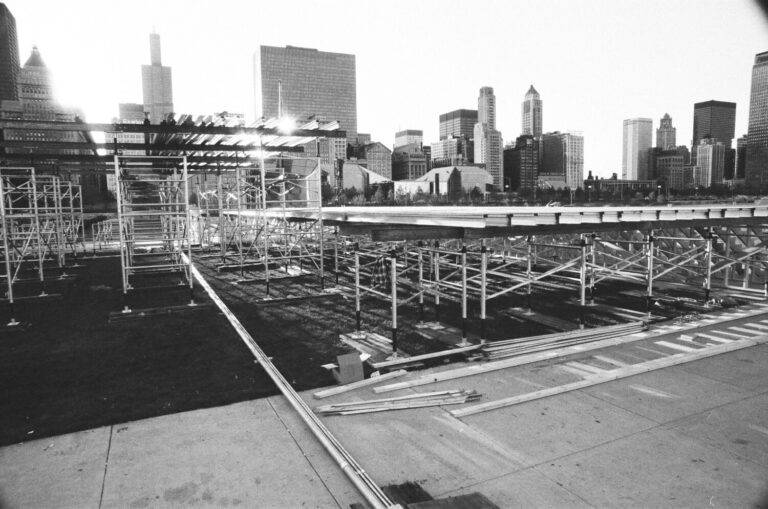
Papal altar construction for Pope’s mass in Grant Park, Chicago, September 19. 1979. ST-19070083-0018, Chicago Sun-Times Collection, CHM
More than 200,000 (some estimates say up to 1 million) people were in the crowds of his Grant Park Mass, with thousands more lining the streets in neighborhoods around the city as he made visitation rounds. When it was announced in 2025 that the new global leader of the Catholic church hailed not only from the US but more specifically Chicagoland, it seemed fitting that the Church and the city have wanted to mark the moment with large-scale fanfare again, including the public mass held at Rate Field in 2025.
Embed from Getty Images
Pope Leo XIV addresses Catholic faithful on the scoreboard at Rate Field, home to the Chicago White Sox, during a celebration and mass to honor his selection as Pope, Chicago, June 14, 2025. (Photo by Scott Olson/Getty Images)
When we imagine sacred spaces across the city of Chicago, any number of beautiful architectural monuments may come to mind. However, as papal visits and large-scale masses in Grant Park demonstrate, there are innumerable locations in the city that have served as temporary—even spontaneous—places of spiritual encounter. Often, these traces of gathering moments are erased from our visual memory of the city’s landscape but have powerfully shaped our collective history.
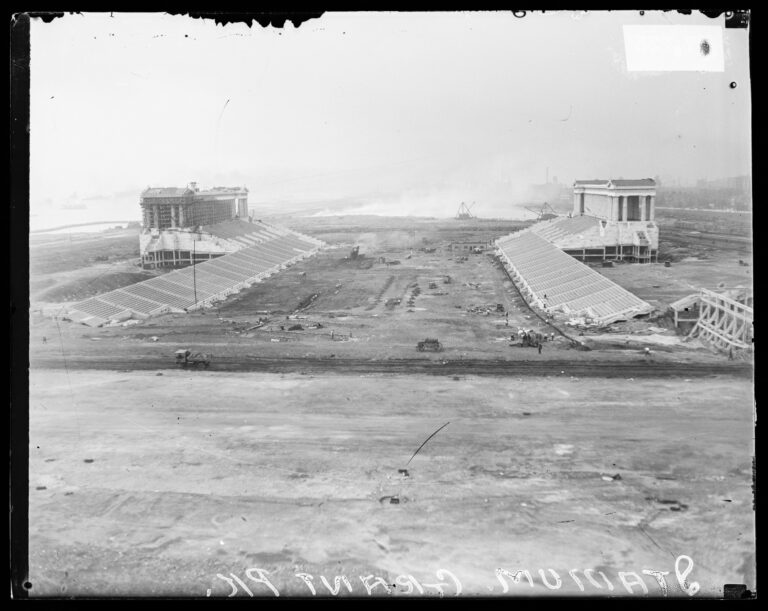
Construction of Municipal Grant Park Stadium, (renamed Soldier Field in 1925), Chicago,. July 1924. DN-0077235, Chicago Daily News Collection, CHM
Parks, beaches, stadiums, theaters, and countless other spaces in the city demonstrate these lesser-known sacred connections. The Municipal Grant Park Stadium, renamed Soldier Field soon after, is an example of how spaces evolve and transform in both sacred and contested ways. The original stadium was designed by Holabird & Roche in 1924 and opened to the public in October of that year.
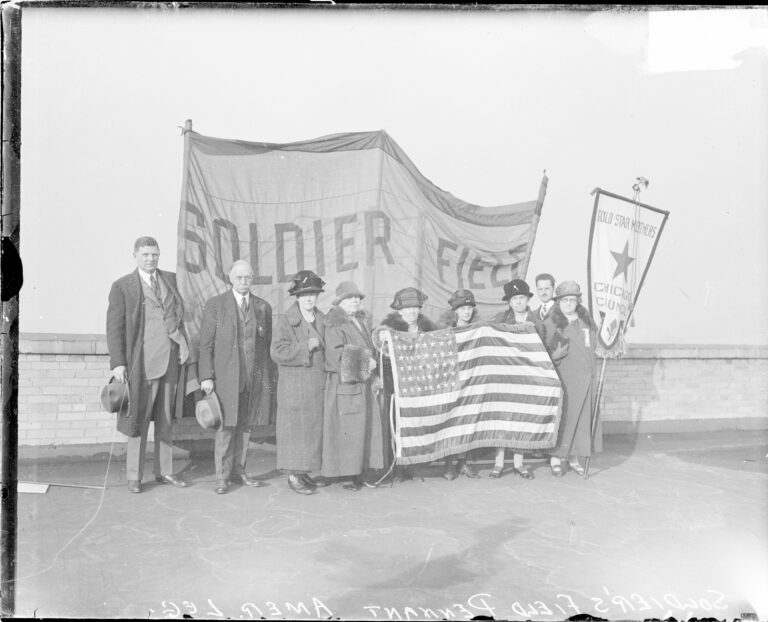
Soldier Field dedication with group of women and men, members of the American Legion, standing in front of a banner that reads “Soldier Field,” Chicago, November 11, 1925. DN-0079575, Chicago Sun-Times/Chicago Daily News Collection, CHM
On November 11, 1925, it was renamed as a form of memorial for soldiers lost in World War I, becoming thereafter known as Soldier Field. Since its opening, Soldier Field has been home to athletic games, concerts, and a host of other large-scale events. It has served as the home field for the Chicago Bears since 1971 and home stadium of the Chicago Fire FC twice, first from 1997 to 2006, and again since 2020.
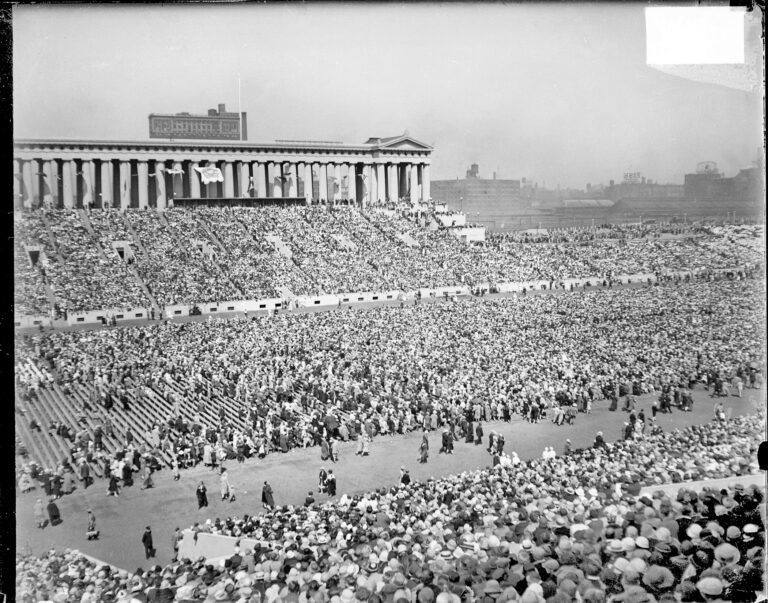
People walking along a wide pathway in Soldier Field during the International Eucharistic Congress, Chicago, 1926. DN-0081741, Chicago Sun-Times/Chicago Daily News collection, CHM
As with many buildings in transition, the uncertain future of Soldier Field can be a time to remember the many ways its history has transformed. Held June 20–24, 1926, the 28th International Eucharistic Congress was the first of its kind in the United States. The events took place across a network of places across Chicagoland—some dedicated religious spaces such as Holy Name Cathedral, with others transformed specifically for the congress, including Soldier Field.
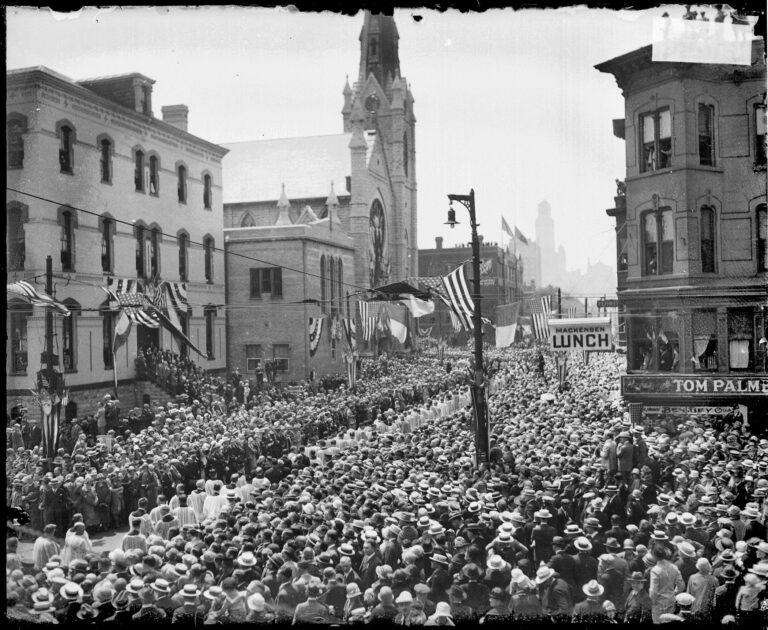
Crowd standing outside Holy Name Cathedral during the International Eucharistic Congress, Chicago, 1926. DN-0081857, Chicago Sun-Times/Chicago Daily News collection, CHM
The goal of Eucharistic Congresses was to reengage people with the Catholic Church and Christianity, especially during an age of what was then seen as increasing secularization. It gets its name from the eucharist, meaning the process of giving and receiving communion, and church leaders believed large, public displays would remind the public of the importance of the Church. Functionally, they served in many ways as a religiously oriented Wworld’s Ffair, bringing together representatives of different nations. The first Congress was held in Lille, France, in 1881, followed by a series of other congresses in France, Belgium, Switzerland, Italy, England, Germany, Spain, Austria, Holland, Syria, and Canada. In 1923, Chicago was identified as the next congressional location, making it the first host city in the US and “put[ting] Chicago on the map” for global Catholicism in a way never done before.
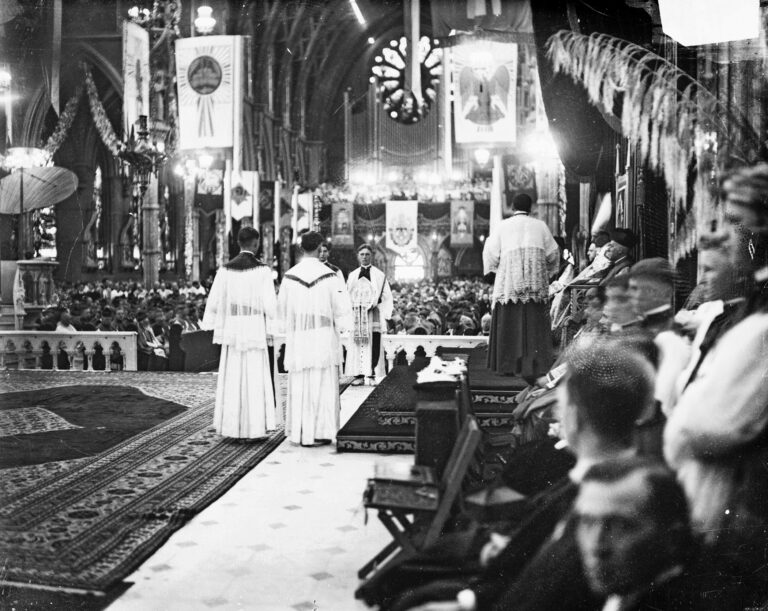
Clergy in front of the altar at Holy Name Cathedral during the International Eucharistic Congress, Chicago, 1926. DN-0081835, Chicago Sun-Times/Chicago Daily News Collection, CHM
The Chicago congress formally opened with a Midnight mass on Sunday, June 20, at Holy Name Cathedral followed by with a solemn mass at every church in the Chicago Catholic Archdiocese. The next day, events began at Soldier’s Field with a day dedicated to children, including a choir of 62,000 children from Chicago’s parochial schools. Tuesday, June 22, was Women’s Day, followed by Higher Education Day on Wednesday, June 23, concluding the events at Soldier Field.
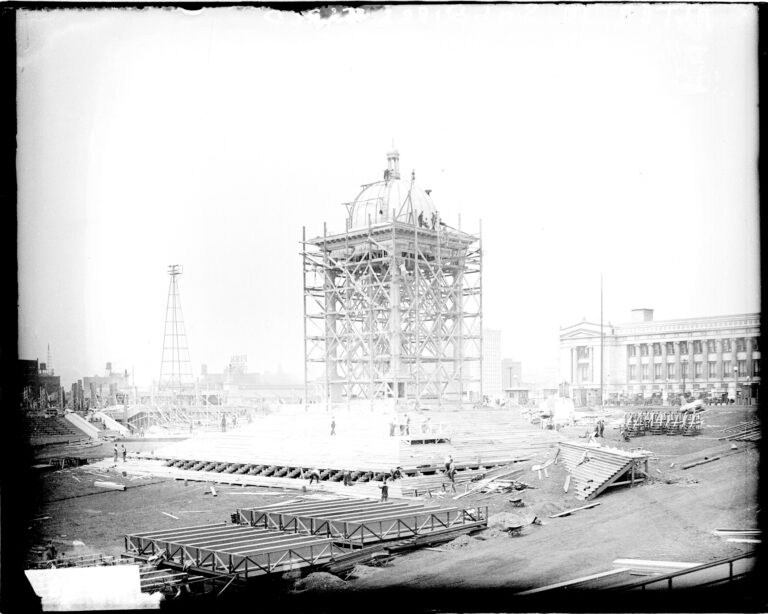
Altar being erected on a large field with grandstands near Solder Field, Chicago. 1926. DN-0080948, Chicago Sun-Times-/Chicago Daily News Collection, CHM.
To celebrate communion en masse, a series of temporary altars were constructed, including an altar platform at Soldier Field with a golden baldacchino inspired by the Basilica of Saint Paul Outside the Walls in Rome. More than 10,000 priests were recruited to help with serving, and Chicago-area nuns prepared more than 4.5 million communion wafers to be served.
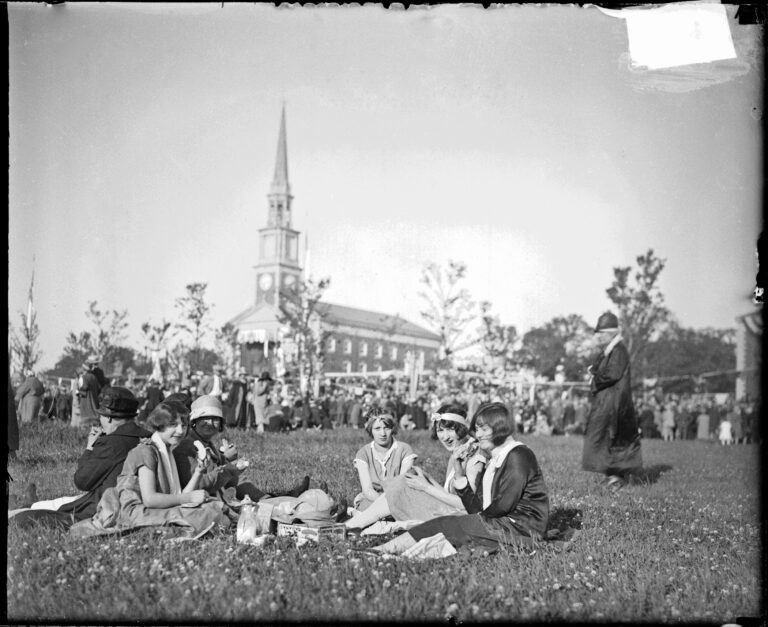
Five young women sit on grass in front of the Chapel of the Immaculate Conception during the International Eucharistic Congress, Mundelein, Illinois, June 1926. DN-0081898, Chicago Sun-Times/Chicago Daily News collection, CHM
The final day of the congress shifted to suburban Mundelein, with events held at the St. Mary of the Lake Seminary (now University of Saint Mary of the Lake). The seminary chapel was too small to accommodate the massive crowds, so again a temporary altar space was built on the steps of the chapel with crowds gathering across the plaza and open spaces beyond. So many were in attendance that transportation logistics across railways became a major concern, and the highway from Lake Bluff to Mundelein was pedestrianized for nine miles to accommodate the swelling pilgrims.
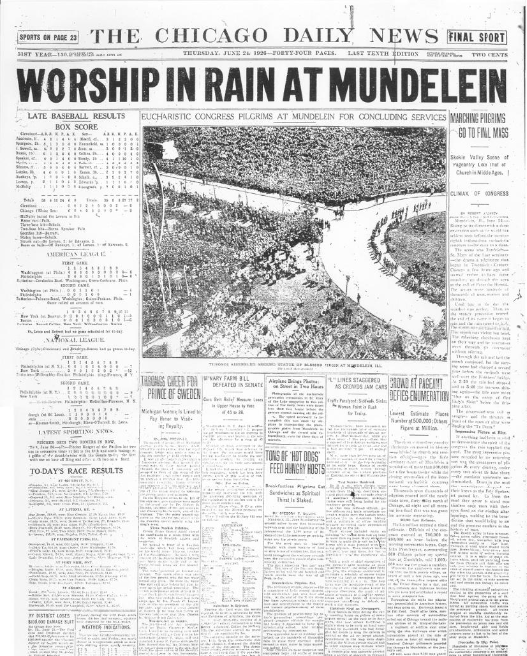
The Chicago Daily News’s coverage of the Mundelein event included details such as the pilgrims’ consumption of ten tons of hot dogs, the crush of passengers on the trains, which began running at two-minute intervals from 4 a.m., and the Daily News‘s own pride at getting photographs from Mundelein into papers on the street within two hours, thanks to swift delivery by airplane.
The success of the 1926 International Eucharistic Congress led to it becoming a model for future civic and religious gatherings in Chicago. It was also a time when the worldwide Catholic community experienced Chicago’s welcoming spirit.