

In recognition of Women’s History Month, we share excerpts from a forthcoming Chicago History article by Ann Saunders on her mother Doris E. Saunders, a librarian, author, editor, businesswoman, and professor, perhaps best known in Chicago for her work with Johnson Publishing Company, which published Ebony and Jet magazines and empowered Black self-representation.
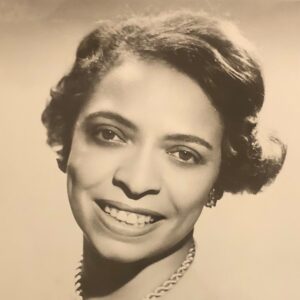
Promotional image of Doris E. Saunders for her radio show, The Doris Saunders Show, which broadcast on WBEE, c. 1966. Courtesy of Ann Saunders
In Chicago’s Bronzeville neighborhood, there were businesses to establish and manage, newspapers like the Chicago Defender to keep up with and contribute to, and churches and religious institutions that offered both refuge and responsibility. Within this vibrant world, my mother, Doris E. Saunders (1921–2014), lived and thrived. A hidden figure in the story of Black Chicago and beyond, she left behind a legacy that few know, but one that deserves a place in the city’s historical memory.
Early Life and Literary Roots
An only child born to an only child, my mother grew up without siblings or cousins. She craved family—and with it, the stories, kinship, and culture that connect generations. Books became her extended family. As an early young reader and precocious, she found companionship in books like Heidi (published in 1821). I was named after the heroine in Anne of Green Gables (published in 1908). By age twelve, she was reading the poetry of Paul Laurence Dunbar and Scott’s Official History of the American Negro in the World War (1919) by Emmett Jay Scott, which were permanent fixtures on her grandmother’s library table.
Her education unfolded in Chicago’s public integrated schools and its libraries, especially the Hall Branch Library, which opened in 1932 in Bronzeville. Named after Dr. George Cleveland Hall, a surgeon and cofounder of the Association for the Study of Negro Life and History with Carter G. Woodson, the Hall Branch was created, my mother said, because Hall believed his community deserved a first-class library. I think my mother drew resourcefulness and agency from books.
In 1935, my mother met Charlemae Rollins, the Hall Branch’s children’s librarian, who would become a lifelong mentor and friend. Rollins introduced her to the canon of Black literature—Langston Hughes’s poetry, W. E. B. Du Bois’s essays, James Weldon Johnson’s The Autobiography of an Ex-Colored Man (1905), Nella Larsen’s fiction, and The Negro in Chicago (1922), Charles S. Johnson’s landmark study of the 1919 race riot. My mother had grown up hearing about that riot in family conversations, and reading Johnson’s analysis gave her a context for those memories.
Johnson Publishing and the Innovative Information Management
Encouraged by Rollins, my mother wrote a letter to John H. Johnson, publisher of Ebony magazine, proposing something that had not been done before: a special in-house library designed specifically to house reference materials by and about Black people. This was an opportunity to realize a long-held concept, now with a focus on supporting the editorial and advertising work of Johnson Publishing Company (JPC). When interviewed, she was hired on the spot.
John H. Johnson established his company in Chicago in 1941 with his first publication, Negro Digest (later renamed Black World). He began publishing Ebony in November 1945. Ebony became the company’s flagship magazine. Ebony shared stories, news, and information about African American life. The company and all its publications fostered social, cultural, economic, and political awareness and development among generations of people of African descent across the globe.
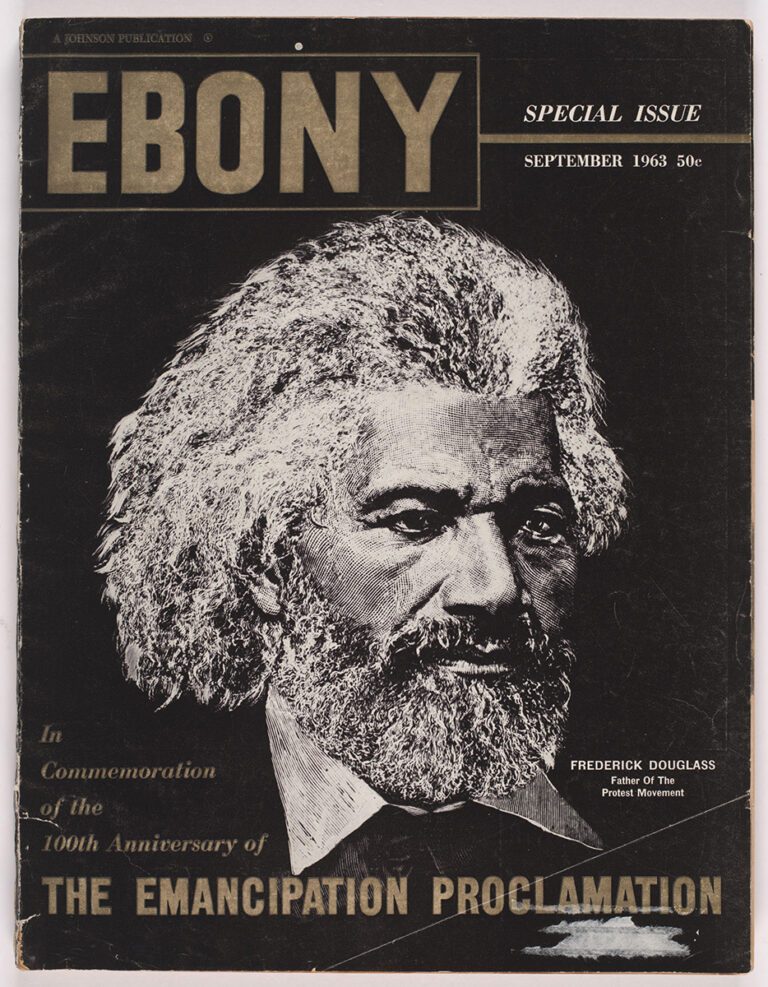
Ebony Special Issue: The Emancipation Proclamation, cover designed by Herbert Nipson and Norman Hunter, Johnson Publishing Company, Chicago, September 1963. CHM, ICHi-183267
So, in 1949, at 27, my mother began creating a groundbreaking corporate library—the first of its kind—organized around the Black experience as its primary focus. Because the library was Mom’s concept, she established the initial parameters of its scope by defining the library’s position in the corporate structure. Unlike many other corporations where the library was in the lower echelons of the corporate structure, this library was on the same level as other departments, including advertising, editorial, circulation, and subscriptions.
* * * *
But she was more than a librarian. She was, in her words, an “information and marketing manager.” In an era before computers, PDFs, internet access, mobile phones, or even electric typewriters, she became the living interface for JPC’s information infrastructure. Working with carbon paper, mimeograph machines, manual typewriters, and landline telephones, she built a system that revolutionized how JPC accessed, analyzed, and archived information. Her design served every department across the company, providing a responsive, interdisciplinary model of information management tailored to JPC’s mission and markets.
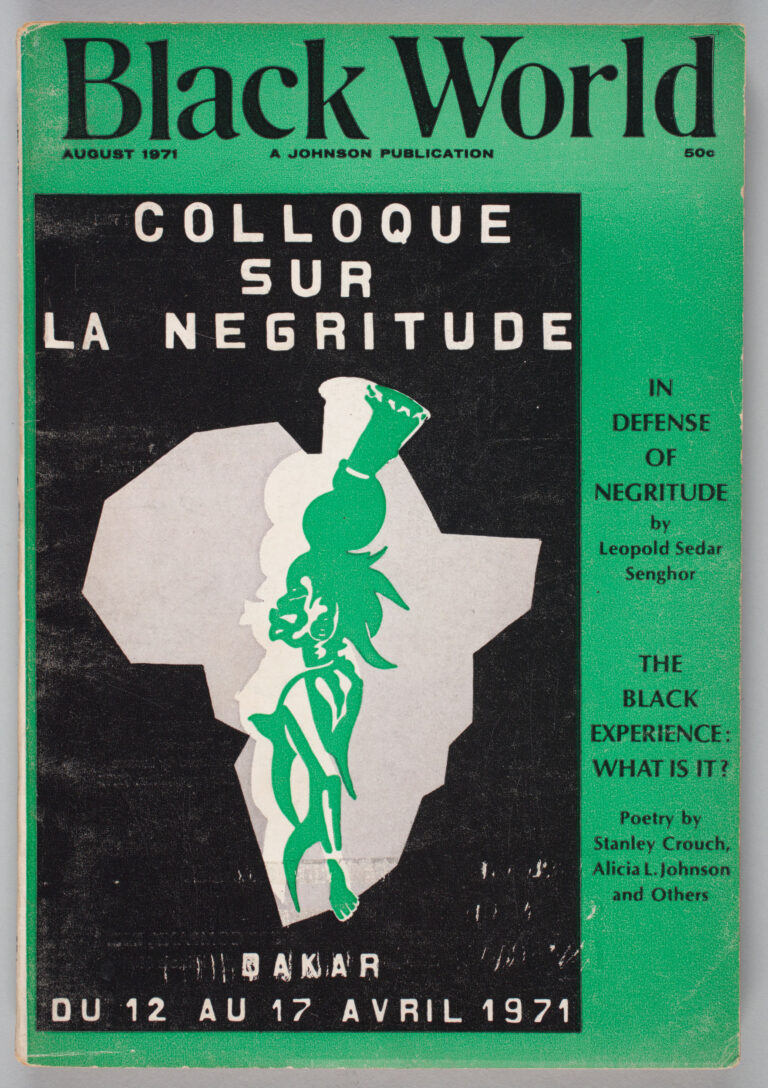
Black World, edited by Hoyt Fuller with cover designed by Herbert Temple, Johnson Publishing Company, Chicago, August 1971. CHM, ICHi-182539
From the start, she established associations, memberships, subscriptions, and networks with organizations whose publications and data would underpin her work, supporting JPC’s advertising staff. In her first few years, she collaborated closely with the company’s New York advertising office, led by William P. Grayson. Her pioneering marketing research verified what Black newspapers already knew, but what most mainstream advertisers had failed to realize or accept: the existence of a vibrant, $16 billion “Negro market.” Her research helped persuade national advertisers to buy ad space in Ebony, driving the company’s financial success.
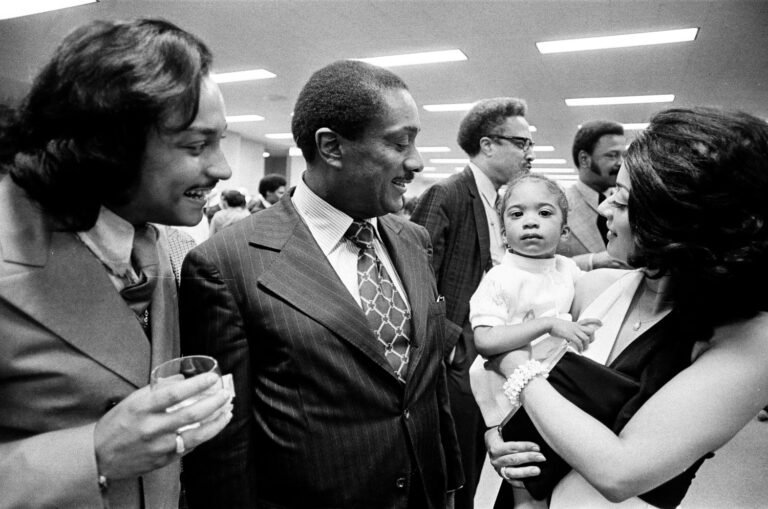
People enjoying an open house for the new Johnson Publishing Company building, 820 South Michigan Avenue, May 16, 1972. ST-70004694-0042, Chicago Sun-Times collection, CHM
This was not guesswork. My mother’s ability to extrapolate, interpret, and organize census, demographic, and business data had been honed during her year in the Social Science and Business Division at the Chicago Public Library. By the end of 1955, Ebony could point to advertising revenue, rather than circulation alone, as the marker of its success. This shift also helped open new avenues in the broader media landscape, including commercial photography, advertising, and publishing directed at Black audiences. By 1970, other media companies were launching books and magazines targeting Black consumers, once it became clear just how profitable the market was.
Learn More
- Subscribe to Chicago History magazine by becoming a Museum member.
- See more works published by Johnson Publishing Company in our exhibition Designing for Change: Chicago Protest Art of the 1960s–70s.
- Find publications from Johnson Publishing Company in the Abakanowicz Research Center.
- Explore the Doris E. Saunders papers at the Chicago Public Library, Woodson Regional Library, Vivian G. Harsh Research Collection of Afro-American History and Literature.