

Jojo Galvan Mora, CHM Digital Humanities Fellow, writes about the significance of Claudia Sheinbaum Pardo being elected president of Mexico, how Chicago’s Mexican community both influenced and is impacted by it, and the community’s importance in local, national, and international politics.
As midnight drew closer on June 2, 2024, Mexican voters on both sides of the US-Mexico border witnessed history when that year’s presidential election was called in favor of Claudia Sheinbaum Pardo, cementing her place in history as Mexico’s 66th president and as the first woman and first Jewish person to hold the nation’s highest office. Sheinbaum succeeded Andrés Manuel López Obrador (AMLO), continuing the leadership of the progressive National Regeneration Movement (MORENA) over Mexico for another six years. Chicagoans with Mexican citizenship played their role in a historic moment of their own: the 2024 election marked the first time that Mexicans living abroad in the US could vote in person at the Mexican Consulate on the Near West Side.
Mexican nationals wait to cast their vote in the Mexican presidential election at the Mexican consulate in Chicago on June 2, 2024. Photo by KAMIL KRZACZYNSKI/AFP via Getty Images
According to data from Mexico’s Instituto Nacional de Eleccciones (National Elections Institute or INE) more than 10,000 Mexican citizens registered to vote in Illinois. The Mexican consulate in Chicago reported 1,500 in-person voting slots.
A Mexican national fills in her ballot for the Mexican presidential election at the Mexican consulate in Chicago on June 2, 2024. Photo by KAMIL KRZACZYNSKI/AFP via Getty Images
Sheinbaum was born in Mexico City to a Jewish family with Eastern European roots. Both of Sheinbaum’s parents were scientists, her father a chemist, while her mother worked as a biologist. This upbringing led Sheinbaum to the sciences, and she earned a PhD in energy engineering at the National Autonomous University of Mexico (UNAM) in 1995. Sheinbaum first entered politics in 2000 when AMLO, then Head of Government for Mexico City, named her Environmental Secretary.
In 2015, the largest borough in Mexico City, Tlalpan, elected Sheinbaum as mayor. Riding a wave of local popularity, Sheinbaum went on to win the election for the Head of Government in Mexico City in 2018, the same year that her longtime mentor, AMLO, secured the Mexican presidency. Her time in office was marked by a science-forward approach to the COVID-19 pandemic and policy reforms focused on addressing gender violence, outdated public infrastructure, and initiatives to make education available to all. Sheinbaum’s popularity as the leader of the largest urban metro area in all of North America made her a logical choice to succeed AMLO after the conclusion of his six-year presidential term. She won close to 60% of the vote at home and from Mexicans abroad, and carrying 31 out of 32 states in the country. She was inaugurated in October of that year, and her leadership has been defined by policies focused on energy reform, nationwide passenger rail modernizations, and social welfare programs designed to support children and mothers.
New president of Mexico Claudia Sheinbaum Pardo receives the presidential sash during the investiture ceremony as part of the presidential inauguration on October 1, 2024, in Mexico City, Mexico. Photo by Manuel Velasquez/Getty Images
In Chicago, Sheinbaum represents an aspirational figure for thousands of people with Mexican heritage in the metro area. According to data from a report published by University of Illinois Chicago’s Great Cities Institute in 2024, as of 2022, Mexicans made up at least 50% of the population across 15 neighborhoods in the city, and about one-fifth (roughly half a million) of the city’s entire population.
Sheinbaum’s ascension to the presidency also highlights the resounding impact of women in both local and transnational politics, especially in a city like Chicago, where women with Mexican ancestry are increasingly visible as business owners, educators, and political leaders. As an international figure, Mexican president Claudia Sheinbaum represents a milestone in the history of women achieving high leadership roles, and also the undeniable importance of Chicago’s Latine community as constituents in both local and international politics.
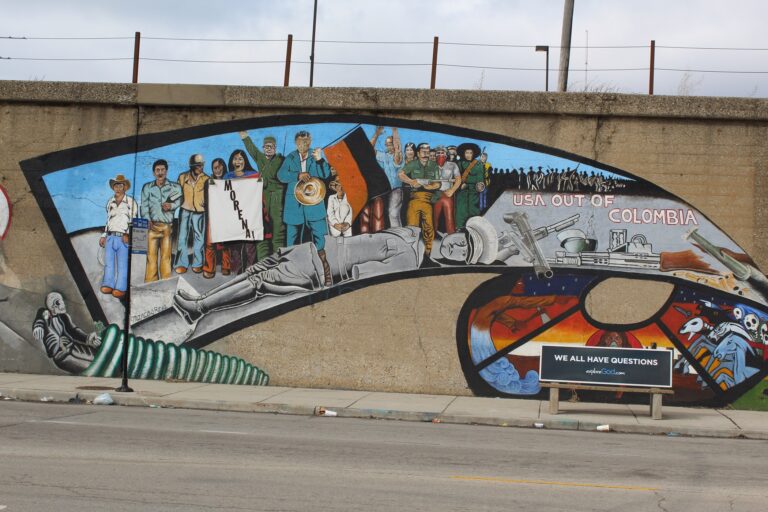
This photograph of “Fallen Dictator,” from Marcos Raya’s (b. 1948) mural Prevent World War III (1980) is currently on view in Aquí en Chicago. The banner depicted in the mural reads “MORENA” (Sheinbaum’s political party) and previously depicted a red and black portrait of Cuban revolutionary Che Guevara, remnants of which can still be seen in the outline behind the current banner. Photograph courtesy of Mario Hernandez, 2024
For more about Chicago’s Latine history, visit Aquí en Chicago, open until November of 2026.
For more on the history of Mexican political movements in Chicago, read Making Mexican Chicago: From Postwar Settlement to the Age of Gentrification by Mike Amezcua, available in our Abakanowicz Research Center.