

In this blog post, Elena Gonzales, CHM curator of civic engagement and social justice and lead curator of Aquí en Chicago, hosts Raiza Erlenbaugh, a master’s student at University of Illinois Chicago, and Chrystal Tilbury, co-founder of Panameños en Chicago, to share their experiences in the Panamanian community of Chicago and the paths that brought them to the city.
Near the closing for the exhibition Aquí en Chicago, I met Raiza Erlenbaugh, an anthropologist whose work focuses on the ways museums represent Latin American histories and communities. She is Panamanian and grew up in the Canal Zone and is part of the last generation of folks with dual citizenship prior to Panamá taking control of the zone. She and her family moved to Chicago in 2026.
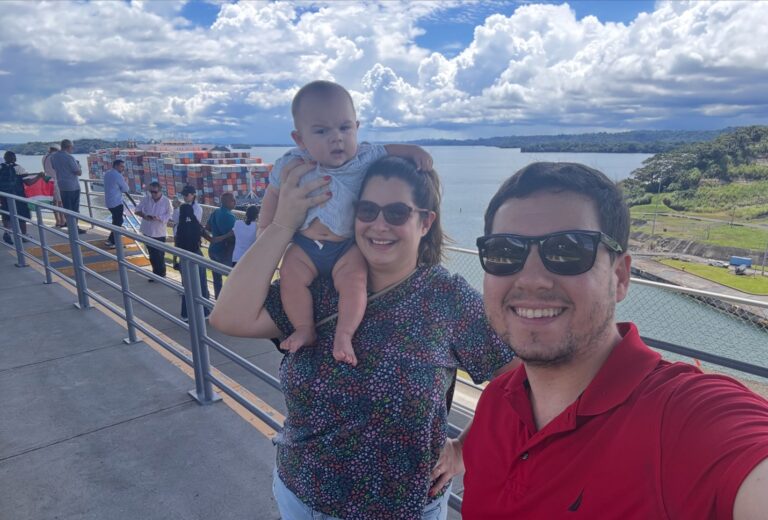
Raiza Erlenbaugh, her husband Arian Chaviano, and their son Gianni visit the Panama Canal’s Aguas Claras Locks for the first time as a family. Behind them, a Neopanamax vessel passes through the Panama-led canal expansion, completed in 2016. Photo courtesy of Raiza Erlenbaugh.
Chrystal Tilbury is a Panamanian from New York who has lived in Chicago for three years. Her Panamanian mother raised her in Panamá. In 2023, After obtaining her architecture license, she visited Chicago while determining if she wanted to move back to the US or stay in Panamá. Ultimately, she chose to follow her path in architecture here.
Logo for Panameños en Chicago, created by @qqlb.design aka @quartzleo_, a graphic designer and visual artist from the University of Panama
Panameños make up quite a small community in Chicago—several hundred people. As Chrystal put it, “When we meet other Panamanians, they either have never met another Panamanian in the city or know someone who knows one.” So, many Chicagoans may not be familiar with the history between the US and this Central American nation.
To understand this history, we need to go back to the 19th century, when the US staked a claim on Latin America through the Monroe Doctrine of 1823. The US stated that it had the right to dominate the hemisphere, to beat out other colonial powers, such as Spain, France, and England, for its own benefit. This country’s economic and military colonization of Latin America led to substantial immigration from many of those nations to the US. Through that process, Latin Americans built communities here. That process of immigration continues today.
Panamá was strategically important to the US in all cardinal directions from both a military and economic point of view. So, in 1903, the US strongarmed the governments of Colombia (which included Panamá at the time) and then Panamá (once it gained independence) to cede control of the Panama Canal Zone to the US.
Raiza recounted what growing up there was like:
“I was born in 1991 and raised in Ancón, Panama, during the final years of the American presence in the former Canal Zone. With an American father and a Panamanian mother, I grew up between two languages, cultures, and communities that were deeply connected yet often divided. I attended both Panamanian and American schools, surrounded by military families, tropical forests, and landscapes that have since changed. I still remember family picnics near the Pedro Miguel Locks and the Gamboa town, in recreational areas that are no longer publicly accessible, where nature has slowly reclaimed traces of my childhood.
Growing up between these worlds wasn’t always easy. To some Panamanians, I seemed too American; to some Americans, too Latina. Yet this experience eventually taught me that identity isn’t about fitting neatly into one category. Panama itself is a meeting place of Indigenous, African, European, Asian, and many other cultural traditions. Today, I see my dual heritage not as a divided identity, but as a reflection of Panama’s intercultural history and the complicated relationship between our two nations.”
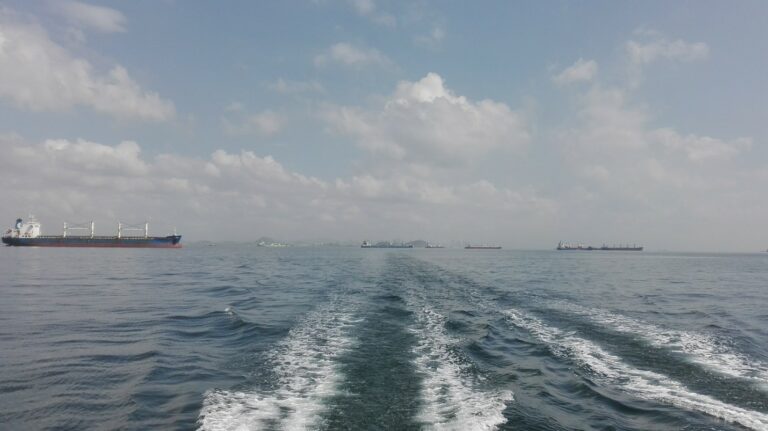
Cargo ships await transit at the Pacific entrance to the Panama Canal, taken from a boat heading to Taboga Island, near the Amador Causeway. Photograph by and courtesy of Raiza Erlenbaugh.
The US entered a pattern with Panamá that became all too familiar throughout Latin America. It supported, two dictators—Omar Torrijos and his successor, Manuel Antonio Noriega—and their policies forced Panamanians to leave the country, either in fear or through outright exile.
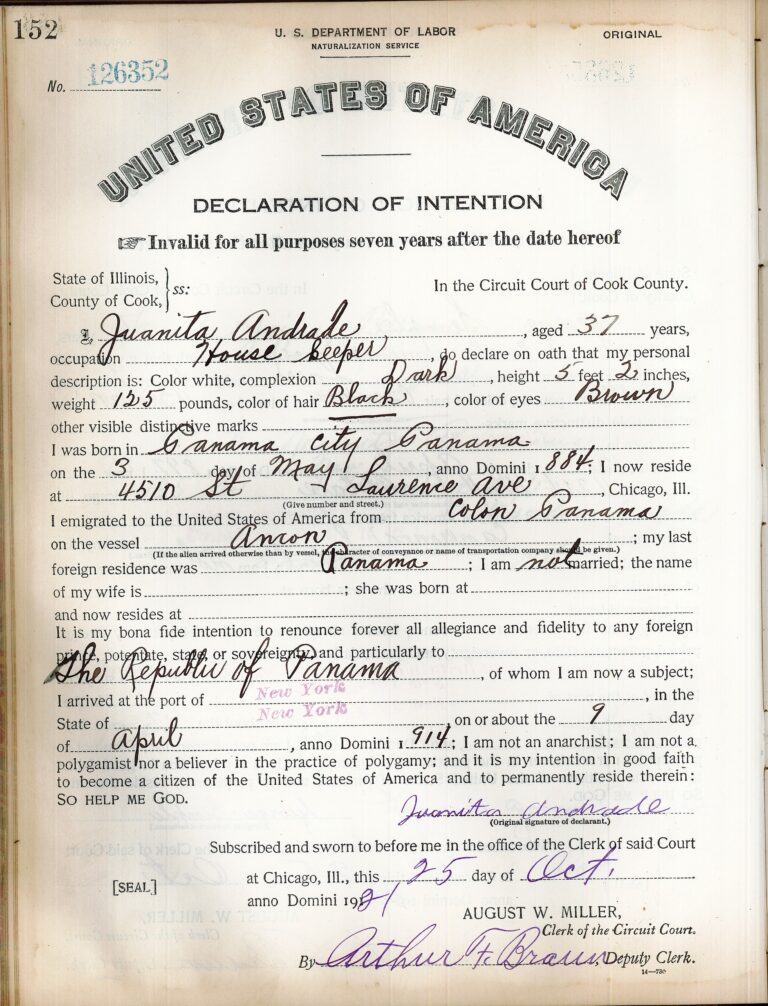
Naturalization certificate of Juanita Andrade, a housekeeper from Panama, 1914. Courtesy of the Archives of the Circuit Court of Cook County.
This is why, as Chrystal put it, “many Panamanians moved to Chicago more than 50 years ago and have children and grandchildren born and raised here. There is also a newer wave of residents who have arrived in the last five years seeking better opportunities.”
Chrystal was inspired to create an account to bring Panamanian Chicagoans together after seeing Panamanian events across the US on Instagram. When she met Alejandra, who was reposted on “Panameñas en el Extranjero,” they decided to launch the page together. Currently, there is no major public event in Chicago that fully represents Panamanian culture, aside from smaller family picnics and private gatherings. Chrsytal’s goal with this project is to build something larger to showcase our community to the city.
We asked Chrystal if there is Panamanian dish that every Chicagoan should try, and she responded, “Out of everything?!” But arroz con pollo and ensalada de papas are her “go-to.”
When we asked her if there were any prominent Panameños in Chicago she would like to highlight, she responded:
“Unfortunately, unlike other Latino groups, second-generation Panamanians often lose connection with the culture due to the lack of local representation. This inspired me to start a new initiative called ‘Panameños en Chicago la están botando’ (Panamanians in Chicago area killing it!) to highlight our presence.”
For example, Sarah was born and raised on the South Side to Panamanian parents. She leads a nonprofit organization dedicated to supporting victims of domestic violence called Yo Soy Ella.
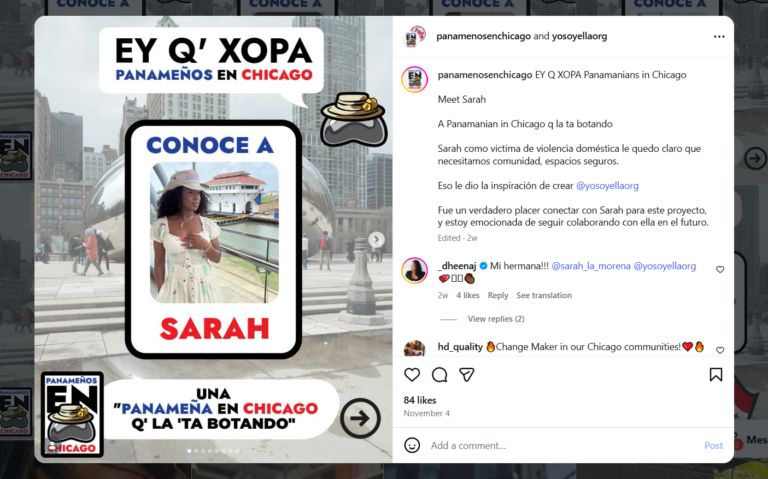
Screenshot from Panameños en Chicago: Panameños en Chicago q’ la ‘ta botando series featuring Sarah from Yo Soy Ella.
Panamá celebrates four national holidays in November, each marking a different historical event: the 3rd (separation from Colombia in 1903), the 5th (consolidation of the separation from Colombia in 1903, also known as Colón Day), the 10th (First Cry of Independence in Villa de Los Santos in 1821), and the 28th (independence from Spain in 1821).
¡Felices fiestas patrias!
Further reading
- Laura E. Gómez, Inventing Latinos: A New Story of American Racism (The New Press, 2020)
- Cristina Hernríquez, The Great Divide (Ecco Press [HarperCollins], 2024)