

In this blog post, Gladys De La Torre, a Kichwa cultural organizer and writer, writes about Pawkar Raymi, one of the most significant celebrations of the Andean peoples, and the Mushuk Nina ceremony, which take place at the spring equinox. Our exhibition, Aquí en Chicago, features objects from the Kichwa Otavalo community.
Read the original post in Spanish./Leer este post en español.
The great celebrations of the Andean peoples originate from the profound observations of changes occurring in Pachamama, or Mother Earth. Based on this ancestral knowledge, specific times of the year are recognized as periods of transformation, renewal, and gratitude, influenced by nature’s cycles and its relationship with the sun. This knowledge has been passed down from generation to generation as part of a living collective memory. These periods were also linked to cycles of planting and cultivation, as the Indigenous peoples organized their lives in relation to the rhythms of Earth and the observation of the sun.
Within this context is Pawkar Raymi, one of the most significant celebrations of the Andean peoples, especially the Kichwa communities. The word “pawkar” refers to blossoming, abundance, and the moment when life springs forth anew with strength. This time marks a period of renewal that is expressed both in nature and in community life.
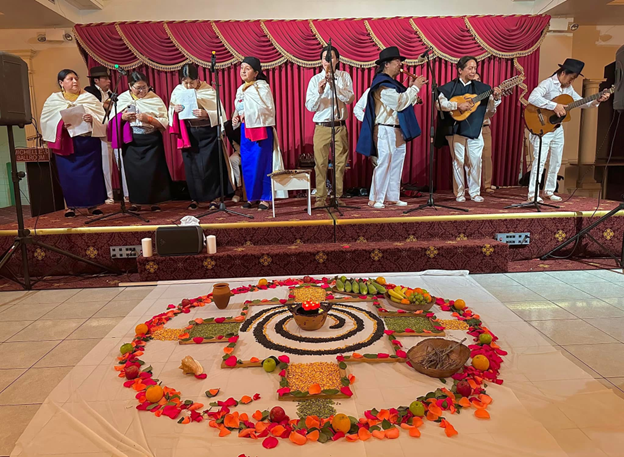
During this time of renewal, the Mushuk Nina ceremony, which translates to “new fire,” is also performed. Mushuk Nina represents the ritual lighting of a fire that symbolizes new beginnings, purification, and the continuity of community life.
These celebrations are symbolically linked to March 21, or the spring equinox, a moment when day and night are in balance. The equinox is the time of year when day and night are of equal length because the sun is positioned directly over Earth’s equator. This phenomenon marks the changing of the seasons and has been observed by Indigenous peoples as a sign of renewal, planting, and balance with nature.
Over the past decade, the Kichwa Otavalo community in Chicago has held Mushuk Nina ceremonies as part of their cultural continuity practices. Through community gatherings, the symbolic lighting of the fire becomes an act of reaffirming their identity, involving families, elders, youth, and children, and strengthening the transmission of ancestral knowledge for this migrant community.
In the Indigenous worldview, Pawkar Raymi and Mushuk Nina can be understood as practices that mark cycles of time, allow for the collective expression of processes of renewal, and strengthen the social and spiritual bonds that sustain community life. These ceremonies not only accompany cycles of nature but also reinforce collective memory and a sense of belonging.
For the Kichwa Otavalo communities living in the diaspora, these practices take on an even deeper meaning. Celebrating far from our ancestral territory is a way to keep our identity alive, transmit knowledge to new generations, and reaffirm that culture is not limited to a geographical space but lives within people and the community. In Chicago, a place with many migrants, this flourishing doesn’t always occur in the land itself, but rather in community ties, collective organization, and shared memory.
“Pawkar kawsayta apamun, mushuk nina yuyayta kawsachin.” (Blossoming brings life, and new fire rekindles memory.)