

Each January 1, Haitians and the Haitian diaspora celebrate Haiti’s Independence Day, which commemorates its declaration of freedom from France. From 1791 to 1804, enslaved people staged the successful revolt that made Haiti a free Black republic and the first independent nation in Latin America. As part of Aquí en Chicago, we are inaugurating a new series of blog posts on Latin American heritage. Ben Henderson, our guest author of the Haitian American Museum of Chicago writes about the Haitian community in Chicago.
Tell us about the Haitian community in Chicago. How big is it? How long have Haitians lived here?
Haitians have always been a part of Chicago’s story and key to the city’s founding. French frontiersmen brought the first Haitians to Illinois. These people were enslaved in Haiti (then called St. Domingue) in the 1720s to work in lead mines, likely making them the oldest Black community in the state.
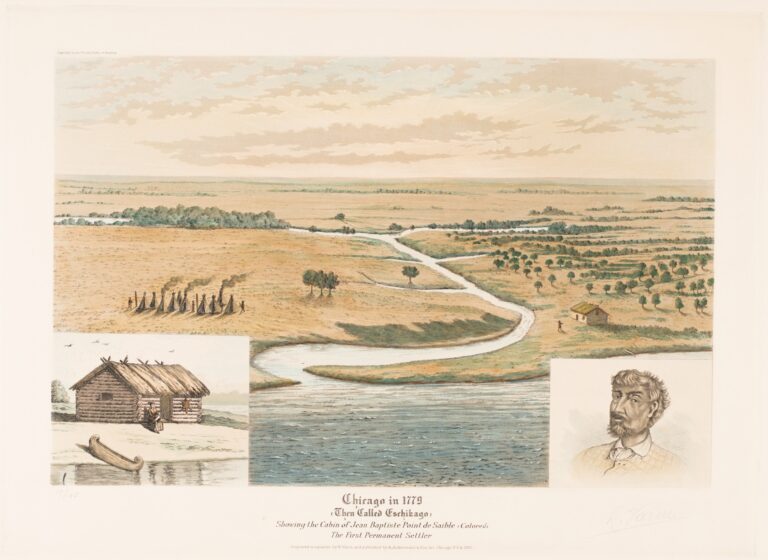
Engraved view of Chicago in 1779, including the cabin of Jean Baptiste Pointe DuSable and his portrait, c. 1926–32. Published by A. Ackermann & Sons Inc. CHM, ICHi-005623; Raoul Varin, artist
Around 1779, Jean Baptiste Point DuSable, a Haitian immigrant and trader, became Chicago’s first permanent non-Indigenous resident when he established his trading post on the mouth of the Chicago River. He lived there until 1800 alongside his Potawatomi wife, Kitihawa, and their two children. After becoming a state in 1818, Illinois attempted to discourage the emigration of Black people through the Black Laws (1819–65), which denied them fundamental freedoms and discouraged migration.
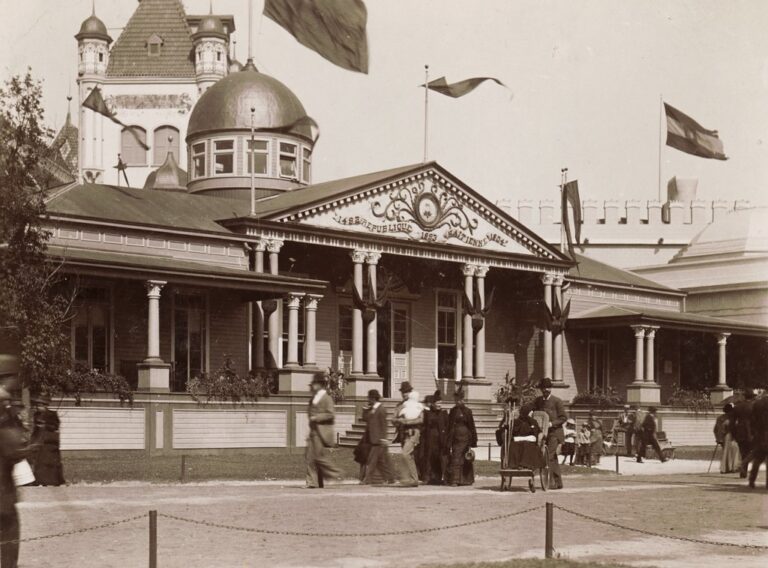
The Haitian building at the World’s Columbian Exposition, Chicago, 1893. Frederick Douglass, who represented Haiti at the fair, used the visibility of his position, as well as the building’s meeting and office facilities, to continue his advocacy of equal rights and his efforts to call attention to the inequities faced by people of color in the US. CHM, ICHi-040687
Haitian immigration to the United States picked up again in the late 20th century due to the Duvalier dictatorship, and the population grew from 92,000 in 1980 to 731,000 in 2022, according to the Migration Policy Institute. Today, around 40,000 self-reported Haitians have settled in Chicago, according to data from the General Consulate of Haiti in Chicago.
Is there an activity/location related to the Haitian community that every Chicagoan should experience?
Two main venues that the residents of Chicago should know about within the Haitian community are the Haitian American Museum of Chicago (HAMOC), in Uptown and Room43 in Bronzeville. HAMOC is one of two Haitian museums in the US (along with the Haitian Heritage Museum in Miami). The museum’s mission is to promote and preserve Haitian art, culture, history, and community in Chicago and beyond.
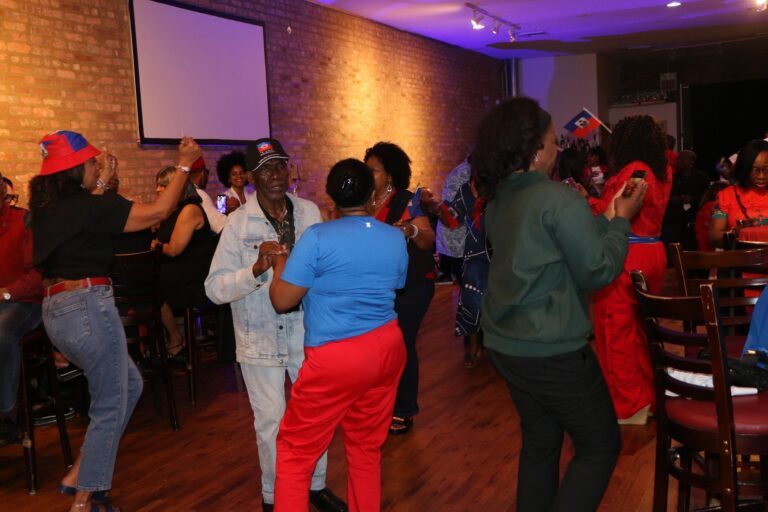
Attendees at a Konpa Sware dance night at Room43. Courtesy of HAMOC
At Room43, every third Thursday of the month from 7 to 11 p.m., HAMOC, in partnership with DJ Frantz, hosts a Konpa Sware dance night. Konpa is a contemporary genre of music and dance of Haiti. This event is open to all Chicagoans to learn about Konpa and enjoy a night of community. The event is sponsored by Norman Bolden, a businessman, friend of HAMOC, and owner of Noman’s Bistro and Room43.
Is there a food/meal/dish related to the Haitian community that every Chicagoan should try?
Haitian cuisine derives from a combination of cultures. Similar to other Caribbean and Kreyol cuisines, Haitian food makes heavy use of herbs and spices, known as epis and pikliz. Popular foods include pastries with stuffed meat called pâté, red beans and rice, and a historical and cultural soup, called soup joumou (squash soup). In 2021, the United Nations Educational, Scientific and Cultural Organization (UNESCO) added soup joumou to the Representative List of the Intangible Cultural Heritage of Humanity.
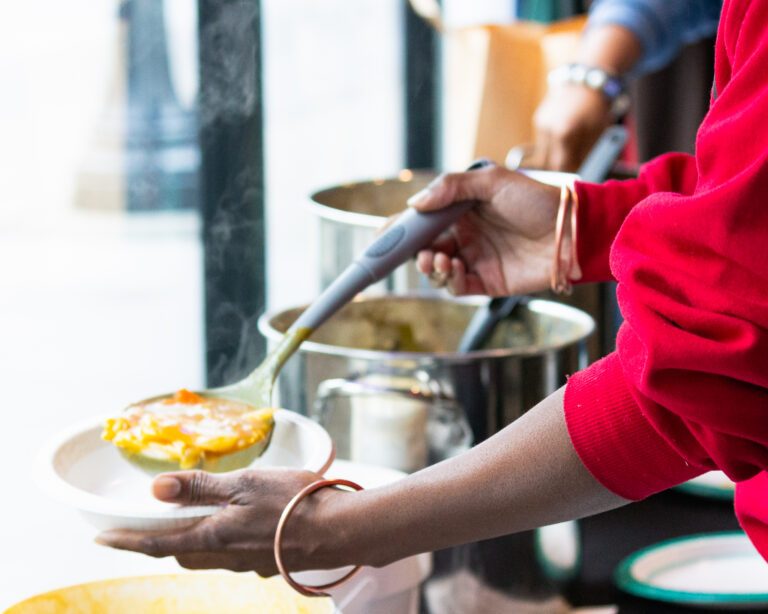
A diner ladles soup joumou into a bowl. Courtesy of HAMOC
This soup is typically served on January 1 to honor Haitian Independence Day of 1804. To have a taste of Haitian cuisine, including soup joumou, visit the two Haitian restaurants in the Chicagoland area—Kizin Creole, in West Ridge on the North Side and Lior’s Cafe in Washington Heights/Roseland on the South Side.
Is there a prominent person in the Haitian community you would like to highlight?
The attorney general of Illinois, Kwame Raoul, who was raised in the Hyde Park community area, is the son of Haitian immigrants. Prior to becoming attorney general, Raoul was appointed to the Illinois Senate seat that former President Barack Obama previously held. Raoul remains active in civic organizations, including the Haitian American Lawyers Association of Illinois, reflecting his deep ties to both the Chicago and Haitian communities.
Additional Resources
- View the Digital Chicago project “Spaces and Stories: Haitian Churches and Oral Histories in Chicago”
- Purchase Elsie Hector Henandez, Haitians in Chicago (Images of America), Dover, NH: Arcadia Publishing, December 30, 2025.