

Categories: Politics and Civics
Tags: US Civil War

The Grand Army of the Republic

By: Robert Blythe
May 26 2017

CHM collections volunteer Robert Blythe details the history and contents of the Grand Army of the Republic, Department of Illinois records in our Research Center.

During the Civil War, some 2.7 million men served in Union blue from 1861 to 1865. To preserve their bonds of comradeship and ensure that veterans and their families received sufficient care, many of these men joined the Grand Army of the Republic (GAR). The organization was both a fraternal order, similar to the Elks or Odd Fellows, and a potent lobbying force on veterans’ issues. The GAR took on a military structure with hundreds of local posts that were organized into departments embracing one or more states.
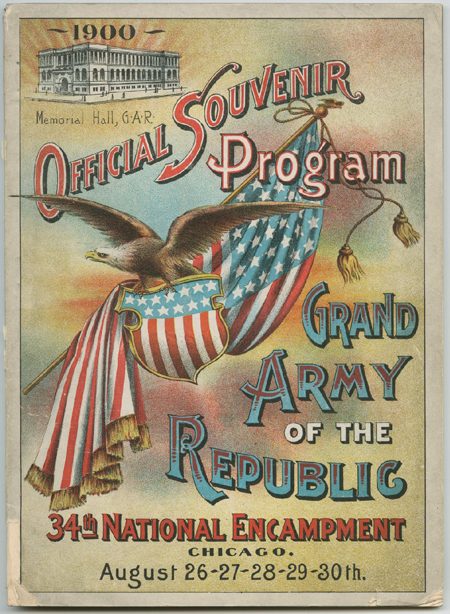

The cover of the souvenir program for the 34th National Encampment, 1900. CHM, ICHi-76897

The departments sent representatives to an annual national encampment, which was the governing body of the organization. Records of a number of the Chicago GAR posts are preserved at the Chicago History Museum in the Grand Army of the Republic, Department of Illinois records.
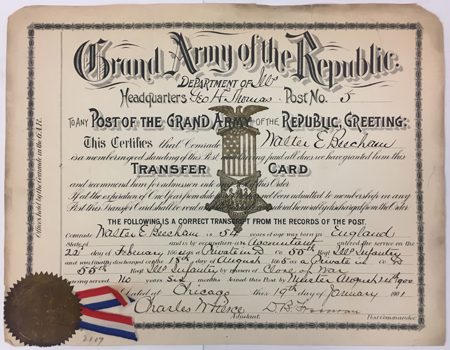

A certificate of transfer from the GAR, Department of Illinois records, box 10, folder 2

Many of the records discuss mundane matters, such as dues payments, transfers from one post to another, and meeting arrangements, but among the most interesting items are correspondence files from one of the largest posts, the George H. Thomas Post. Many letters are from veterans who had fallen on hard times and needed help. Relief work among veterans and their families was a major commitment of the GAR, as they provided food, coal, free medical care, and cash payments in emergencies. Much of this work was carried on by a GAR auxiliary group, the Women’s Relief Corps.
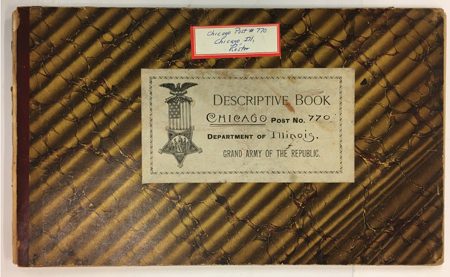

A log recording the activities of Post 770. GAR, Department of Illinois records, box 1

The GAR was likely one of the only integrated national organizations in the last third of the nineteenth century. Close to 200,000 men of color had served in the federal army, and many black veterans were welcomed into predominantly white posts, including some in Kentucky and Maryland. Segregated posts were the rule in the Deep South, however, and some northern posts kept blacks out because a handful of post members could reject an applicant in a secret ballot. The bond between white Chicago veterans and the freed people of the South is revealed in correspondence between the George H. Thomas Post and Claflin College (now Claflin University). The post provided new American flags to this historically black institution, which proudly flew them over the soil of South Carolina.
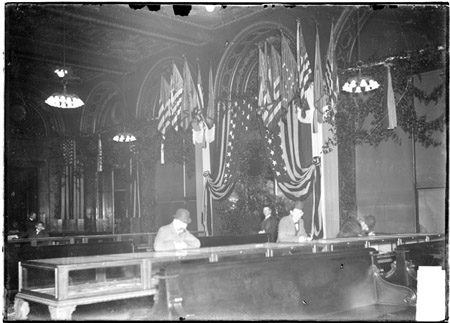

The GAR Memorial Hall, c. 1903. CHM, DN-0000327

A reminder of the GAR presence is the Memorial Hall in the Chicago Cultural Center (formerly the Chicago Public Library). This imposing hall, dedicated in 1897, was meant to serve as a commemorative museum honoring all Illinois Civil War veterans and a meeting space for GAR members. More information on the hall and the GAR in Chicago can be found in Robert I. Girardi’s article “Remembering the Grand Army of the Republic” in the winter 2015 issue of Chicago History magazine.

Reading the letters of Chicago’s Civil War veterans at the Chicago History Museum truly brings home to present generations their deep loyalty to the nation that they helped to save.

Join the Discussion

Leave a Reply

Your email address will not be published. Required fields are marked *

5 × two =

Jon LippOctober 28, 2024 at 04:24 pmHave commemorative medal awarded to my uncle as Department Commander, Galesburg May 4-6, 1897. 31st annual encampment.
Mary MortonOctober 28, 2024 at 04:25 pmVery interesting information. The GAR Hall is beautiful, even today. Reading about its past makes it even more special. Thanks for the post.
Gene MeierJune 2, 2025 at 07:02 amI am writing the exhibition record from the American point of view about 19th century rotunda panorama, the biggest paintings in the world, 50 x 400=20,000 square feet, housed in their own rotundas which were 16-sided polygons. Chicago in 1893 had 6 panorama companies and 6 panorama rotundas.PANORAMA PLACE, Wabash and Hubbard Court[later Balbo]contained the BATTLE OF GETTYSBURG [on view October 1883-1895] and a second rotunda that had rotating panorama exhibits. On September 18,2003 I found in the display case of Milwaukee County History Museum the F.W.Heine diaries, which commence 1860 and conclude upon Heine's death 1921. These are the only known narrative of a panorama studio, that of William Wehner of Chicago-Milwaukee. From 1885-88 Wehner produced 2 units of BATTLE OF ATLANTA,2 units of BATTLE OF MISSIONARY RIDGE and 3 units of JERUSALEM ON THE DAY OF THE CRUCIFIXION. The diaries needed to be transcribed in German,translated to English, scanned to computer. LONG STORY SHORT: the G.A.R.in the 1880s was domiciled in the BATTLE OF GETTYSBURG panorama , and the L.G.A.R [Ladies of the Grand Army of the Republic] were domiciled in the second rotunda, across the street from GETTYSBURG. This info is revealed in the F.W.Heine diaries. [NOTE: a third rotunda stood on Michigan between Madison and Monroe that contained the BATTLE OF SHILOH in the 1880s, and in the 1890s the CHICAGO FIRE CYCLORAMA]
Gene MeierNovember 19, 2025 at 07:09 amPanorama Place (Wabash & Hubbard Court, later Balbo) featured BATTLE OF GETTYSBURG (on view 1883-1895) and BATTLE OF MISSIONARY RIDGE & LOOKOUT MOUNTAIN in the 1880s. Offices for the G.A.R. were in the BATTLE OF GETTYSBURG cyclorama building(including a museum), and the LADIES of the G.A.R. had an office across the street in the MISSIONARY RIDGE panorama building. Documentation comes from the F.W.Heine diaries, which I discovered in the display case of Milwaukee County History Museum September 18,2003.These are the only known narrative of a panorama company, that of William Wehner (1847-1928) of Chicago-Milwaukee and later Santa Clara County, California.The diaries needed to be transcribed in German, translated to English, scanned to computer.Michael Kutzer(1941-2024), an artist who studied under his father, learned Greek and Latin, studied classic literature and learned German Handscrift, which went out of style in the 20th century.Michael did not have a German language understudy in Milwaukee, but I served as his English language understudy here in Sycamore, Illinois. For 20 years Michael transcribed years 1980-1894,providing exquisite German typed transcription and English language synopsis. Michael died last New Years Eve.I would like to find someone to continue Michael's work and complete years 1895-1921 of the F.W.Heine diary project.THERE IS MORE TO THIS GAR and LGAR STORY THAN APPEARS AT THE GAR ROOM IN PRESENT DAY CHICAGO CULTURAL CENTER WHICH HAS NOT BEEN DOCUMENTED UNTIL NOW
Translate »