
As we recognize US at 250 at the Chicago History Museum, CHM director of exhibitions Paul Durica shares the memorable but exaggerated life of David Kennison, whose story connects Chicago (and CHM) to the American Revolution.
Chicago’s connection to the American Revolution achieved physical permanence with the dedication of a granite boulder on the western edge of Lincoln Park in December 1903. A plaque set within the stone identified the ground below as the final resting place of David Kennison, whose body had been left behind when so many others had been disinterred in the 1860s as a city cemetery transformed into the public park we have today.
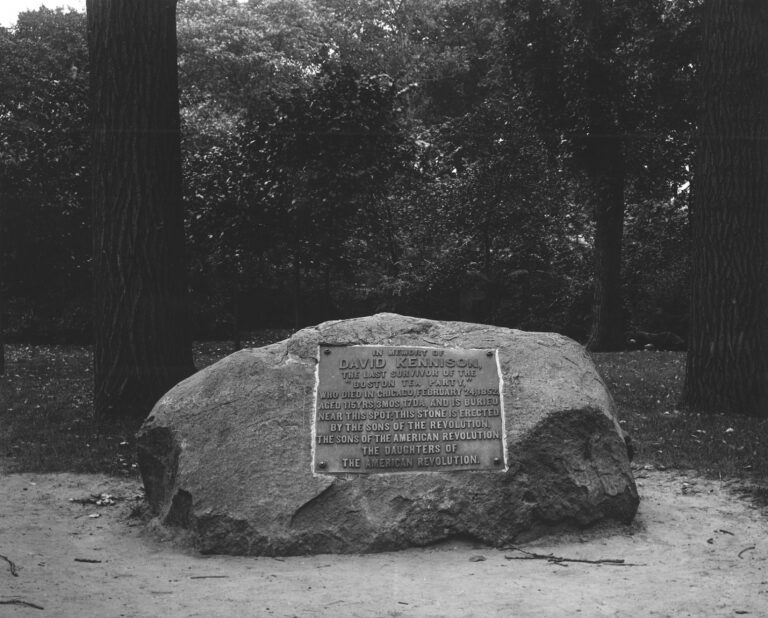
David Kennison memorial boulder in Lincoln Park, Chicago, c. 1909. CHM, ICHi-040901
Who was David Kennison? Why did organizations like the Sons and Daughters of the American Revolution see fit to fund the placement of this large boulder? Back in late February 1852, the large crowd that had gathered at that same spot, or close to it, for a military funeral, paid for by the city, knew the man and why he should be memorialized.
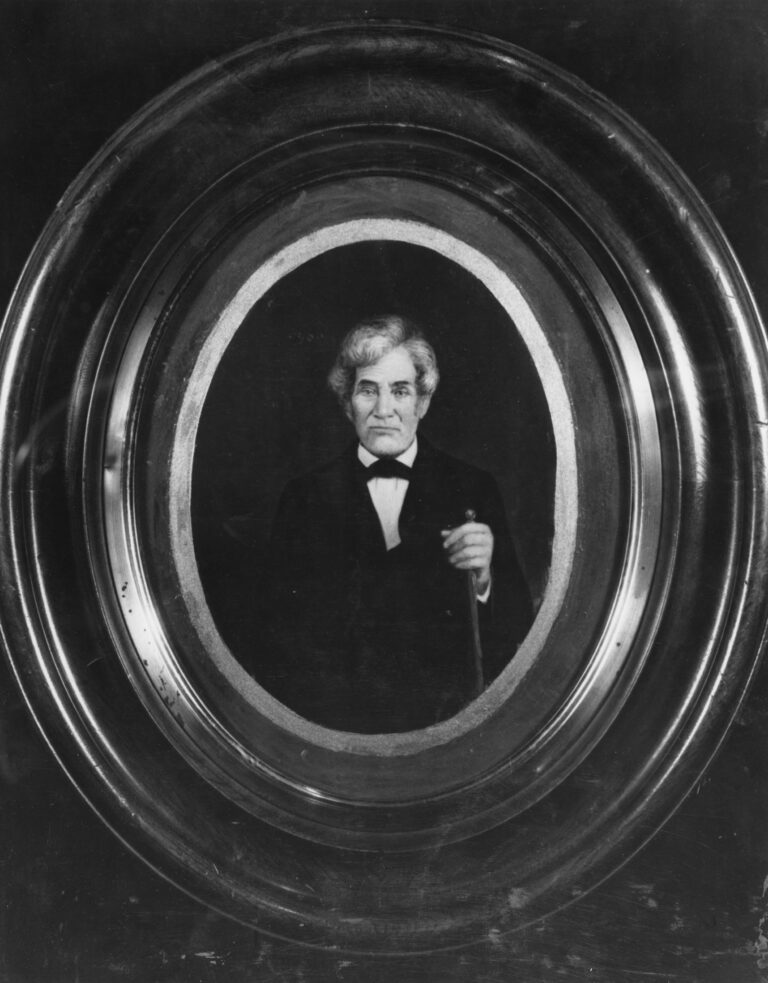
Portrait of David Kennison. The donor received this portrait from her grandfather, Dr. Aaron Gibbs, an early physician of Chicago, who was one of the chief benefactors of Kennison. CHM, ICHi-030498
Until his passing at the improbable age of 115, Kennison had been the last surviving participant in the Boston Tea Party. He had served with distinction in the American Revolution and the War of 1812, when he’d happened to be stationed, for a time, at Fort Dearborn, the military base around which Chicago grew.
His life connected the creation of the country to what was surely destined to become its largest, most important city. Everyone in 1852, it seemed, believed this. Anyone who left an account of the early years of Chicago in the archives of CHM mentions Kennison and his funeral.
He had lived in the city for seven or so years before his passing, surviving on a modest pension from service in two wars, supplementing it with odd jobs. In 1848 he began to work for a P. T. Barnum-esque museum on Lake Street where he told his life story to visitors. He also took out an advertisement in a newspaper in November of that year, around the time of what he said was his 112th birthday, asking the public to attend on that day and provide the aged veteran with whatever they thought appropriate.
In 1848 the Illinois and Michigan Canal opened; the first railroad arrived; the Board of Trade formed. What better time for Chicago to reflect upon the glories of the past when future greatness seemed ensured?
That November Kennison had a relic of sorts to share alongside his story. Before five witnesses, in a signed statement, he pledged upon his “sacred honor” that the “tea in this [glass] vial” he now produced contained “a portion saved . . . from cargoes thrown into the sea from ships in the early evening of the 15th of November in the year 1773.” That he got the date of the Boston Tea Party wrong was of little matter—he was 112, after all, and could be forgiven such a small error.
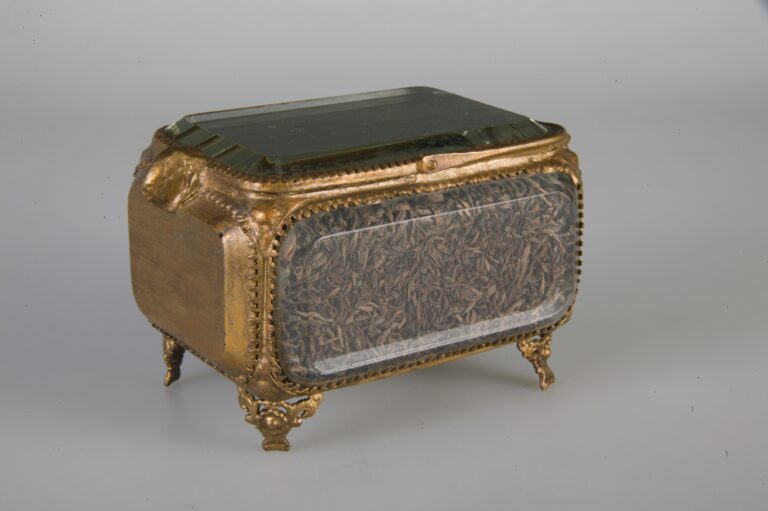
Kennison’s brass tea caddy that supposedly contains tea leaves from the Boston Tea Party. CHM, ICHi-066833
Among the five witnesses was Fernando Jones, an early resident of the city, who decades later helped identify Kennison’s final resting place in Lincoln Park. Jones helped get the memorial boulder placed there and donated that vial of Boston Tea Party leaves, as well as the affidavit signed by himself and the other witnesses, to the Chicago Historical Society.
The details of Kennison’s life can be traced to two sources, the above-mentioned November 1848 newspaper advertisement and other articles that appeared in the same paper, the Chicago Democrat, and The Pictorial Field-Book of the American Revolution from 1850.
The book’s author, illustrator, and amateur historian Benson J. Lossing had traveled across the United States collecting firsthand accounts of the American Revolution from those who’d lived through it. Despite taking great care in his research, Lossing appears to have found Kennison’s story credible. It would be repeated in countless newspaper and magazine stories well into the 20th century and become part of Chicago lore.
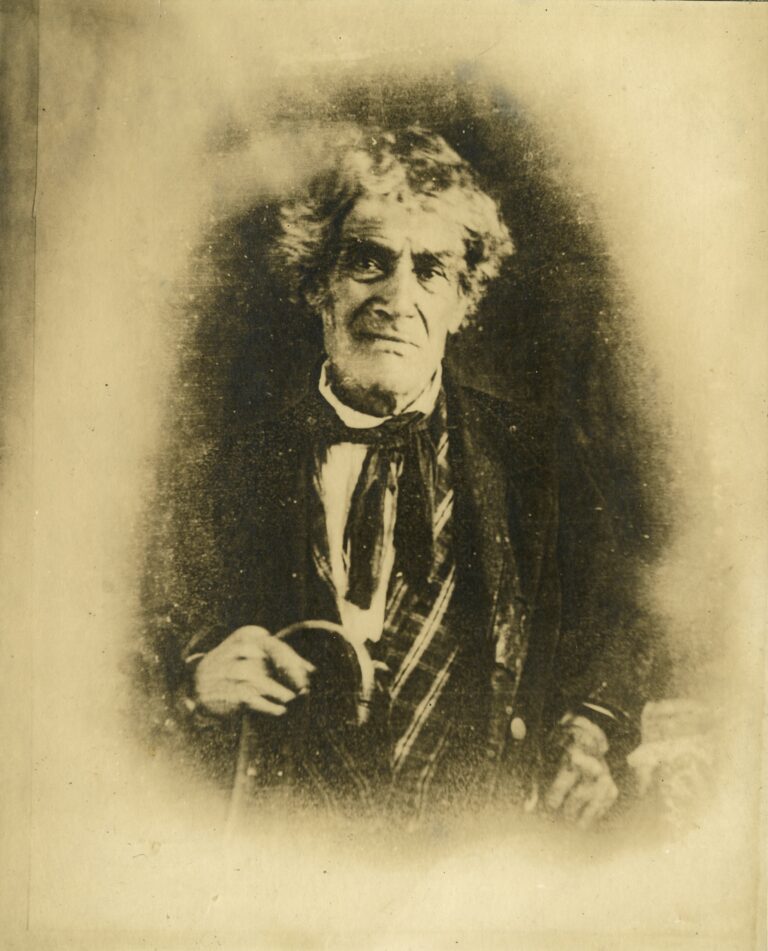
Undated daguerreotype of Kennison. CHM, ICHi-040899
Kennison claimed to have been born in 1736 in present-day Maine. A poor, manual laborer, he found common cause with the American patriots fighting for the equality of all men. After taking part in the Boston Tea Party, Kennison fought in seemingly every significant battle in the American Revolution from Lexington through Yorktown. When hostilities with Great Britain broke out in 1812, he enlisted again, despite being in his 70s, and received a wound from which he never fully recovered. Barely surviving on his pensions from service in two wars, he arrived in Chicago having passed the century mark, where he became a valuable member of the community, a link to the nation’s past.
The Museum acquired its copy of Lossing’s Field-Book in August 1914. In late July of that year, Dr. Charles J. Lewis gave a talk entitled, “David Kennison: The Last Survivor of the Boston Tea Party,” before the Borrowed Time Club, a group whose membership was restricted to those over 70, in Oak Park. In the talk, Lewis questioned Kennison’s story.
As a doctor, Lewis valued facts, so he wrote to various government agencies to learn more about Kennison’s pensions and military service. The records he received indicated that Kennison had attempted to enlist when he was about 17 in 1780 but had been denied on account of his size. The records suggested that he was born around 1764 and, thus, would have been about 9 at the time of the Boston Tea Party, too young to have participated. He did serve in the War of 1812, but he lied about his age—in his late 40s, he was too old—when he enlisted. Rather than 115, he was likely in his late 80s when he died in Chicago.
An Oak Park paper covered Lewis’s talk, but otherwise its typed pages in CHM’s collection were ignored. In the early 1970s, Albert G. Overton followed a similar line of research and reached the same conclusion as Lewis. Even then, the legend of Kennison persisted well into the 21st century, his memorial boulder in Lincoln Park becoming a rallying point for various self-proclaimed patriots opposing perceived governmental overreach.
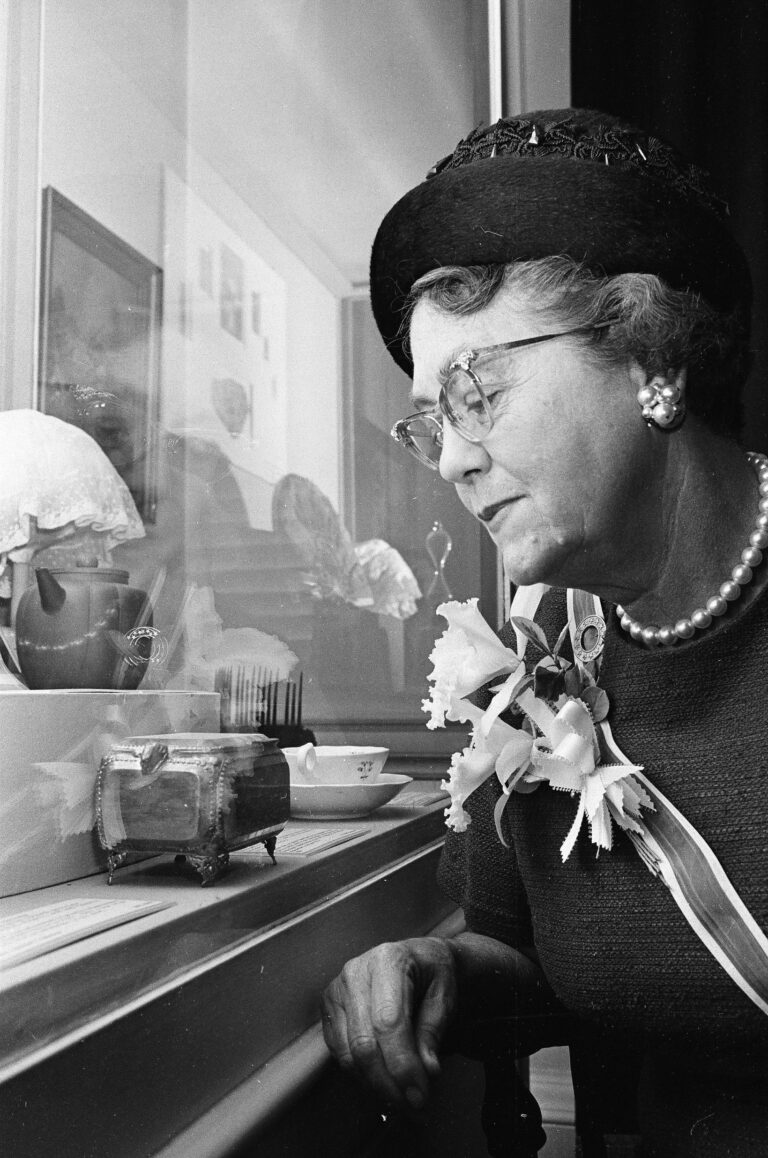
The tea caddy was on display in the then Chicago Historical Society, September 17, 1964. It was on display again in the 1987 exhibition We the People: Creating a New Nation 1865–1920. ST-19031900-0003, Chicago Sun-Times collection, CHM
“I think that the people in Chicago when he came here were so anxious to be connected to this great national event, to have this real Revolutionary War hero living in their midst, that that they wanted to believe this person,” said the late Russell Lewis, then the director of collections and research at CHM, in a Chicago Tribune story responding to the Tax Reform Coalition protesting at Kennison’s memorial in 2003. “And I think there are a lot of people today that still don’t want to believe that he was a fake.”
Charles Lewis was kind to Kennison’s memory in the conclusion of his talk in 1914. Kennison may not have been part of the Boston Tea Party or have served in the Continental Army, Lewis concluded, but he did live through that period of American history and had attempted to fight for his country while still a teenager. As an older man, when the opportunity arose again in 1812, he lied in order that he might take part in the nation’s defense. His personal deceptions in many ways mirrored the willful blindness of his adopted home, Chicago—both seem to have arisen from a very human desire to be part of something larger than oneself, of something meaningful and memorable.
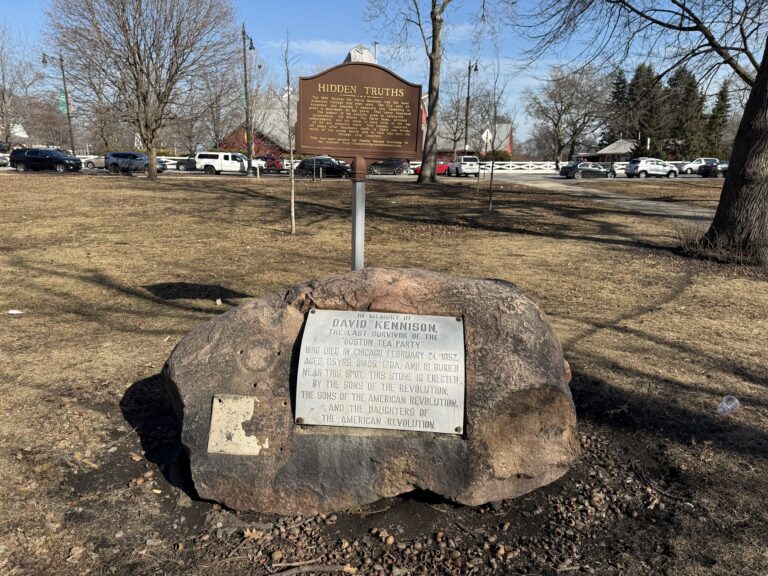
The boulder honoring David Kennison, 2026. Photograph by CHM staff
And if Lossing is to be believed, Kennison used the public belief in his story to draw attention to the unfinished business of the American Revolution. “At a public meeting, in the summer of 1848, of those opposed to the extension of slavery,” Lossing writes. “Mr. Kinnison [sic] took the stand and addressed the audience with marked effect. He declared that he fought for the ‘freedom of all’ . . . and closed by exhorting his audience to do all in their power to ABOLISH SLAVERY.”
Sources
- Clarence R. Bagley Papers, February 8–March 6, 1922, Chicago History Museum
- Lester Curtis Papers, 1935–1947, Chicago History Museum
- Rex W. Huppke, “Con Man Became City’s Hero,” Chicago Tribune, August 31, 2003, N_A1
- David Kennison Papers, 1848–1852, Chicago History Museum
- Charles Josiah Lewis, “David Kennison: The Last Survivor of the Boston Tea Party,” read at Oak Park, IL, July 30, 1914
- Benjamin John Lossing, The Pictorial Field-Book of the Revolution (New York: Harper & Bros., 1859 [c. 1850])
- A. E. Ormes, “Chicago’s Revolutionary Hero,” Chicago Magazine, vol. 2 (Sept. 2011): 594–97
- Albert G. Overton, “David Kennison and the Chicago Sting,” typed manuscript in collections record, Chicago History Museum.
- Alexander S. Prentiss Letter, 1852 Feb 25, Chicago History Museum
- Scrapbook of Clippings on David Kennison, Chicago History Museum
- William Hay Williamson, “David Kennison Spills a Ship of British Tea,” Chicago Today, vol. 2, no. 2 (Jan. 1928)