


On May 27, 1933, the second world’s fair set in Chicago opened to colorful fanfare in the midst of the Great Depression. In this blog post, Paul Durica, Director of Curation and Exhibitions at CHM, writes about the circumstances of the A Century of Progress International Exposition and how planners sought to make it different from the first world’s fair.
On a cloudy evening in late May 1933, starlight lit up the lakefront in Chicago. Forty years had passed, it was believed, since the light had emanated from the star Arcturus in the constellation Boötes and arrived on photoelectric plates at four observatories where the weak current it generated would be amplified and then sent, via telegraph wires, to the nation’s second largest city. The four decades separating the light’s departure and its arrival served a purpose, which was to remind those in the present that in 1893 Chicago had hosted a world’s fair, the World’s Columbian Exposition, in Jackson Park, on the South Side of the city.
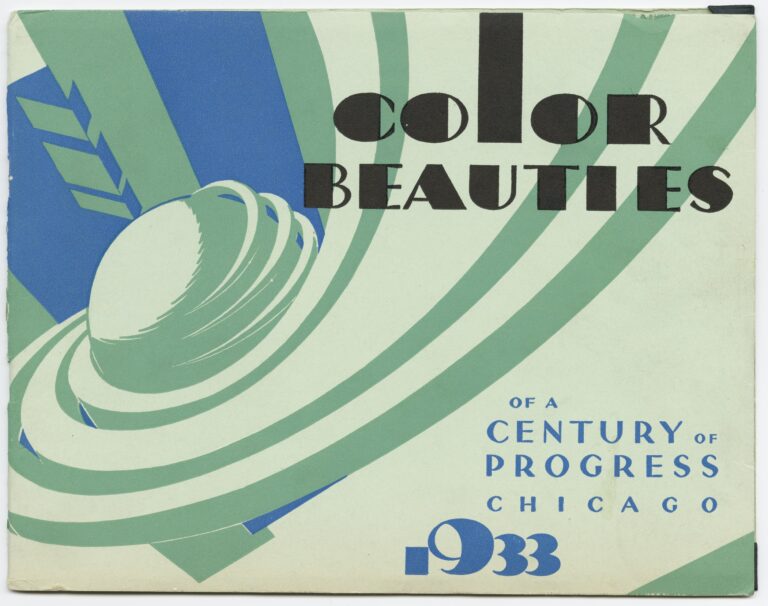
The front cover of Color Beauties of A Century of Progress Chicago 1933. CHM, ICHi-073747. A stylized drawing of the star Arcturus appeared on several A Century of Progress souvenirs, such as this pamphlet.
The 1893 fair had as its core 14 immense neoclassical structures painted a blinding white. Now, farther north but still along the lakefront, stood another cluster of large buildings, sleek and modern. There was another key difference, made clear when the light from the star Arcturus arrived at 9:15 p.m. on that evening of May 27. One by one, accompanied by the singing of the national anthem, the blasting of cannons, and the pealing of bells, the sleek and modern buildings became bathed in electric light, a rainbow of colors. The White City of 1893 receded into the past. In 1933, the A Century of Progress International Exposition, the city’s second world’s fair, opened in a burst of what could only be described as technicolor.
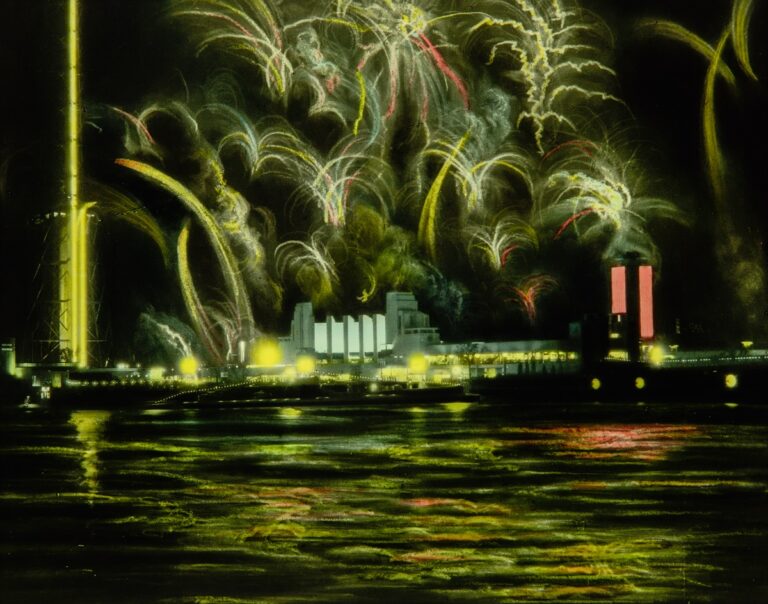
Night view of fireworks above the Sky Ride Tower and Hall of Science at the A Century of Progress International Exposition, Chicago, 1933. This lantern slide was hand-colored by the photographer, Anton Rodde. CHM, ICHi-176028; Anton Rodde, photographer
An opening in which color chased away the clouds fit the purpose of this world’s fair. Outside the fairgrounds, the Great Depression continued to immiserate the people of Chicago and the rest of the nation. The widespread economic collapse that had begun almost four years prior had threatened to cancel plans to mark the city’s centennial, but the planners pressed on, raising enough private funds to produce the fair. Even the assassination of Chicago mayor Anton Cermak in March of that year—an event that eerily mirrored the political murder of Mayor Carter Harrison at the conclusion of the 1893 fair—did not pause the preparations. Instead, Cermak’s ultimate successor, Edward Kelly, turned the event into a kind of memorial to Cermak, his vision for the future of the city.
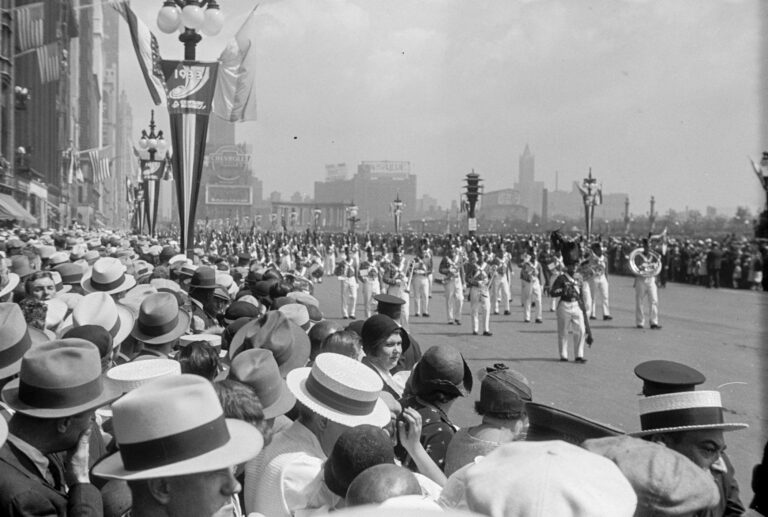
Crowds of people watch a marching band parade down Michigan Avenue at Monroe Street near Grant Park for the opening of the A Century of Progress International Exposition, Chicago, May 27, 1933. CHM, ICHi-167209; O. L. Cook, photographer. Note the Arcturus symbol on the banners.
Earlier that day, a parade along Michigan Avenue had led to the fairgrounds, which encompassed today’s Museum Campus and more, and into Soldier Field, where a formal opening occurred. Wave after wave of representatives of the various nations with pavilions at the fair processed past a reviewing stand upon which stood Mayor Kelly, Illinois governor Henry Horner, president of the fair Rufus Dawes, and US postmaster general James Farley, who came with a message from President Franklin D. Roosevelt. When the black-shirted Italians marched by, they gave the assembled dignitaries a one-armed fascist salute.
Following the international delegations were columns of cadets, soldiers, and veterans. When Black veterans of the Great War entered Soldier Field, separate from their white counterparts, the Chicago Tribune noted they were “heartily cheered.” After them came Lillian Anderson of Racine, Wisconsin, Queen of the Fair, and her court of “fifty ladies of honor,” as selected by readers of the Tribune. Anderson bore medals that she bestowed upon Farley, one for him and one for the absent Roosevelt. Episcopalian bishop George Craig Stewart dedicated the fair with a prayer. The Tribune had observed earlier in the day that the “orators [had promised] to be mercifully brief.” Everyone knew things really would get started when the sun went down.
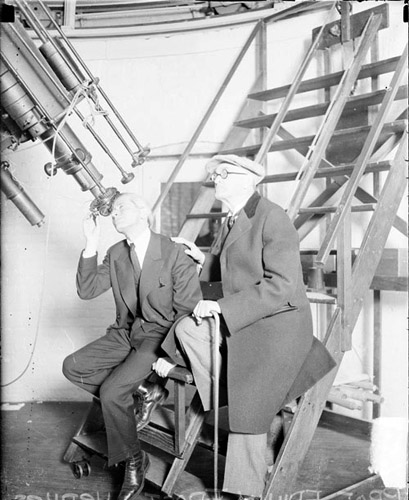
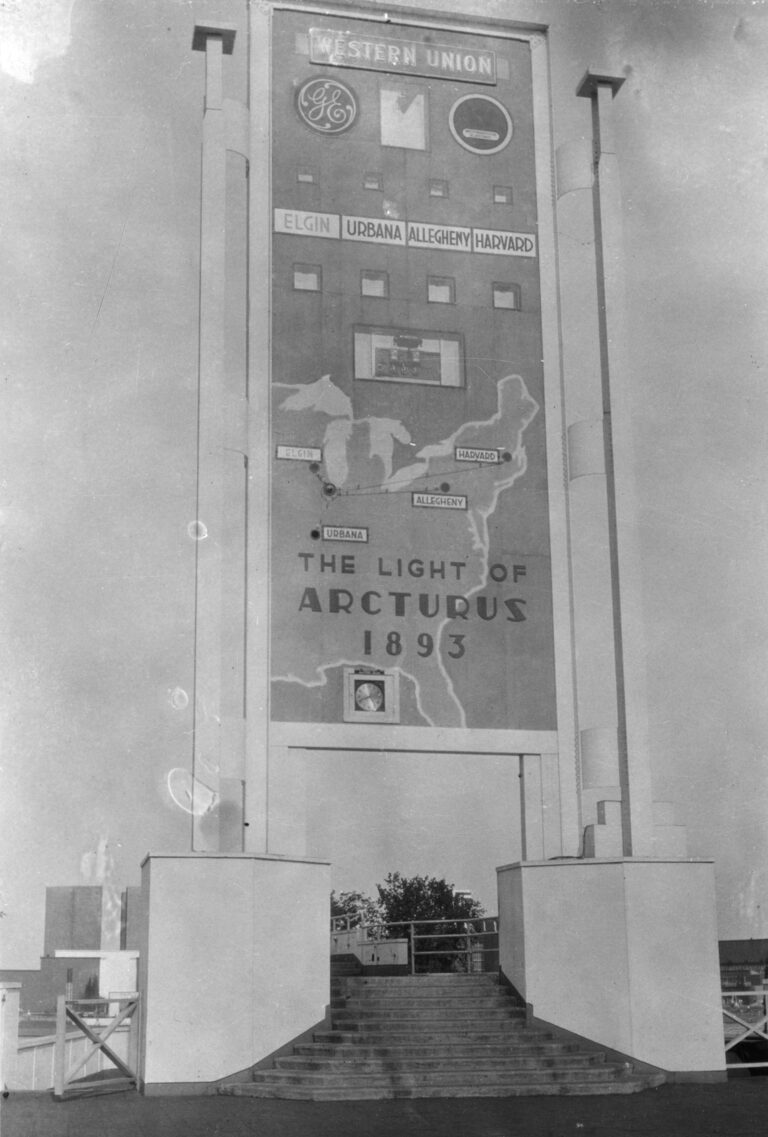
Left: Professor Edwin Frost (right) leaning on stairs next to an unidentified man looking through a telescope in the Yerkes Observatory in Williams Bay, Wisconsin, 1927. DN-0082807, Chicago Sun-Times/Chicago Daily News collection, CHM. Right: The Light of Arcturus board by the Hall of Science at the 1933–34 A Century of Progress International Exposition. CHM, ICHi-038601
Capturing light from the star Arcturus to open A Century of Progress had been the idea of a blind astronomer Edwin Frost, formerly of the University of Chicago’s Yerkes Observatory. He was there, on a platform outside the Hall of Science, when all the lights came on. After explaining the science behind capturing and harnessing the power of starlight, Frost asked the jubilant crowd, “Is this not a fitting demonstration of this century of progress?”
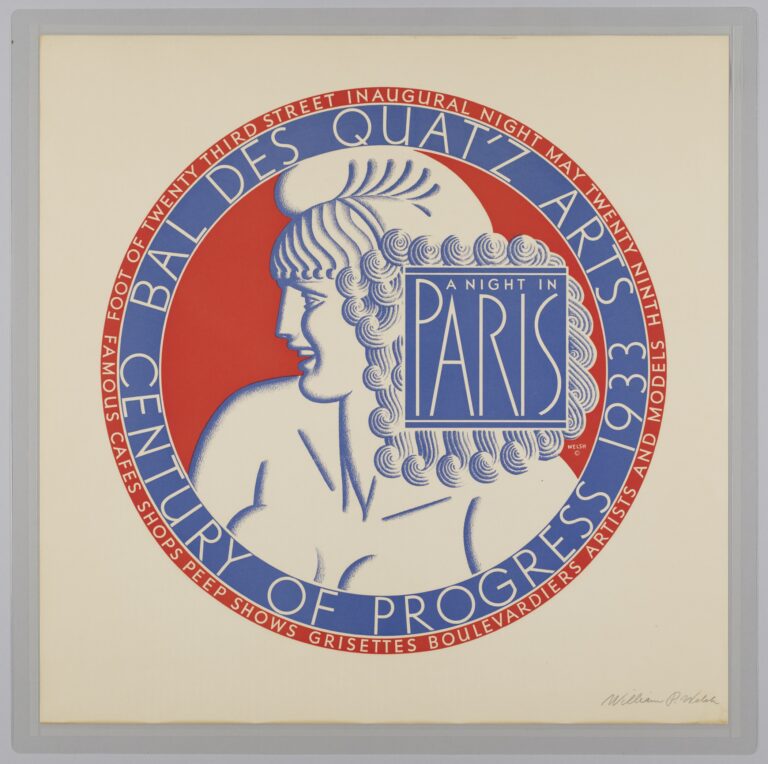
Broadside for A Night in Paris at the A Century of Progress International Exposition, Chicago, 1933. CHM, ICHi-075758; William P. Welsh, artist
After the lighting ceremony, about 3,500 of the city’s elite, many in elaborate costumes, attended the Bal de Quat’z’Arts (Ball of the Four Arts) in the Streets of Paris attraction and celebrated late into the night. They enjoyed beer and wine, now legal again after 13 years of Prohibition. A performer named Sally Rand caused a small stir when nonattired as Lady Godiva she rode a white horse through the crowd.
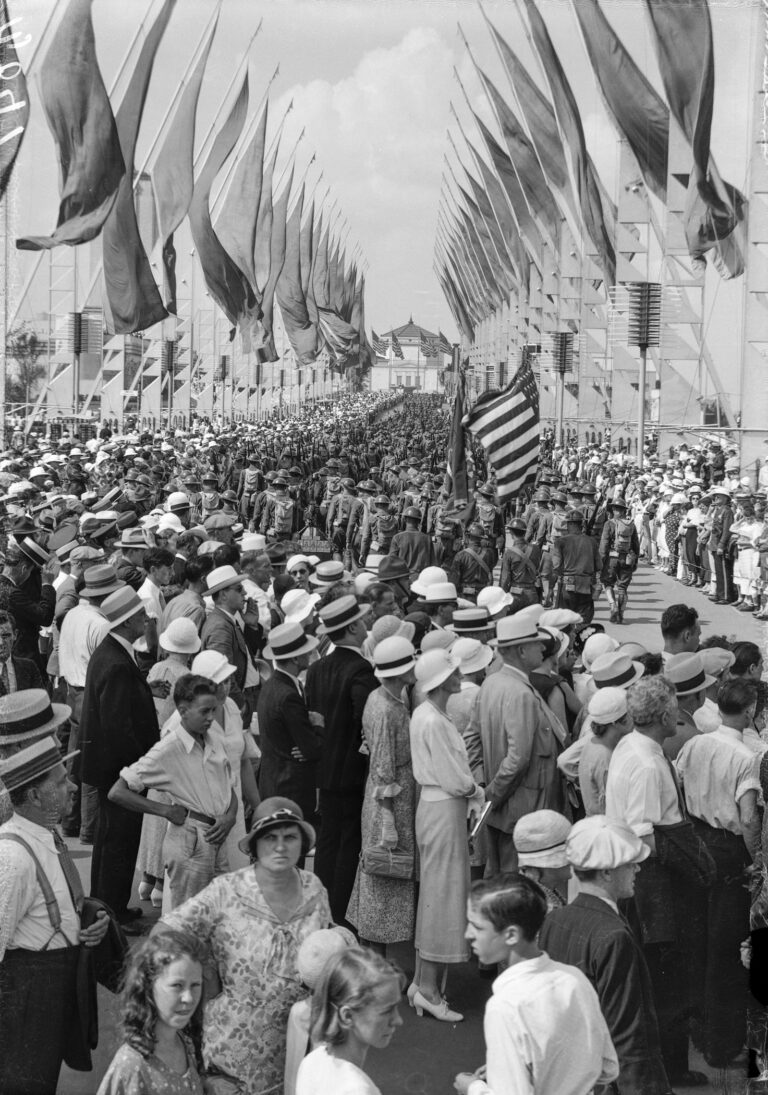
A parade along the Avenue of Flags during Illinois Day at the A Century of Progress International Exposition, Chicago, 1933. DN-0011047, Chicago Sun-Times/Chicago Daily News collection, CHM
The Tribune believed 150,00 to 200,000 attended the opening of A Century of Progress. By the time the fair closed in November, it is estimated that a total of 22 million had passed through the turnstiles. The second Chicago world’s fair proved such a success that it was brought back the following year, with an Earth-bound President Roosevelt, via a projected film, kicking off the opening evening’s festivities.
Sources
James O’Donnell Bennett, “Exposition Starts with Pageant in Soldiers’ Field,” Chicago Daily Tribune, May 28, 1933: 1
Ibid., “Miles of Wonders Show Progress of Century,” Chicago Daily Tribune, May 27, 1933: 1
“Four Observatories Will Help Arcturus Open World’s Fair,” Chicago Daily Tribune, May 25, 1933: 1
“Fox Shows How Arcturus’s Light Will Open Fair,” Chicago Daily Tribune, 27 May 1933: 2
Philip Kinsley, “Star Sets 1933 Fair Ablaze,” Chicago Daily Tribune, May 28, 1933: 1
Lenox R. Lohr, Fair Management: The Story of A Century of Progress. Chicago: Cuneo Press, 1952.
Additional Resources
- Learn about our digital resources related to the World’s Columbian Exposition and the A Century of Progress International Exposition
- Read the Chicago History magazine article “Modern by Design: Chicago Streamlines America” to learn how Chicago introduced streamlined design to the masses via the A Century of Progress International Exposition