


To mark the 274th anniversary of George Washington being initiated into freemasonry, Heidi Samuelson, PhD, CHM Content Manager & Editor, writes about Washington’s history with the freemasons and an 18th-century masonic apron in the Museum’s collection.
George Washington (1732–99) is known for many things—a commander of the Continental Army, presider over the Constitutional Convention, and the first president of the United States. But he is also one of the most well-known freemasons in history.
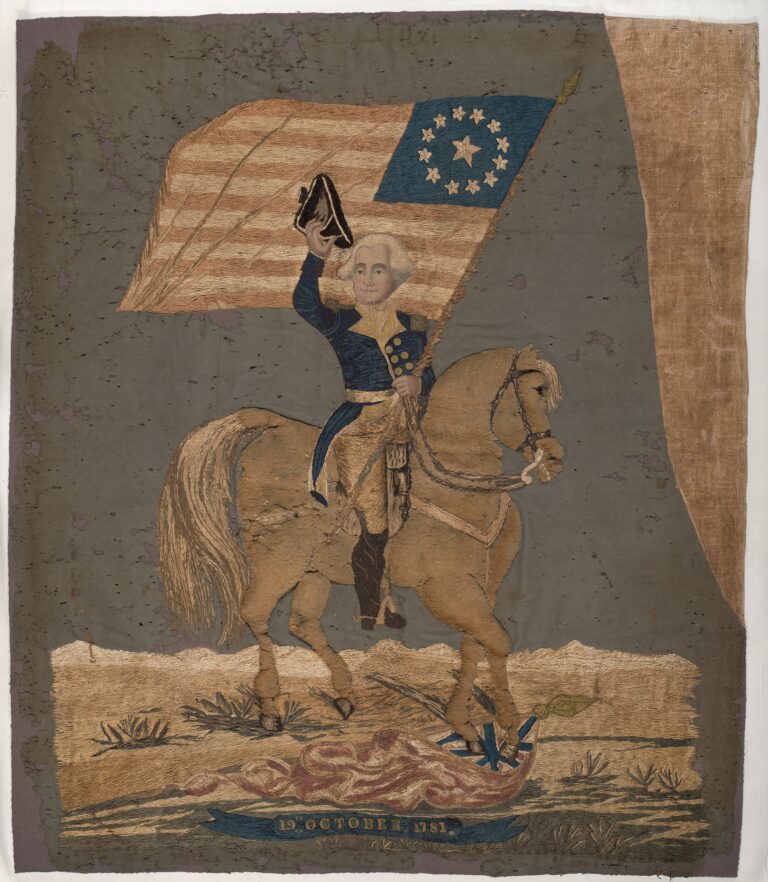
Banner commemorating George Washington’s victory at Yorktown in 1781. Rachel Simon Louis, 1855. Charles F. Gunther Collection, CHM, ICHi-052658
At age 20, Washington was initiated into freemasonry as an Earned Apprentice in Fredericksburg, Virginia, on November 4, 1752. The exact date that Fredericksburg Lodge No. 4 was established isn’t known, but it is thought to be around 1735. However, it was only granted a formal charter by the Grand Lodge of Scotland in 1758. Washington passed to the Fellowcraft degree on March 3, 1753, and was raised to the Master Mason degree on August 4, 1753.
Washington was recommended for the office of Grand Master in 1777, but he either turned it down or was never offered, likely due to the on-going Revolution. However, he did serve as the charter Master of Alexandria Lodge No. 22 in 1788–89. And in 1789, he took his first oath of office on a Bible belonging to St. John’s Lodge No. 1 of New York. While there is some question as to how active Washington was in the masons, he did remain a member in good standing of Fredericksburg Lodge No. 4 until his death.
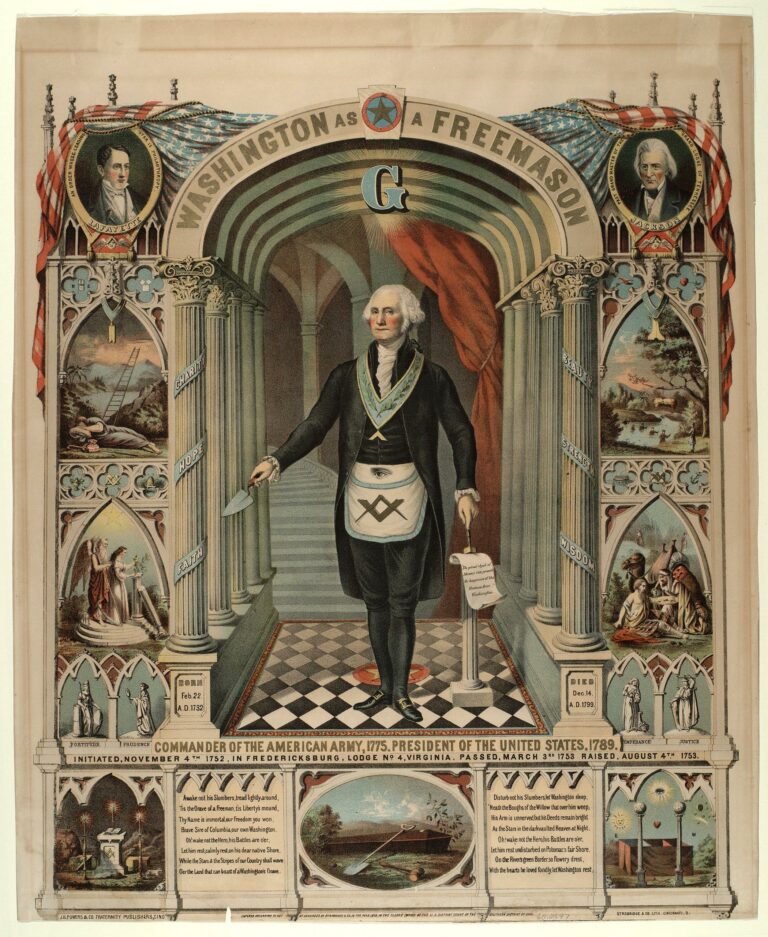
Washington depicted as a Freemason in this 1870 lithograph by Strobridge Company of Cincinnati, part of the Harry T. Peters “America on Stone” Lithography Collection, National Museum of American History. DL.60.2597
Freemasonry is a fraternal organization thought to have originated from the stonemasons guild in medieval Europe. There is evidence that the movement dates to the 15th century, with the first ceremonial regalia. However, by the 18th century, aristocrats and artists pushed out the craftsmen originally associated with it. English and French freemasons supported “Enlightenment-era” ideals of liberty, fraternity, and equality. The institution was known for advocating moral, intellectual, and spiritual self-improvement.
Masonry came to the Colonies with British settlers, with the earliest lodges being formed in Pennsylvania likely around 1715, though Boston’s St. John’s Lodge was the first lodge recognized by the Grand Lodge of England in 1732. The organization didn’t demand that members have a particular religious affiliation, but rather a belief in “the Supreme Architect of the Universe.” Masons believed in following moral law, as well as the liberal principles of truth and justice.
James Henry Heron’s account of the “Mother Lodge of George Washington” describes him as follows: “He was a Man’s Man!—a Soldier!—a Statesman—a Planter—a Diplomat, and a thinker of great and noble thoughts. He had strong feelings for his home—for his mother—for the soil, and for truth and principle in every action. He also had a depth of religious spirit that few could fathom, so it was natural for him to turn to Masonry [to] intensify his spiritual strength.”
Among the freemasonry objects in CHM’s Charles F. Gunther Collection is an apron thought to be from the 1750s. Though it was claimed to have belonged to George Washington, there is no evidence to support a specific owner. However, it is still an excellent piece from the era, and Washington likely had a masonic apron at the time. Masons wear aprons while at their lodges, and the practice reflects stonemasons’ protective leather work aprons.
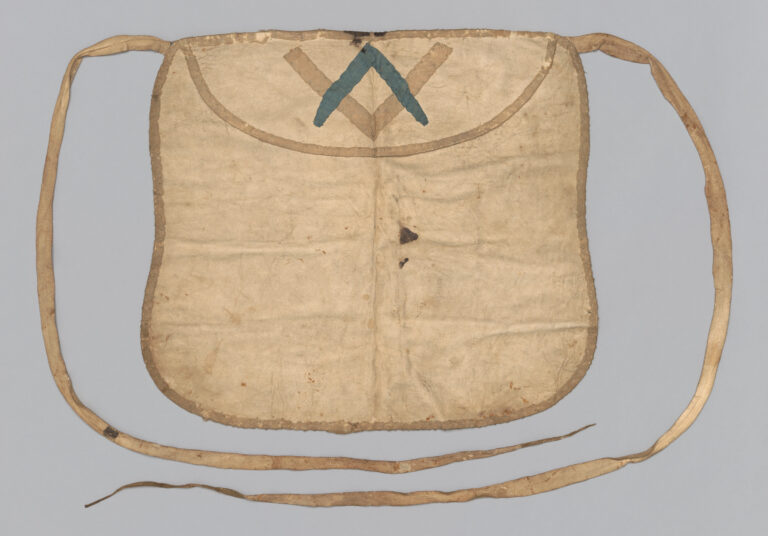
Front view of a masonic apron, c. 1750. CHM, ICHi-186882
This particular apron is made of white kid or lambskin leather, with the edges bound in white grosgrain with blue thread and two white leather straps. The rounded flap has a masonic symbol—the compass over the builder’s square—in appliqued grosgrain. Derived from the working tools of stonemasons, the square symbolizes morality, or being “square” in your duties and actions, and the compass symbolizes self-restraint required to live a balanced life.
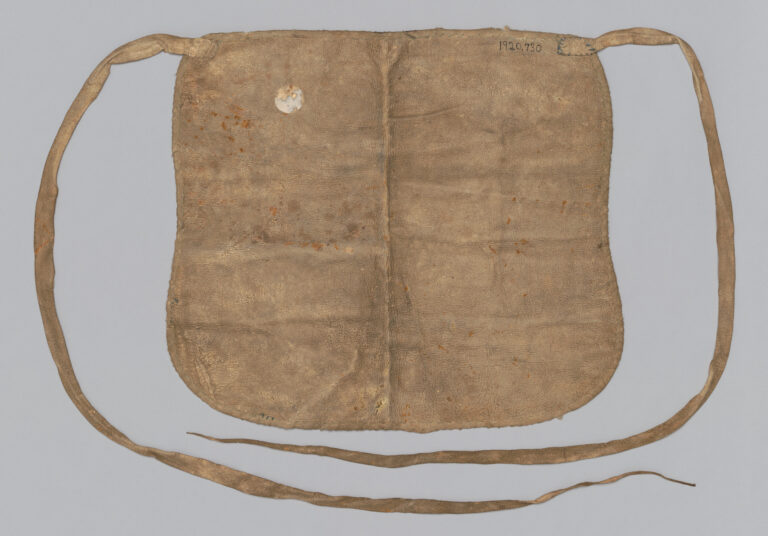
Back view of a masonic apron, c. 1750. Note the lack of a signature, which would normally identify the owner of a masonic apron. CHM, ICHi-186883
Around 1750, Masonic aprons were transitioning from plain, unadorned white lambskin to decorated, often hand-painted, garments. This reflects the period, during which there were no universal regulations, so members personalized or localized their aprons. The symbols they chose often reflected the degree they had attained within the organization. The square and the compass were common, but they weren’t standardized to the current symbol of the masons you might know today.
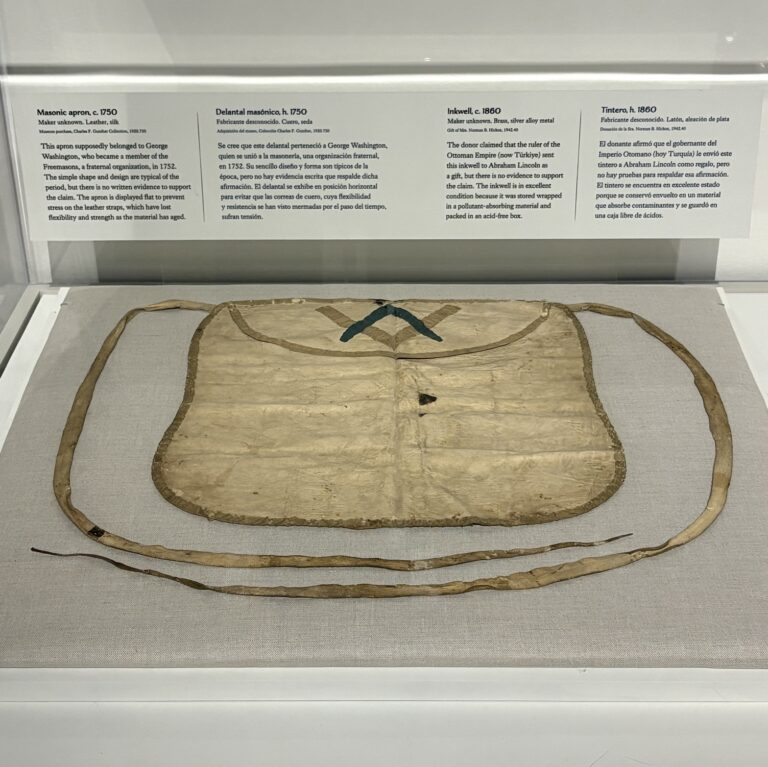
The masonic apron on display in Threads of a Nation: Preserving Presidential Clothing. To help preserve the object by reducing its exposure to light, it will go off display at the end of February 2027 and be replaced by another artifact.
The apron was examined by conservators and found to be in good enough condition to be displayed flat, mounted on a padded fabric-covered board. The grosgrain ribbon around the apron is particularly fragile from age and exposure to light. It was likely originally blue in color. The apron straps were twisted and distorted from use and appear to have been restitched where they join at top corners of the apron.
Additional Resources
- See the apron in our exhibition Threads of a Nation: Preserving Presidential Clothing, which is open now through July 18, 2027
- Peruse items related to freemasonry in our research collection, available at the Abakanowicz Research Center
- Watch “The History of Freemasonry in Chicago,” Ask Geoffrey, WTTW, November 2, 2016