


For National Immigrants Day, Jojo Galvan Mora, CHM Digital Humanities Curator, writes about braceros—workers from Mexico who came to the United States as part of a temporary labor initiative from 1942 to 1964 to be employed in the US agricultural and railroad industries.
Since its inception, the Bracero Program, has fascinated scholars across several disciplines. Originally titled the Mexican Farm Labor Agreement, the program started through an executive order in 1942 to solve worker shortages brought on by the deployment of men to fight in World War II. The Bracero Program is the largest guest worker program in US history, having brought in more than 4.5 million workers primarily for agricultural work, later expanding the program to allow for work on the American railway system. This massive undertaking was overseen through a collaboration between federal agencies in both the US and Mexico and remained in existence until 1964, thanks to the passage of ongoing federal legislation amid interest in continuing the ongoing supply of cheap labor the program afforded to US companies.
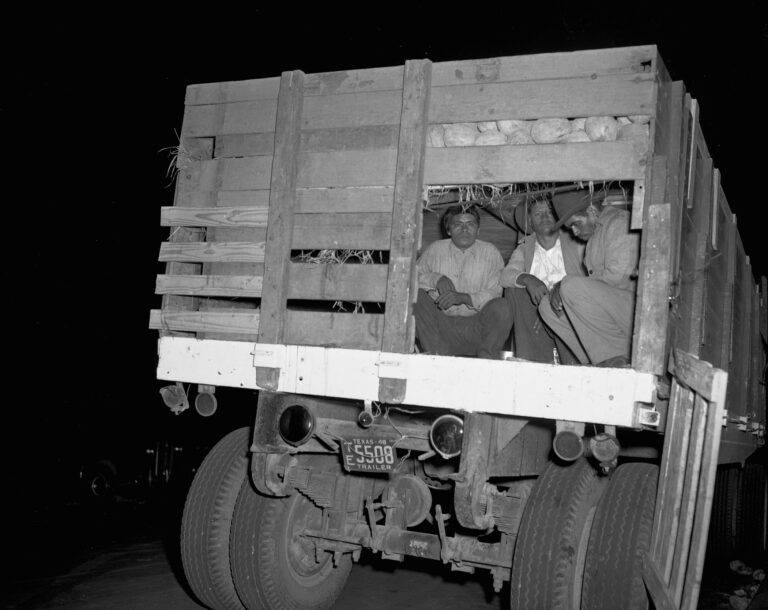
Three Mexican men crouch in the back of a truck to demonstrate how they traveled to Chicago from Texas safely, Chicago, June 12, 1948. ST-17600004-E1, Chicago Sun-Times collection, CHM
Despite contracts outlining promises of adequate food, shelter, and a minimum pay of 30 cents an hour, the reality of being a bracero was often far more difficult. Upon arrival to the US border, participants would be stripped of their clothing and would have to undergo invasive medical examinations that often included being sprayed with toxic chemicals like DDT before being shipped off inside cattle cars or trailer trucks to their work destinations, sometimes hundreds or thousands of miles away from the border. While the program got off to a slow start, according to research by historian Mae Ngai, by 1948 until its end in 1964, the program admitted an average of 200,000 workers per year. Many of them arrived in Chicago to lay down railroad tracks, with a substantial portion of settling in the city, particularly on the Southeast Side, forming some of the city’s first predominantly Latino neighborhoods.
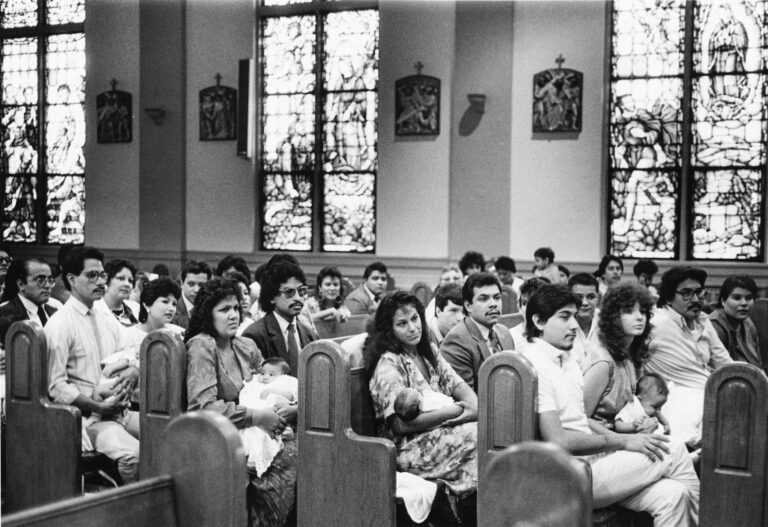
Couples holding babies awaiting to be baptized at Our Lady of Guadalupe Church, the city’s oldest Latino parish, Chicago, September 5, 1987. CHM, ICHi-039083; Antonio Perez, photographer
From the inception of the program until roughly 1949, every bracero working stateside had 10% of their pay docked from their pay check. The purpose behind this mandatory deduction was to reduce the likelihood of illegal overstays once employment contracts ended, as these funds were pooled and transferred from an American banking institution to a Mexican one, where the collected funds were supposed to be held insavings accounts under the names of individual workers. While the specific sum is unknown, it is widely accepted that at least $32 million ($446.6 million in today’s dollars adjusted for inflation using 1949 data as the base) were collected from these workers, with most participants unaware of this practice altogether. In 2001, a group of former braceros brought forward a class-action lawsuit in the Federal District Court in San Francisco, naming both the US and Mexican governments, as well as the involved banks, demanding their withheld wages be paid with interest. Despite popular support and a sympathetic judge, the suit was ultimately dismissed.

Guadalupe Morales is a former participant in the bracero program who now resides in Chicago Heights, Illinois, August 4, 2000. ST-10002469-0018, Chicago Sun-Times collection, CHM
Thanks to ongoing advocacy and public pressure, the Mexican government under President Vicente Fox agreed to pay the funds owed to the braceros, creating a $14.6 million fund that would award each claimant (or their descendants) $38,000 pesos (roughly $2,000 today) to all braceros who could prove “they worked in the braceros program between January 1, 1942 and December 31, 1946.”
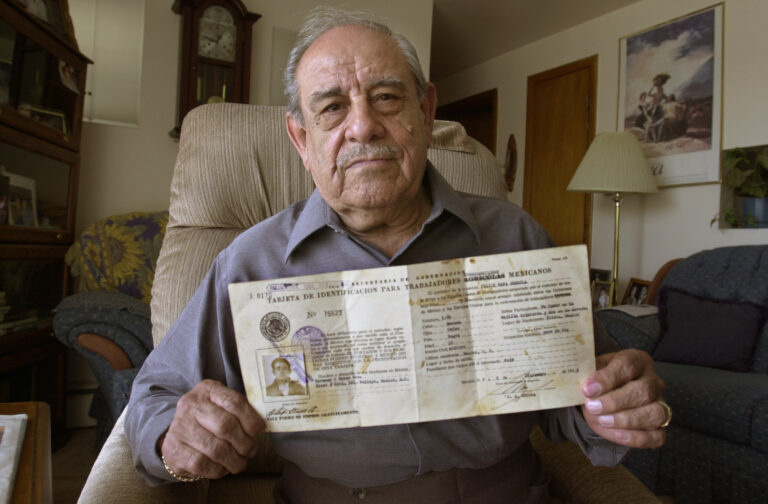
In Chicago, Felipe Nava filed a successful lawsuit, releasing up to $2,000 per bracero. He is pictured here holding his Tarjeta de Identificación para Trabajadores Agricolas Mexicanos (Identification Card for Mexican Agricultural Workers), 2001. STM-000439426, Chicago Sun-Times photograph collection, CHM
Despite ongoing calls for the program’s renewal and for the reopening of claim processing, the allocation of more funds continues to be tangled up in political debate. It is unknown how many were able to successfully file claims and receive compensation. While grim, this story is just one example of the larger and infinitely more complex history of guest worker programs between the US and its neighboring countries.
In 1952, the Immigration and Nationality Act created the H-1 and H-2 visa program, enabling US employers to recruit and hire temporary foreign workers from outside the country to fill employment vacancies in both specialized and seasonal work positions. Since then, both programs have undergone significant reforms and expansions and continue to be an important part of the intertwined history of foreign relations, labor, and immigration in this country.
Additional Resources
- Learn more about the history of the Bracero program by visiting Aquí en Chicago, which closes on November 8, 2026.
- Read more in Mexican Workers in the United States: Historical and Political Perspectives available at the Abakanowicz Research Center