


Hannah Simmons is a student at Northwestern University and the Black Metropolis Research Consortium graduate assistant at our Abakanowicz Research Center (ARC). As part of her work, she is writing a series of blog posts related to the Chicago Covenants Project.
Racially restrictive covenants justified anti-Black violence in Cicero, a working-class, primarily Southern and Eastern European immigrant community neighborhood in Chicago, years before the anti-Black violence that came to be called the “Cicero Race Riot of 1951.” In July 1944, the Federation of Chicago Neighborhoods lamented in their publication, Restrictive Covenants, how “unjust” it would be for white soldiers to come home only to find that their “homes have been taken over by negroes.” The paper claimed that if African Americans moved in, these once-nice neighborhoods would become slums. The Federation’s overall argument conveyed a mindset that justified racial segregation and reinforced the commonly held fallacy that African American residents drove down property values.
Furthermore, the Federation’s argument completely omitted African American soldiers’ involvement in the war, ignoring the fact that when African American soldiers came home, they were forced back into segregated housing, despite their sacrifice and fight for democracy abroad. In other words, though African American soldiers were pivotal in the victory against fascism abroad, the Federation still painted them as enemies to the progress of the domestic housing market. This mindset, fallacy, and disregard for African American servicemen’s sacrifice all fueled the Cicero Race Riot.

An example of racial violence against Black veterans in Chicago, c. 1947. This map indicates the locations of the homes of persons arrested for participation in racial violence in the Fernwood Park area, where Black veterans were housed in the Fernwood Housing Project. CHM, ICHi-183577, Chicago Council Against Racial and Religious Discrimination, creator
On July 11, 1951, a woman cheered with the crowd as the furniture of the Clark family sailed through a shattered window, landing with a crash three stories below. “It’s a shame,” she stated, watching as someone set the furniture on fire, “Our boys are fighting and dying in Korea for democracy and look what’s happening here. Is this civilized?”(1)

Cicero police arrest a youth, Cicero, Illinois, 1951. DN-N-7947; Chicago Daily News collection, CHM
To this woman, and the hundreds of Cicero, Berwyn, and Chicago residents who watched and participated in the destruction of the Clark family’s property, it wasn’t civilized for the Clarks, an African American family, to move into all-white Cicero. Yet, there was nothing uncivilized about destroying the Clarks’ property and causing $50,000 (today, approximately $623,000) in property damage to the apartment building. As the building was damaged and the Clarks’ property was destroyed, the police stood by and watched, arresting no one.
Though rumors had spread that the Clark family was part of a larger ploy to integrate Cicero, the Clark family was simply looking for a place to live. At the time, Veteran Harvey E. Clark Jr., a graduate of Fisk University, was a CTA bus driver trying to find an affordable place for him and his wife, Johnetta Clark, also a Fisk University graduate, to raise their two young children, Michele Elaine Clark, age eight, and Harvey Evans Clark III, age six. However, racial prejudice stood in the way of the Clark family and the home they sought to raise their family in. Despite the Clark family’s simple desire to find an affordable place to live, the prejudice of their would-be neighbors made this simple desire for housing and a place to raise their family into a controversy. A controversy that bloomed into a race riot that the police were called in to quell.
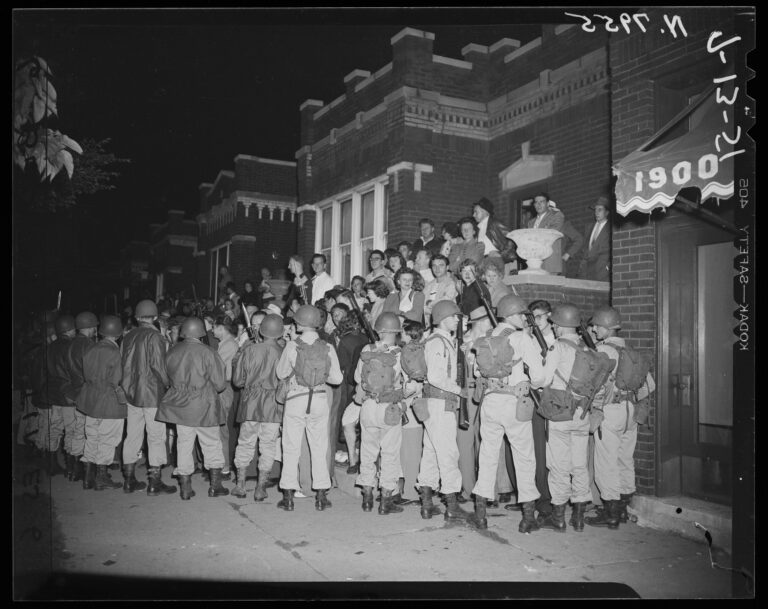
National Guardsmen form a cordon around a mob during the race riot in Cicero, Illinois, July 13, 1951. DN-N-7955; Chicago Daily News collection, CHM
Though he was called to quell the riot, Cook County sheriff John E. Babb did not want the Clarks to move in. Observers mentioned that he had told the crowd that he was on their side.(2) However, even he knew that the mob had gone too far. So, on July 12, he asked Governor Adlai Stevenson II to summon the National Guard to quell the rioters and protect the building. In the evening, crowds clashed with the National Guard, Cook County police, and Cicero police. The crowd threw bricks, flares, and torches, injuring National Guardsmen and starting a fire near the apartment. By 12:51 a.m., the National Guard and police had pushed the crowd from the building. Around 70 people were arrested that evening, and over a dozen were injured.
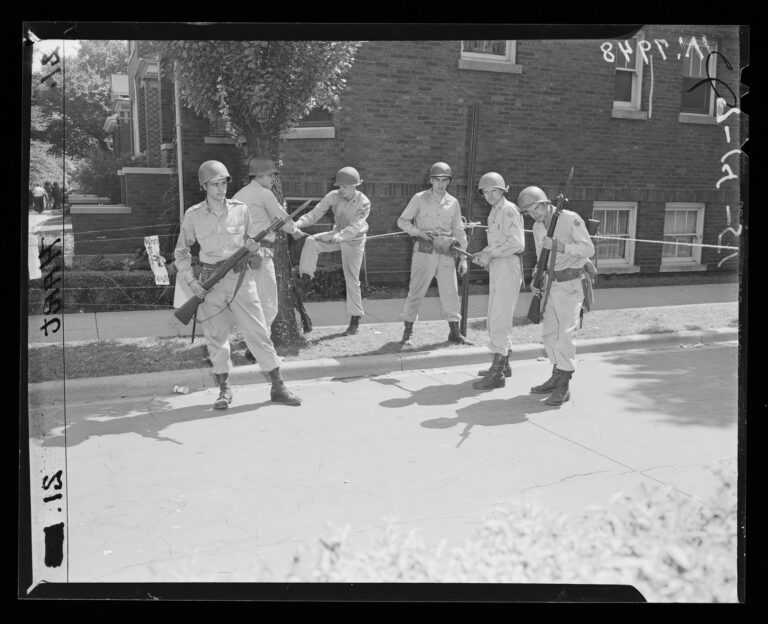
National Guardsmen stringing a wire barricade at the scene of the race riot in Cicero, Illinois, July 14, 1951. DN-N-7948; Chicago Daily News collection, CHM
Over the next few days, as the mob continued, 117 people were arrested. Most of them were let go. It wasn’t until September 18, 1951, that people were indicted, and none of those individuals had been involved in the riot.
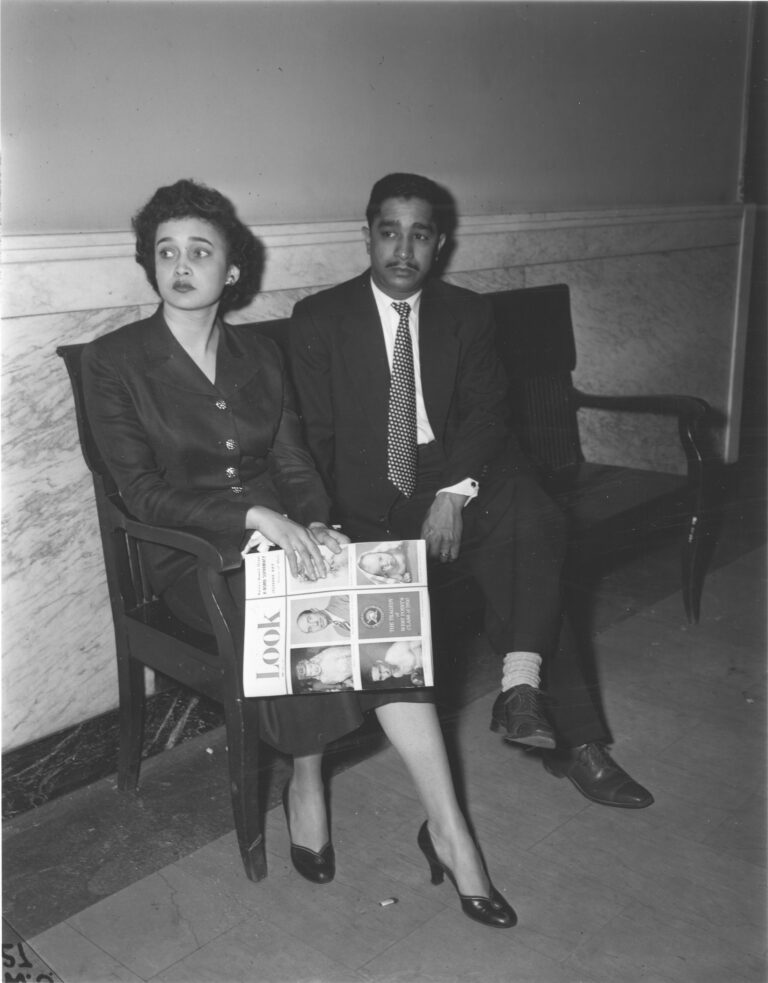
Harvey E. Clark and his wife, Johnetta, seated on a bench during the Cicero Race Riot trial, Chicago, c. 1951. ADN-0000064, Chicago Daily News/Chicago Sun-Times collection, CHM
On September 18, 1951, a Cook County grand jury indicted the former owner of the building, Camille De Rose, George C. Adams, De Rose’s lawyer, George Leighton, an NAACP attorney, and Charles Edwards, the real estate agent, for conspiracy to injure property by causing “depreciation in the market selling price” by selling to a Black family. As a result of vigorous protests from groups like the Chicago Council Against Racial and Religious Discrimination, a federal probe was launched. In 1952, the police chief, two policemen, and the village attorney of Cicero were indicted for the race riot, and charges against De Rose, Adams, Leighton, and Edwards were dropped.
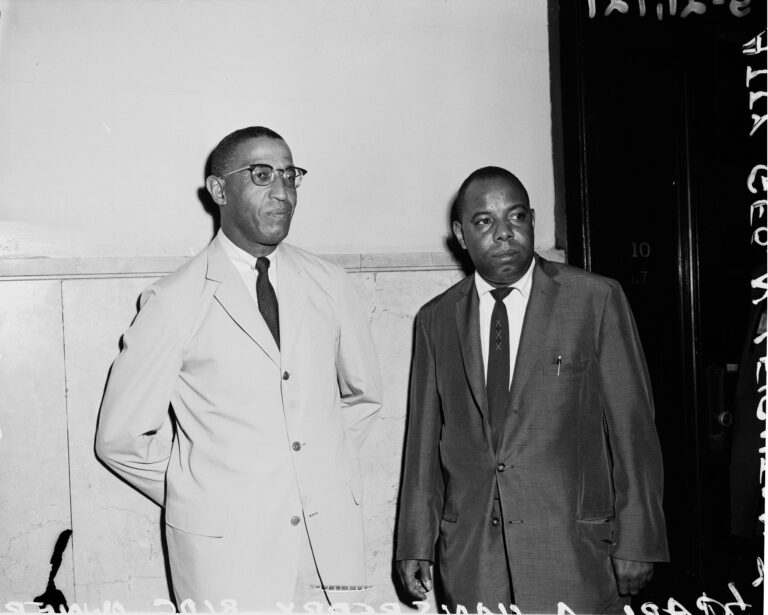
An undated photograph of George N. Leighton (left) with his client Carl A. Hansberry during their legal challenge of racially restrictive covenants, Chicago. ADN-0000067, Chicago Daily News/Chicago Sun-Times collection, CHM
The Cicero Race Riot of 1951 show the enduring legacy of racial segregation and anti-Black violence. Furthermore, although the indictment of four Cicero officials and three policemen showed the potential for justice, none of the actual violent actors were ever indicted. This lack of indictment leaves questions about whether justice was truly served in Cicero.
Notes
- Camille De Rose, The Camille De Rose Story, 180.
- “Cicero Riots, 1951, Including Activities of Bayard Rustin in Chicago, Planned Purchase of Cicero Property, Housing Discrimination of Minorities, Communism in Cicero, Federal, State, and City Housing Policies, Dave McNamara’s Work in Cicero, Indictments of George N. Leighton and Others by Cook County Grand Jury, Need for Education Relating to Minority Housing, Reconciliation Efforts and Presence of National Guard,” 3. Bayard Rustin Papers; Alphabetical Subject File 1951.https://www.proquest.com/archival-materials/cicero-riots-1951-including-activities-bayard/docview/2900590824/se-2.
Additional Resources
- Read more about George Leighton’s life and the role he played in defending the Clarks
- Learn about CHM’s critical analysis of riot terminology within our descriptive metadata in our blog post “Riot or Uprising? A Reflection on Race and Language in the Contested City”
- Stop by the Abakanowicz Research Center to read Camille DeRose, The Camille DeRose Story
- Listen to Studs Terkel’s interview with Lorraine Hanberry in which she discusses A Raisin in the Sun