


Hannah Simmons is a student at Northwestern University and the Black Metropolis Research Consortium graduate assistant at our Abakanowicz Research Center (ARC). As part of her work, Hannah is writing blog posts related to the Chicago Covenants Project.
On August 9, 1929, John F. Wagner, a resident of the then all-white Auburn Park neighborhood on Chicago’s South Side, received a letter from the Auburn Park Property Restriction Association. Attached to the letter was an “anti-colored restriction agreement” for Wagner to sign. The purpose of signing the document was to keep the neighborhood all white by prohibiting the sale of property to all persons having “one-eighth part or more of negro blood.” Restriction agreements like the one Wagner received are a small part of the larger history of racially restrictive covenants in the Chicago metropolitan area. Now, you may ask, what is a racially restrictive covenant?
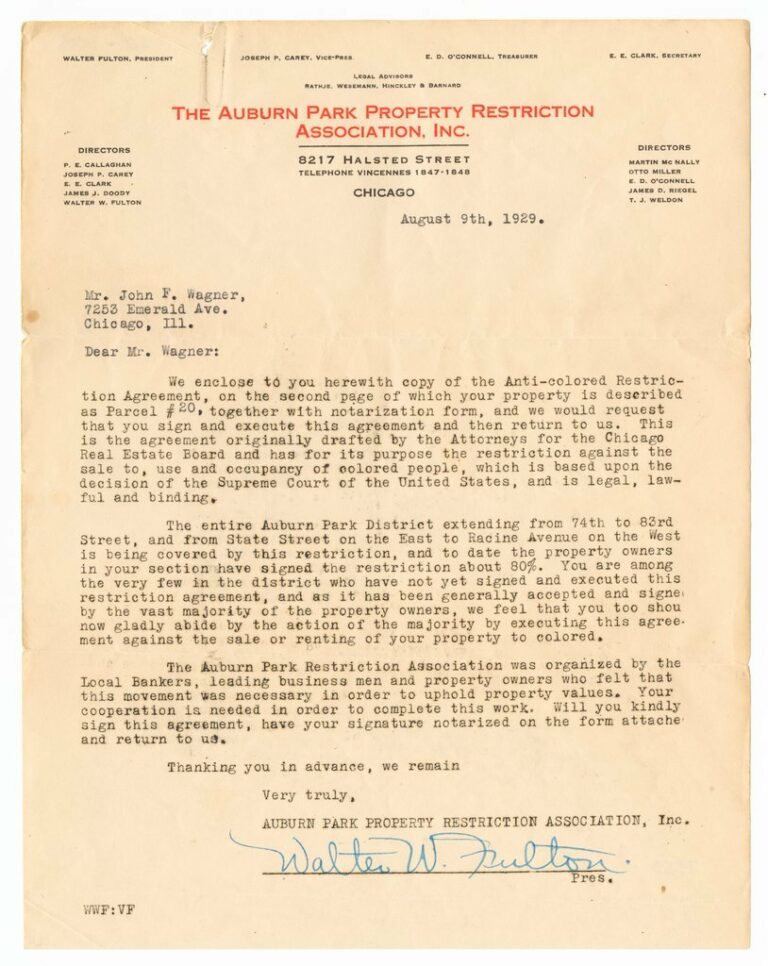
The cover letter to the racially restrictive covenant from the Auburn Park Property Restriction Association’s president Walter W. Fulton to John F. Wagner, August 9, 1929. Gift of Mrs. Charles Kwaak. 1979.53. Auburn Park Property Restriction Association collection [manuscript], p. 1. CHM, ICHi-031705
According to historian Thomas Lee Philpott’s The Slum and the Ghetto (1978), a racially restrictive covenant was “a contractual agreement among property owners that none of them would permit a ‘colored person’ to occupy, lease, or buy his property” (189). While many neighborhoods on the South Side were under covenants, covenants were signed throughout Chicago. For example, the ARC has a letter from the Near North Side Property Owners Association to the Chicago Historical Society, asking the Society to sign a restrictive covenant, and a letter from the Woodlawn Property Owners Association, located in the Woodlawn Neighborhood on the South Side, thanking a property owner for their due payment that would help keep “Woodlawn to white people.” While institutions and individual property owners signed covenants, some of the main enforcers were real estate companies and neighborhood improvement and restriction associations.
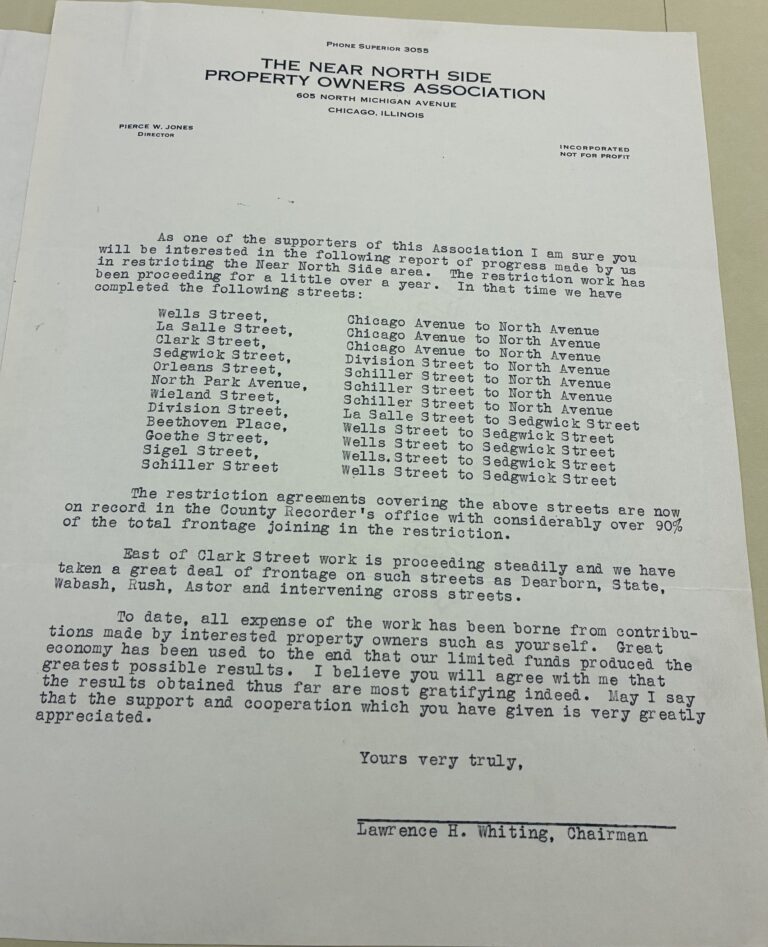
Letter to L. H. Shattuck, director of the Chicago Historical Society, from Lawrence H. Whiting, February 18, 1936. Photograph by Hannah Simmons
Real estate companies, like Baird & Warner, and neighborhood improvement associations, like Near North Side Property Owners Association and Auburn Park Property Restriction Association, promoted covenants, arguing that if Black people were allowed to move in, property values would go down. In the pro-covenant paper Restrictive Covenants (July 1944), the Federation of Chicago Neighborhoods lamented how unjust it would be for white soldiers to come back from war to find that their “homes have been taken over by negroes” and their old neighborhoods were now slums (15). The paper made no mention of how Black soldiers would feel coming back to housing discrimination. Despite the pervasiveness of covenants, Black people and allied groups like the Catholic Interracial Council (CIC) pushed back against them. After years of people decrying the unconstitutional and undemocratic nature of covenants, in Shelley v. Kraemer (1948), the Supreme Court decided that racially restrictive housing covenants could not be enforced. This was a blow against covenant makers and enforcers and a win for those who pushed back against covenants.
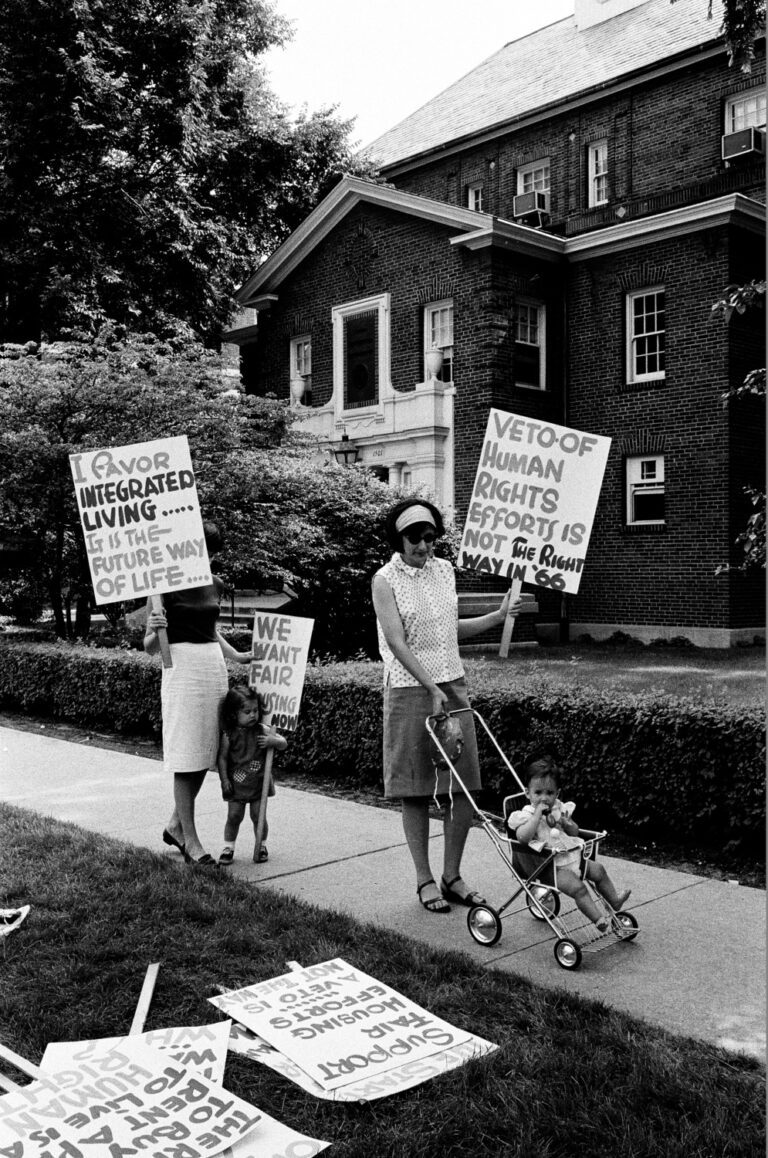
Mothers and children picket for fair housing in front of Evanston City Hall, Evanston, Illinois, June 27, 1966. ST-15001772-0004, Chicago Sun-Times collection, CHM
In the CHM research collections, covenants are discussed throughout the archives. Where the Restrictive Covenants by the Federation of Chicago Neighborhoods extol the virtues of covenants, the CIC records counter with the virtues of interracial neighborhoods and the damage covenants do. The CHM research collections paint a detailed picture of housing in Chicago, which includes a rendering of racially restrictive covenants in the Chicago area. Join me in future explorations of these archives!