

The Missing Exhibition: Building Aquí
Behind the Scenes of the “Aquí en Chicago” Exhibition
When students at a predominantly Latino/a/e alternative high school in Chicago (Instituto Justice and Leadership Academy) realized that Chicago’s major history museum had no information about the Latino/a/e third of the city in its permanent exhibition, they took a stand—and made history. The Missing Exhibition: Building Aquí is a 4-part podcast that follows the students’ protest, the exhibition it inspired, and the long, rich legacy of Latine resistance, migration, and culture in the city. Told through music, oral history, and the sounds of Chicago, the series features the work of legendary Chicano folklorist Chuy Negrete and the voices of curators, activists, and community members working to expand the archive.
From the Puerto Rican Young Lords’ transformation from street gang to political force fighting “urban renewal” and displacement in Lincoln Park, to Mexican American students pushing for bilingual education, and beyond—this podcast explores the profound ways Latino/a/e Chicagoans have shaped the city and why this important history is still missing from many institutions that should be preserving it.
Learn more about the podcast in a blog post by co-creators Elena Gonzales, Curator of Civic Engagement & Social Justice at CHM, and Jesse Betend, producer at Rivet360.
Listen on Spotify Listen on Apple PodcastsProduced by Rivet360’s Jesse Betend in partnership with the Chicago History Museum.
Episode 1: The Missing Exhibition
When students from an alternative high school confront the Chicago History Museum over its lack of Latino/a/e representation, they set off a chain of events that leads to a historic new exhibition—and a reckoning with the past.
This episode also traces the life and legacy of Rudy Lozano, the activist whose name the students carry, and legendary folk artist Jesus “Chuy” Negrete, whose corridos have preserved history and honored the lives of countless Latine Chicagoans.
JESSE BETEND: In 2019, a group of students from a high school on Chicago’s South Side took a field trip to the Chicago History Museum.
ELENA GONZALES: It was a history and social studies class, and they toured Chicago: Crossroads of America, which is the central exhibition at the museum and has been on view now for almost 20 years.
BETEND: They were not impressed…
ANTON MIGLIETTA: They had hot dogs, they had ladies’ gowns, they had the Cubs and White Sox forever, and all this other stuff. But yet, nothing on, you know, on us, nothing on Latino history, Latinx history.
BETEND: The students who happened to be mostly Mexican, noticed quickly that the museum that was meant to represent their city, had completely failed to represent them.
MIGLIETTA: …So they’re all pissed at that, right? They’re definitely pissed at that and just feeling like that was bogus.
BETEND: So they decided to do something about it.
(Music)
BETEND: When a group of high school students confront the Chicago History Museum over its lack of representation, they set off a chain of events that leads to a historic new exhibition—and a reckoning with the past.
I’m Jesse Betend, and I’m partnering with the Chicago History Museum to unveil their new exhibition Aquí en Chicago.
Building Aqui is a 4-part podcast which follows the students’ protest, the exhibition that it inspired, and the rich legacy of Latine resistance and culture in the city—told through music, oral history, and the sounds of the city itself.
In this first episode we’ll meet Chicago History Museum Curator of Civic Engagement and Social Justice, Dr. Elena Gonzales, and explore the work of community historians like legendary folk artist Jesús “Chuy” Negrete, who are preserving history where institutions fail.
A student protest, a missing exhibition, and a labor leader whose legacy refuses to stay buried. This is the story of how a South Side classroom challenged a city’s narrative—and won.
(Music)
BETEND: The Chicago History Museum’s new exhibition, Aquí en Chicago, opens its doors on October 25th—but the story of how it came to be began nearly 6 years ago.
ELENA, SPEAKING TO MIGLIETTA: Can you take us back to 2019 and talk a little bit about what your class was like before your visit to the History Museum? (fades under narration)
BETEND: Dr. Elena Gonzales is the curator of Civic Engagement and Social Justice at the Chicago History Museum. She interviewed the class’s teacher, Anton Miglietta, for the museum’s oral history collection.
Back in 2019, Anton was “Mr. Miglietta,” teaching history and social studies at Instituto Justice and Leadership Academy.
MIGLIETTA: Rooted in Pilsen and Little Village communities in this area, also called Heart of Chicago.
BETEND: Reflecting the neighborhood around it, the school’s student body is nearly 40% Mexican.
The school is called Instituto Justice and Leadership Academy – one of two Chicago Public School charter schools under the parent organization Instituto del Progreso Latino. In 2017, the school, which was formally the Rudy Lozano Leadership Academy, named after a beloved Mexican labor organizer, was consolidated into IJLA. Though the school no longer bears Rudy’s name, the staff does aspire to carry on his social justice work through its student-led curriculum.
MIGLIETTA: Being an alternative school model with the name Rudy Lozano Leadership Academy…. it just has this background of… social justice right from the beginning.
BETEND: Over his 20+ years in the classroom, Anton’s developed a habit. He likes to give his students a little survey to find out what topics most interest them. Some tend to come up again and again: immigration, community issues with police. Those are some of the big ones. But the results for the 2019 survey were surprising.
MIGLIETTA: so I asked them in the survey, what do you want more of? And they said, “field trips.” And so we said, okay, well what field trip should we do?
And a little list went up, and most of them said they had never been to the Chicago History Museum. And it was a Chicago history class. And so we kind of like, everybody looked at each other like, let’s do that one.
BETEND: So the day rolls around and our unusually eager highschoolers head downtown excited to see the history they’d been learning about in class.
GONZALES: They toured Chicago: Crossroads of America, which is the central exhibition at the museum and has been on view now for almost 20 years.
BETEND: A lot of classwork from the previous semester dealt with Indigenous history and the ways that institutions tended to portray communities of color. So the students were itching to put what they’d learned into practice and explore the museum through that specific lens.
GONZALES: Chicago: Crossroads of America is an exhibition that is 14,000 square feet. It’s the Museum’s central exhibition. It opened in 2006, and it really tells the story of Chicago as a metropolis, a city on the make, and a sort of business and transportation hub. It’s kind of an industrial history, and what I find is that it centers the city itself as a protagonist rather than the people.
BETEND: For anyone who hasn’t been, the museum’s premier exhibition Chicago: Crossroads of America, is all about BIG IDEAS and BIG SHOULDERS. Inside you’ll find an exhibition dedicated to each of our beloved baseball franchises, the Cubs and White Sox. Another section dedicated to the local titans of industry…
GONZALES: There are some pretty big displays on places like Crate & Barrel, Marshall Fields,
BETEND: …there was a special display dedicated to the Vienna hot dog.
(Music)
MIGLIETTA: So they broke into groups of two or three. . . . In these groups of two or three they were all spread out, so I was just walking around, just sort of checking in with each group of two or three the best I could.
I remember at that time, a special exhibit was the women’s gowns. And they were checking that out and, and they, they were thinking about the sort of the classism of this, right? Or like, okay, “this is like rich, this looks like rich white women stuff, right?”
And then another group was looking at the exhibit at that time related to the Vienna hot dog and what have you. And they were like, okay, you know, they, they were like, “Okay, this is, you know, you know, just sort of popular food.” And then another group was looking at all the Cubs and White Sox stuff, and so as they were looking and observing these things and recognizing sort of the, um, sort of general and trivial Chicago history,
They then noticed, you know, some pieces on Indigenous history, not very well, you know, represented and, and not too authentic.
GONZALES: I think many people immediately notice the way in which this manifests in the very opening spaces of the Gallery. So if you go into Crossroads you experience a narrative that very much portrays Indigenous folks as being ancient history, gives them no agency. They do not have a voice, and furthermore the narrative states very specifically, and if I had the label in front of me, I would read it to you, but it states very specifically the ways in which the interactions between these groups positively affected colonizers and doesn’t really care at all about what happened to the indigenous folks in those interactions
MIGLIETTA: But then they really all noticed. Little group by little group. So it was really intriguing to see their individual responses.
BETEND: Most offensive was the exhibition’s treatment of the man widely recognized as the founder of Chicago. Jean Baptiste Point Dusable was an American trader, born in Haiti, who travelled all the way to modern day New Orleans where his ship was wrecked. Sometime around 1770, he would find himself near the mouth of the Chicago River, manning a trading post that would ultimately lay the foundation for the city of Chicago. Many Chicagoans take particular pride in the fact that Chicago’s symbolic father-figure, was a man we would today consider Latino, who wasn’t remotely “from here.”
MIGLIETTA: And you wouldn’t know. You’d have no idea.
It’s really like only about a foot and a half of an oval framed picture of DuSable with no real representation to who he was. No name above his plaque of significance. I think just below there’s a small piece. And you wouldn’t know. You’d have no idea. So they’re all pissed at that, right? They’re definitely pissed at that and just feeling like that was bogus.
A question came up of where’s stuff on Mexicans and other, you know, Latino groups, right? But, you know, most of them being Mexican, I think that’s, they’re like, “Where’s the Mexican?” Let’s go see. So they started to look for that.
And everyone was basically saying, “Yeah, I don’t see anything.” Right? Except for the Lowrider.
BETEND: As the students spread out again to explore “Crossroads” a second time, some of them start to rethink one of the first things they saw when they entered the museum.
GONZALES: In the front lobby of the museum at that time there was a beautiful Lowrider car, which really rubbed the students the wrong way given the lack of context. They didn’t really feel like their history was really being told and it was just this one car standing for the entirety of this third of Chicago
BETEND: Why was the Lowrider there like what was the thought process behind it and was something missed in communication?
GONZALES: Yes, I wanna start by saying that Chicago has a very vibrant and expressive and tight Lowrider community. There is the Slow and Low festival which is co-founded by Lauren M. Pacheco who’s one of our advisors on Aquí. The car, which is a 1978 Chevrolet Monte Carlo, was actually commissioned by the History Museum in 2006.
So there was this gentleman named Pedro Cisneros III who is from Bishop Texas, who came to Chicago in 2001 and formed this car club, Amistad Car Club. And you know he was building his community. He was connecting with likeminded individuals in Chicago, and they were making these beautiful cars, which have you know these incredible paint jobs, all these crazy tricks that they can do you know, they’re really works of art and they’re absolutely fantastic.
And the History Museum, like I said, commissioned the Monte Carlo in 2006 for the reopening of the newly expanded building, which is also the same time when Crossroads opened. At the time there was more context about the car club.
When the students encountered the car, there was not enough context about what it was even doing there and so the perception was, “We’re being stereotyped. The only thing the History Museum wants to say about Latine communities is that you know we drive these Lowriders.” And I can understand completely how the students got to this idea. I think it’s a disservice to the local Lowrider community to let it end there, because it’s not you know it’s not that Lowriders are bad, it’s not that that our Lowrider is bad, our Lowrider is fantastic and Lowriders are very cool.
BETEND: After the field trip was over Anton and the class walked to the lake to debrief.
MIGLIETTA: That’s when the conversation started really spreading about, “I can’t believe there was nothing in there, you know?”
Um, ’cause that’s when they started talking about they had hot dogs, they had ladies gowns, they had the Cubs and White Sox forever and all this other stuff. But yet nothing, you know, like, like they didn’t even exist, you know? So we chopped that up and talked a little bit.
When we got back was when they were all queued in.
We’re sitting around in the classroom, they’re all queued in. And, Roger says, you know, “That’s, that’s bogus. I can’t believe that.” And I was like, “Well, what do y’all think? Like, what, what do you think you know you should do?,” and he said, “Let’s write a letter.” And I was like, “Oh, okay.” And, and a few people said, “No letter ain’t gonna do nothing.”
And a few people said, “Yeah, let’s do it.” And then another person said, “Or a petition”, and then another person said, “Nah, let’s do social media ’cause that’s more modern.”
So that’s when it got even more real, and Sammy really stepped up to provide a lot of the, um, um, always a very poignant comment, a very necessary one, a very, uh, process oriented also. So both content and process. Roger, he’s got a big teddy bear spirit right? But he’s just wanting to like, take action, right. But Sammy started to be real tactical about it
We essentially agreed that all these would be good tools. Let’s do the letter, a poster to bring the letter to life….
… And then let’s put those on social media and launch the petition. So it was like all of the above.
GONZALES: So you knew from the beginning that you were gonna do all those different things?
MIGLIETTA: No, when I walked into debrief, I had no idea.
So they go through a little process of drafting and or forming a social media team. And Sammy was definitely on that with a few other people. Put together, uh, the first few social media posts, and they named the group,
Latinx History Now, I think something like that with the exclamation point. And then they, um, put up a few of their pictures with the posters. But anyway, before the museum even read the letters, they had already, it sounds like, got word of the social media posts.
And already responded back with some sort of, you know, effective, um, you know, whether it was PR approach or recognition or a little bit of both. Right. And then, yeah, conversation got sparked up pretty quickly after this social media, ’cause then they like invited us to converse with them, I think it was. And got us to set this day to meet with them
GONZALES: And at that point, were the students surprised? Like now you are going to the History Museum to meet with the people there, that’s being set up. How was the response?
MIGLIETTA: Most students were surprised that they got the response to the letters on social media. Um, most students were definitely surprised that it actually worked and worked so fast and that this was like actually happening.
Um, I think they thought they would have to protest more, or like, yeah.
BETEND: The day of the meeting arrives, and the students show up prepared. They’ve got their posters, they wrote a press release, they’ve even got a concrete list of demands.
GONZALES: I have them in front of me. They had a few different demands on their list. They wanted the CHM to issue an apology to Latine and generally to the youth of Chicago. They wanted us to create an advisory committee, and then they wanted that committee to have the power to determine what should happen to the Lowrider, and also they wanted an exhibition that asked for feedback and explained what the students were doing in their protest. They also wanted the museum to commit to rotating and permanent exhibition space for Latine history, and finally they hope to launch a city wide research curriculum development project. So kind of to make Anton has described this last demand as wanting to see a city wide movement around Latine history, and preparing teachers better for it making it more of a zeitgeist within our educational setting.
MIGLIETTA: And the press release was designed to get a little media there, so we didn’t have this meeting without documentation and without, you know, a public record of it.
So they sent out the press release and CBS Two News… asked could they do an exclusive coverage of it, … So CBS2 News was there.
BETEND: The students carrying signs and posters, a collection of CHM staff including then Vice President of Interpretation and Education, Anton, their teacher, and a TV production crew all pile into the Museum’s front lobby… and past the infamous Lowrider…
MIGLIETTA: We get there, we get welcomed and brought up to the, uh, the old fancy room…
GONZALES: The Mandel Room.
MIGLIETTA: Yes.
GONZALES: For anyone listening in posterity.
MIGLIETTA: With the old fancy, um, you know, paintings of the old fancy white guys.
GONZALES: Mm-hmm.
MIGLIETTA: Um, so that was, you know, for, for the students that was just classic. That was just like, wow, this is, yeah, this is what they would have.
So the footage is so wonderful. ’Cause they’re just like these, you know, they’re, it’s on the news coverage, right?
GONZALES: They’re just straight up unvarnished.
MIGLIETTA: Yes. They really are. They really are. So it’s so, it’s so beautiful.
(CBS News Broadcast Audio)
REPORTER 1: They are pushing for answers and seeking some change.
CHM REPRESENTATIVE (PETER ALTER): I think what makes this day really special is to sit down and really dig into some of the issues that you raised.
REPORTER 2: CBS 2 was the only camera allowed inside a meeting between leaders of the Chicago History Museum and about 15 students from the Instituto Justice Leadership Academy.
STUDENT 1: This is a Chicago History Museum and we would like to see more of our people.
REPORTER 2: The alternative school is expressing their disappointment after noticing the exhibits and narratives about Latinx people fell short.
STUDENT 2: Imagine how many younger kids came in and didn’t think that their ethnicity or family background wasn’t as important because they didn’t see it in the museum.
MIGLIETTA: And then we started to hear from the museum officials, and they were both sort of like representing this, you know, apologetic energy as well as this is such an opportunity and thank you. And then I forgot the gentleman’s name.
GONZALES: Are we thinking about Peter Alter? Yeah. Yeah. So, Peter is one of the curators.
MIGLIETTA: Yeah. So, Peter comes out and addresses the, um, Lowrider and takes this, um, real humble approach of recognizing his role in it and like apologizing
ALTER: Our intention was not to offend, but that is a failure I would say that definitely lies specifically with me.
MIGLIETTA: So the students were, you know, thankful for that right afterwards, but they were really, you know, be a battle afterwards.
ALTER: We’ve got some work to do, hopefully through this process of meeting with you, you can help us think about what those next steps for the museum might be
(CBS interview)
REPORTER 2: And now they are getting results. A first step in what they hope will become a permanent or long running exhibit.
STUDENT 3: Well I am glad that questions are being answered and that we are coming into agreements
STUDENT 4: I am shocked because we actually got this far. I thought it wasn’t gonna go this way.
ALTER: And I hope that we can move forward in a collaborative way.
CBS REPORTER: Good for them for speaking up. Jim tells us that at the end of the meeting, the group picked another time to gather (fades into music)
BETEND: Do you have any insight into what the museum’s intentions were with meeting with the students were they prepared to meet these demands or was there some element of hoping to maybe find a compromise that didn’t require massive internal change?
GONZALES: I think that the museum wanted to hear the students out and see what they wanted and see how they could best come to an accord. The museum has a longstanding history of dealing with community based exhibitions as they come up and what that basically means is when a community makes enough noise about needing to be represented in Chicago history, the museum comes in and creates a temporary exhibition. And I know that’s uh stating things very bluntly but you know our Neighborhoods exhibitions are an example of that. So this I think was initially envisioned, I think initially the History Museum envisioned that the response to the students would be a community based temporary exhibition and that would happen relatively quickly.
BETEND: There was this moment where the head of negotiations for the museum pulls the teacher Anton aside.
MIGLIETTA: He brought me to the side two different times during this thing. So the first time was right after the meeting. Students, everybody’s in the room still, and he says, “We can do this really better with you, me, and, and you know, yourself, the principal, and, you know, and a few CHM representatives. We can just, you know, and we, you know, we might not really need the students, right?” And I said, “You know, that’s just not gonna happen.”
So I shared that with the students, right? ‘Cause I felt like they should know that, that, you know. They need to know they’re the ones organizing this and they need to know what, what they’re up against. And then the second time he brought me to the side was when we were walking through to get like, sort of like a general, you know, chance to walk around a little bit, even though we’d already been but a little walk around.
And he, and he talks to me and he says, you know, we have a lot of pressure here from um, different, you know, ethnic groups, right? We have pressure, I have, I have a lot of pressure from the Germans, the Italians, the Polish, the Irish, Jewish, and on and off. And it was all white groups. So it, he named six about, and it was all white ethnic groups that he just literally named to me.
He did not say one group of color and, and not one community of color in the entire, in, in the entire city. So that was mind blowing. Um, and I shared those comments. So essentially he was like, we want to leave out the students. And just to let you know, there’s a lot of pressure here to keep it like that, you know, and, and to focus on those groups .And, and I’m pretty accountable to that. That was his message.
So once the students understood that they, you know, they understood it was gonna be a fight, and that got them, I think even more, you know, inspired, right? I think it’s like, oppression breeds resistance. And it’s true, the students were revved up by that and so they, that inspired them to better navigate, you know, the next steps.
GONZALES: They have determined from the moment of the visit to the History Museum that their voices are going to be heard. They are very brave in standing up in this room full of adults and I mean that metaphorically and you know literally they’re standing up on social media they’re standing up at the news media they’re standing up in these meetings, and they’re speaking out they’re saying you know what “We’re not gonna be silenced we’re not gonna be sidelined this is our project, no you can’t resolve this in the quiet with the adults and just paper this over”, and so yeah. I’m very proud of them and I think the reason I keep wanting to tell their story and keeping their story so central project is not only because it’s theirs and because they earned it but also because I know that their story can inspire so many more young people like them and I’m hoping that many young people who visit the history museum or encounter this project in various ways are inspired to make change in their communities as well
BETEND: This is the part of the story where Elena starts to take center stage. In addition to her position as curator of community engagement and social justice, Elena is also the lead curator on Aquí en Chicago. She was hired specifically for the role, representing just one of the students’ victories.
But she’s also stepping into the project a couple years in, with pressure to make up for lost time.
GONZALES: The History Museum was starting out in a deficit position. We did not have the relationships. We did not have the collections that would make this project possible
BETEND: And she was stepping into a role that came with heavy expectations.
GONZALES: One of the challenging things when I stepped into this role is that the expectation was to represent all of Latine Chicago, which is not one community, it’s a third of the city. It’s many communities that are connected in important ways.
BETEND: Coming up, how do you appropriately represent a diverse group of people from more than 20 countries of heritage, sometimes with vastly different backgrounds and cultures?
…People connected, at times, by little more than others prejudice, or the means by which they came to America? Maybe just the color of their skin.
Other times, bound together by a common struggle for recognition, or fight for liberty–
–And do it all in 4,000 sq ft.?
(Music)
BETEND: You’ve probably noticed my or Elena’s use of the phrase Latine, a few times during this podcast. It’s a gender-neutral alternative to Latino/Latina, and while it’s increasing in popularity, especially among younger spanish speakers, it’s true that lots of people prefer other terms
GONZALES: The history museum as a whole has chosen to use o/a/e. That’s not very practical for us to say. My goal is just to be inclusive
BETEND: In the interest of inclusivity, we’ve decided to use the term people prefer. So at times we may switch between Latine or Latino, but the truth is most people don’t actually prefer either of those terms, anyway.
GONZALES: When it comes to this set of communities, often you won’t even hear people say Latino, Latina, Latine or anything like that. You’ll hear them say Mexican or Puerto Rican or Cuban or what have you.
BETEND: Typically people identify with their heritage. Where more general terms like Latine can be helpful in the context of American history, is when we’re trying not to be too specific:
Both “Latine” and “Latino”, or “Latina” try to recognize a wide group of people who often share common experiences — like migration or colonization — but come from very different countries and cultures. Sometimes these groups have been bundled together by outsiders, other times, grouped together by choice. In terms of describing any individual person’s characteristics and experiences, Latine is about as descriptive as saying ‘brown,’ or ‘person of color.’
Interestingly, the term Latino itself was born right here in Chicago in the early 1970s —
GONZALES: “Chicago is the first place that Latino was actually used as an umbrella term to band people together politically
BETEND: The story goes that during the Civil Rights Movement, Mexican and Puerto Rican workers were demanding fair hiring practice from Illinois Bell, the telephone company. Instead of approaching the company separately, the workers united under the one identity of Latino.
Respectfully representing any one culture is already challenging, but the concept of Aquí went well beyond that.
We’re also talking about history that might not have been well preserved.
Plus, museums typically display…things. While they do use plaques or signs, the main way museums communicate is with objects.
GONZALES: When we have a gap in the historical record where we don’t have the correct materials because those materials have been lost a time… one thing that I think is really helpful is to bring in artist artwork to fill those gaps.
BETEND: One of the objects you’ll find if you visit Aquí in person, is an acoustic guitar. It’s accompanied by an old case, road-worn with stickers.
GONZALES: The other thing is, who is doing the work when institutions are falling short? And the answer is community-based historians, and that can look a lot of different ways.
BETEND: Both the guitar and case belonged to a man whose life was dedicated to preserving the history Elena was looking for: legendary Mexican American folk singer and scholar, Dr. Jesús “Chuy” Negrete.
(Music)
BETEND: Chuy was a master of the Corrido, a form of Mexican ballad, whose lyrics often tell stories ripped directly from history.
GONZALES: Chuy Negrete was precisely one of these community-based historians who was in the business of preserving his community’s history.
BETEND: Chuy’s authentic style was his signature: salt-and-pepper goatee, almost always wearing a cowboy hat, and very likely a wide grin.
(Music)
GONZALES: He was an ethnomusicologist and a musician and he did this work in a very specific way which is through the art form of the corrido.
BETEND: He sang about the lives of those around him: the plight of farm workers and immigrants, as well as tales of migration and revolution. Of surviving struggle and outwitting adversity.
Here’s a piece of a story written by broadcaster Linda Lutton, for Chicago’s public radio station, WBEZ, celebrating Chuy’s life and music.
LINDA LUTTON, WBEZ: Imagine having a song writer who followed you through life, from one country to the next, and sang of your trials and victories, your history. That’s what Chuy Negrete did for Mexican immigrants and their children.
Here he’s singing about all the jobs Mexican immigrants come North for, “I picked cherries in Minnesota, took care of dogs in North Dakota, I worked the mines of Arizona…”
BETEND: In just a few words Lutton is able to capture why Chuy remains such a beloved figure with so many in the city, and beyond.
According to Chuy’s widow, Rita Rousseau, the topics he sang about were often close to his heart.
RITA ROUSSEAU: They had been farm workers in Texas when he was, when he was little. So he had, um, a specific affinity with, um, the farm worker
BETEND: Chuy’s family came to Texas through America’s Bracero guest worker program, which offered immigrants hard agricultural jobs for a chance at receiving citizenship.
When he was 7, Chuy’s family moved to South Chicago for work in the steel mills. It was there, in the newly forming Mexican community, Chuy was first introduced to the guitar.
ROUSSEAU: He learned how to play guitar from his neighbor and at church.
FRANK CORONA: His father was a steel worker.…I lived on 87th. He lived on 91st and Houston.
BETEND: Frank Corona remembers growing up in the same neighborhood as Chuy.
CORONA: And, uh, I played the guitar. He played the guitar
BETEND: They became good friends. Later, Frank would tag along when Chuy’s music pulled him onto the road.
CORONA: But Chuy was amazing. Dr. Negrete was amazing. We traveled the Southwest in the, the circuit for the Chicano movement
BETEND: Chuy’s interest in Mexican history and music brought him into the budding Chicano movement where he eventually met labor organizer Cesar Chavez and participated in protests for the United Farm Workers Union
ROUSSEAU: Cesar Chavez was in South Chicago and he was just, you know, fascinated by him and just truly inspired.
BETEND: His music became a regular part of Chavez’s United Farm Workers rallies and a fixture at protests around the city. Chuy was as comfortable performing at Universities and museums, as he was from the back of a flat bed truck. Invited or not.
Performing uninvited is actually how Rita and Chuy first met.
ROUSSEAU: Okay. I love that story.
Um, it was the opening of the Dia de los Muertos exhibit at the Mexican Museum, which is now called the National Museum of Mexican Art in 1988. And, um, I had come just ’cause I had the, the use of somebody’s car
BETEND: Rita was in the neighborhood and figured she’d just stop by and check it out.
ROUSSEAU: And he had come with his guitar and was going around and singing and playing appropriate songs. And I thought that was just wonderful. I just, but it turns out that he had, that he had just done that on his own, you know, the next time he went, they said he had to confiscate the guitar, but…
GONZALES: So it wasn’t part of the program?
ROUSSEAU: Not, not officially, but could have fooled me, you know, and I was like, I was like following him around because I thought, this guy’s really good.
BETEND: Afterwards the two sat in his car and talked. He was thrilled to discover she spoke Spanish.
ROUSSEAU: And he said, “Oh, you’ll have such pretty babies.” You know that was that. So that’s really sweet. It happened really quickly.
GONZALES: He was the voice of the Chicano movement and he was the voice of the labor movement
BETEND: Negrete was regularly referred to as “The Chicano Woodie Guthrie.” It’s a comparison he seems to have approved of based on one of the many stickers slapped on his guitar case over the years seems to be a winking reference
ROUSSEAU: The case was kind of interesting because, you know, he kind of just slapped every poster on it, and at one point, I think he had one that said, “This machine kills fascists” you know, which is the, um, Woody Guthrie quote.
BETEND: Guthrie famously used to scrawl those words on his own guitar in thick black chicken-scratch.
CORONA: He was always into education. He was a speaker, a singer, and uh, he traveled a lot to Southwest.
I used to say, Chuy, take me with you. You know, I’ll give you a second guitar, second voice.
BETEND: Radio legend Studs Terkel interviewed Chuy Negrete for his radio show in 1997.
STUDS TERKEL: Jesús Negrete, known as Chuy, he’s a folklorist, folk singer, musicologist and professor of Latino studies, and he’s known as the ‘Chicano Woody Guthrie,’ and he sing songs, corridos, which are story songs,
…he is a historian who sings the stories of his people
BETEND: Chuy described the importance of the corrido as a sort of newspaper set to music.
CHUY GARCIA: The corrido was utilized to preserve their history because in 1910 the Mexican population was basically 80% illiterate so they used this oral tradition to keep alive their history and to make political commentary. It was their stories, it was their history books. The corrido then is to the Chicano, the Mexican-American, what the Blues is to the Black man.
BETEND: Chuy was also funny; remarkably quick witted and spontaneous.
Here he is singing to a group of college students at University of Iowa about the experience of coming to an American classroom and suddenly getting a new name..
(LANCC performance)
If you were called Alberto, they called you Bert. Lorenzo, la-la-la-la-larry, Domingo, sunday. I knew a guy his name was Domingo Nieve, they called him Ice Cream Sunday. [laughs]
BETEND: But he was deeply serious about the importance of the corrido as a cultural tool. He told that same audience about the experience of performing for incarcerated men who are often surprised to find themselves crying.
GARCIA: When I play for incarcerated men, when I play a song, they cry. “I tell them brothers that’s what you’re supposed to do.”
The corrido also redistributes grief. It redistributes the grief so it can be born again. So the corrido has helped our people, psychologically, like mental health.
BETEND: In the song he tells the story of the Mexican general Pancho Villa’s dying words to his grief-stricken men.
(Music)
BETEND: In response to their anguished question of what to do once he was gone, Villa’s advice, carried on his final breath, “write a corrido”
(LANCC performance)
And that’s the culture war. I’m saying that these ideas are old ideas.
ROUSSEAU: He had this chant about, um, Gigi Mecca or you know, Azteca da da, you know, Chicano. Um, in the, talking about the creation of the race.
(Song shouts “Mestizo”)
ROUSSEAU But they were like punctuation points of his show at the beginning and the end that were just very emotional. Um, so, and he had a thing at the end of that, uh, you know, you must know your history so you can not repeat your history so you can go out and make history. And you know, I don’t think that was an original quote, he got that from someone else.
BETEND: I would argue, the most meaningful songs that Chuy composed actually weren’t meant to be performed on stage.
ROUSSEAU: He had a project where he would write Memorial Coditos for funerals for like, you know, anybody.
(Music)
ROUSSEAU: Somebody would say, you know, my mom died and, and he would go talk to them about, things that happened in her life and where she was born and what she did and who her kids were and so forth, and write a corrido and then he would come and perform it and they’d have it all typed out and it would be something that’s really, really meaningful to these people.
You know, they weren’t like famous people. They were just working class people and to have their Grandma or dad or, you know, whoever’s cousin memorialized in that way was, you know, it was, it was a big contribution.
GONZALES: I didn’t realize that he did that for other people
ROUSSEAU: No it was just kind of a mission that he had
GONZALES: That’s really beautiful
BETEND: Corridos historically can be both comedy or tragedy and political commentary is baked into the tradition. One popular sub-genre are corridos about immigration with plucky migrants and immigration officials, or Migra, playing central characters in a cat-and-mouse game that would become increasingly deadly in recent years.
These tensions are well documented in the early history of the corrido. From humorous references to Immigration officials who crack down most of the year only to look the other way during harvest season, to cautionary tales about the promises of America itself.
In a popular song titled, El Lavaplatos, or the Dishwasher, written in 1930, its composer Jesús Osorio tells a tale of an immigrant newly landed in California, gleeful about having made it across the border without having to pay the fee. His head swimming with dreams of Hollywood, he goes on to work a series of menial jobs before finally returning to Mexico “poorer than when I left there.”
The song became a hit, so much so that three different versions of the song were recorded by different groups on the exact same day, July 1st, 1930, according to copyright.
Another hint of the cultural significance of the corrido is the fact that the US Government has used it for propaganda.
In 2014, the Border Patrol commissioned a series of so-called Migra corridos as part of a campaign to dissuade illegal immigration. This story comes to us from a fascinating blog post Chicago History Museum curatorial fellow, Algae Guzmán. The songs were composed by an American ad agency and distributed to radio stations across South and Central America.
Now, here’s the odd part. One song in particular might have inadvertently become a hit. In 2019, multiple news outlets reported that radio stations were getting calls requesting the song and asking about the artists, completely unaware it was an official production of US border patrol. “La Bestia” or “The Beast” is the nickname for a network of freight trains used by many migrants in their journey North. In reality, riding “The Beast” is extremely dangerous, exposing travelers to numerous perils both from the train itself but also gangs that patrol along the route. The song’s chorus describes the train as an almost-mythical creature
They call her The Beast from the South
This wretched train of death,
With the devil in the boiler
Whistles, roars, twists and turns.
(Music grows)
While it’s unclear how popular the song ever became, but it certainly seems possible that without a blaring “produced by the US Government” sticker on the front, people genuinely took the song to be a celebration of surviving a harrowing journey.
GONZALES: When a powerful entity like the United states government tries to usurp a cultural form that’s an acknowledgement of its power … so I think there’s two ways to see it
GARCIA: When life is harshest for Mexicans and the border, and in Mexico, their folkloric production is at its highest.
BETEND: In his interview with Studs Terkel, Chuy spoke about the relationship between his music and politics.
GARCIA: They say the folk song is not the political struggle, but you can’t have the political struggle without the folk song. They go hand in hand. And it doesn’t take the place of the political action, but you can hardly have the political action without the music.
BETEND: Music was the way in.
And if Chuy was the music, the politician was his friend Rudy.
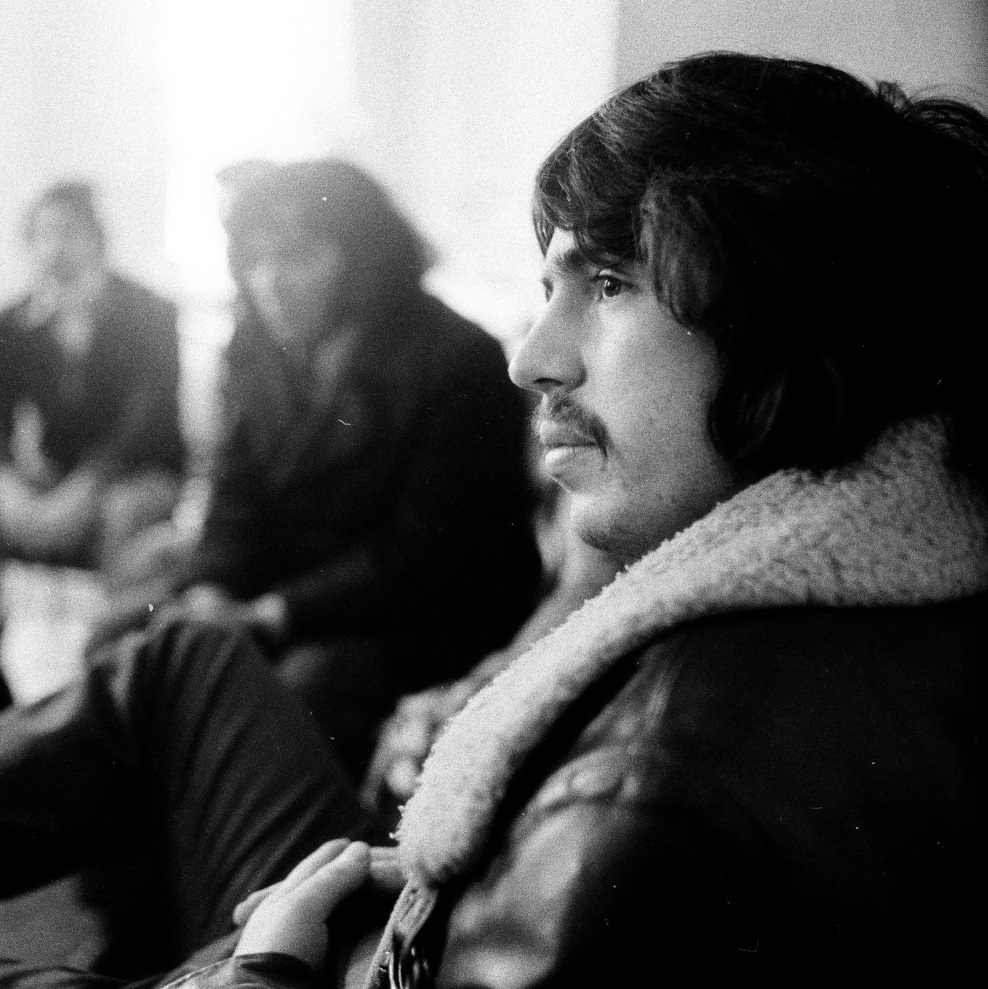
BETEND: May Day, 1979, a man in a heavy jacket stands on a stage in front of a crowd in downtown Chicago, his thick black hair is buffeted by the Spring breeze. At the height of his swift political rise, Rudy Lozano was arguably the most important Latino political figure in the city.
LOZANO: I would like to begin by saluting this effort in the face of one of the most hardest times confronting the working class in this country,
BETEND: The Chicago Reader described his posthumous influence over politics in his community as near-biblical, a timeline splitting event. There was “before Rudy,” and then there was “after Rudy.”
GARY RIVLIN: That’s the significance to me of Rudy Lozano, that this is before and after period where you know, it was a lot of apathy. Uh, there was a lot of fear. Mm-hmm.
BETEND: In an article published two years after Lozano’s death, reporter Gary Rivlin grapples in poignant and often exhaustive detail with the life, death, and legacy of Rudy Lozano. He writes: “When he ran for office in 1983 he awakened his neighborhood’s 100,000 plus Latinos who previously mostly didn’t vote, propelling him to within a whisker of being elected Alderman… He wasn’t just the first Latino to challenge the white machine that ruled his ward, 75 percent latino and 16 percent white, he was more. He awakened people.”
RIVLIN: Uh, there was very low voter registration. It was almost like politics was something over there with the white folks. It was the Chicago machine. Very powerful. Uh, then, and you know, you got something for your vote. Like, if you vote for us, we’ll give you better services. We’ll help you out. If you wanna get rid of a refrigerator, your kid gets in a little bit of trouble. You know, that kind of, that kind of thing. Lozano took that on. He was organizing against some pretty powerful forces, outside forces, uh, in the, in the community.
BETEND: Just like Chuy, Rudy’s family landed in Texas before relocating to South Chicago. Around the same time Chuy was learning his first guitar chords, Rudy was organizing his first protest.
RIVLIN: But then he got into union organizing. There were these, uh, tortilla factories and they hired a lot of people. And the more Lozano looked in, and this is based on my reporting, this is alleged. Um, but I heard it from several people. So I came to believe it was true that, um, the Mexican mafia, whatever you wanna call it, organized crime, was really strong there.
BETEND: In 1979 he joined the International Ladies Garment Workers Union.
He climbed quickly up the ranks. According to Rivlin, the Union’s vice president described Rudy as having a “mind like a computer.”
Within two years he’d become the union’s Midwest Regional Organizing Director — that let him call the shots – And the first targets Rudy set his sights on were the tortilla factories.
He started with Del Rey, the biggest of the two factories in Chicago. To others around Rudy, it seemed like a strange choice: Del Rey only employed around 110 workers, many of them undocumented, making it less likely they’d want to put their employment, or ability to stay in the country, at risk by organizing.
RIVLIN: They had a pay to come, and the deal was they’d work 60 hours and get paid for 40, and it turned out to be more like indentured servitude. They could never pay it back. And so they’re living in lousy conditions, they’re working 60 hours a week and they really can’t get out of it. And so Lozano was taking on powerful forces.
BETEND: Though skeptical, The Union’s vice president, Lou Montenegro, was unable to talk his new director out of the idea, he told Rivlin, “Rudy’s only concern was with the people.”
When I think about union organizing, uh, just from my own experiences I think of like maybe a person with a clipboard, like making sure everyone has water or something like that. But this was very different, right? I mean, uh, what was union organizing looking like at this point in time?
RIVLIN: So a lot of scared people. What Rudy Lozano had to do is go into people’s kitchens, go into the living rooms, meet with them, talk to them, explain to them that, you know, standing up is important and will help yourself, your people, maybe your kids. And you know, it’s, it’s drifting back to the bosses that you know, this guy, this young guy is trying to upset what they have.
BETEND: Lou made Rudy convince the rest of the board on his own because he was too embarrassed to suggest the idea himself.
RIVLIN: And so this was a very exciting time, but also a very scary time ’cause there were threats. You know, there were threats against Lozano with a gun, uh, as a union organizer. There were threats, uh, in Pilsen against those taking on the forces there. I mean, I felt it a little bit too, you know, I did an interview. I’m, you know, there at midnight and, you know, just, just, you’re looking over your shoulder when you hear these kinds of, these kinds of, uh, stories that you know, these are people that don’t want stories, uh, to get out. Rudy Lozano was threatening to expose it through his work.
BETEND: The truth is that Lou was right about the challenge ahead of them; the effort would be long and drawn out, intense and hostile. In fact, it wouldn’t be completed until after Rudy Lozano’s death.
(Music)
BETEND: One of the memorial corridos written by Chuy Negrete was composed for the funeral of his dear friend, Rudy Lozano.
(Music)
BETEND: On the morning of June 9th, 1983, Rudy Lozano was shot and killed in the kitchen of his home. He was 31. His wife, Lupe Lozano, and youngest son, David, were in the house at the time.
Lupe’s father, who lived a few doors away, provided police with one of the few clues: a fleeting glimpse of someone who looked to be in their 20s, wearing a backwards baseball cap, who peddled past on a blue bicycle down the alley away from the Lozano house.
Rivlin writes, “Within hours, hundreds of mourners had flocked to the Lozano home. His body still lay inside. Within days his face was peering out from the plate glass windows of most stores around the barrio, on a poster bordered in black.”
Written across were the words “Un hijo del pueblo,” ‘a son of the people.’
There was considerable pressure on police to find the person responsible.
RIVLIN: I remember counting, there were 15 detectives. It’s what the police called the heater case, that there’s a lot of press attention.
BETEND: For the next few weeks they would follow a winding series of leads and tips that brought them to the backrooms of multiple tortilla factories and the backalleys of City Hall.
Rivlin writes, “After three weeks detectives learned the whereabouts of the murder weapon. The tip came through an anonymous call to Channel 7.”
A few days later an 18 year old, Gregory Escobar, would be charged with the murder.
(Music)
BETEND: At Rudy Lozano’s funeral, thousands marched in a procession for 3 hours. The mayor Harold Washington made a speech. Rudy had been his “liaison to the Latino community” and his efforts had played a crucial role in Washington’s successful bid.
Chuy performed the corrido he’d written in Rudy’s honor.
(Music)
BETEND: Escobar would eventually be convicted. But it would take multiple trials. The jury in his first trial was conflicted about the state’s lack of evidence and unconvinced by the DA’s argument. He was convicted a month later by a 2nd jury after 6 hours of deliberation.
For many of Lozano’s friends and family, convicting Escobar was only the beginning. To them it wasn’t a question of if Rudy’s politics were involved, but which of his many activities had led to his death.
In front of the crowd gathered for the memorial, Chuy and his guitar gave voice to what so many were thinking:
(Corrido)
That’s why they say it was Escobar. That’s why they say that it was Escobar.
Pero la gente no confía en las historias de policía, (fades under)
BETEND: ‘…But people don’t believe the stories of the police.’
(Corrido)
Pero la gente no confía en las historias de policía, (fades under)
RIVLIN: There were informants that came forward and like, you know. Yeah, maybe they were lying.
Maybe it was a made up story, but like one of them the police didn’t even talk to, um, instead they had their preferred performance, who was kind of the middleman for the gun, for Greg Escobar, the shooter. And you know, they kind of bought his story and I’m thinking like, okay, well maybe he’s telling the truth, but he certainly is a tainted source.
And I’m really interested in what these other informants, uh, are, are saying, you know. I sat down with one of them, and you know, they say they overheard a conversation at one of the tortilla factories, um, about, that he thought was about killing Rudy Lozano. And you’re like, okay, well the guy was murdered.
Uh, why don’t we really kinda shake that tree? Why don’t we really pursue that aggressively?
BETEND: In the days after the funeral, a commission was formed to seek justice for Lozano. It was made up of friends, family, fellow activists and even a few local politicians. They wanted Rudy’s death investigated as a political assassination and they wanted to know who put Escobar up to it. Their fear was that arresting Escobar would give the police a reason to give up on investigating any further. In many ways, their fears were justified.
RIVLIN: Within a few weeks they figure out the one who pulled the trigger.
Um, and that’s where it stopped. The case literally closed a few weeks later. And I, you know, I think to myself like.
Wait, if this was. An Irish politician who came within 17 votes of the runoff in an automatic race if it was Polish. I mean, even in Black and White Chicago, it was a Black, um, politician who was gunned down like that, but it just seemed in Chicago then that. Latinos didn’t count.
You know what I mean? Like everyone’s Black and White and you know, Latino was just this other thing that didn’t fit into their, into their equation. I really feel like that had a big impact on everything here. The coverage or lack of coverage of Lozano, but more the point, the investigation afterwards into who killed him.
(Music)
BETEND: Here’s the short version of what happens next: In the reckless pursuit of an easier conviction, the state enshrines its version of the story in testimony and court documents. A story that the Lozano family found as offensive as it was ridiculous; That Rudy Lozano was murdered over a drug debt.
That’s the version of the story I encountered first, repeated in articles, then in the verdict convicting Escobar.
And it’s a story that not even the police believed.
The reality is that there is a chasm sized divergence between many of the communities lived experience and the official narrative
RIVLIN: Here’s the problem.
That’s the story from the guy who’s confessed. But the police did investigate that and just found out he was a really straight-laced fellow. He had nothing to do with drugs. He complained about rock and roll music ’cause it was too drug oriented. He was not into drugs.
BETEND: So how was it possible that the DA was able to convince the jury of a narrative that not even the cases detectives believed. In order to explain, it’s best to start with what everyone believes took place.
In her kitchen, two years later, Lupe Lozano sat with Chicago Reader reporter Gary Rivlin to recount the events of that morning.
RIVLIN: It’s nine in the morning.
He’s still in his t-shirt and doesn’t even have his shirt on. Um, there’s a knock at the back door and someone’s making a case that they need to make a phone call. And Rudy Lozano, generous, Rudy Lozano. Some of his, you know, friends, cohorts called him naive sometimes, you know, let’s the guy in, um, to make his phone call.
BETEND: Lupe was in bed in the next room when she heard the knock on the back door. The conversation struck her as odd. “The voice asked ‘Where’s your wife?’” Lupe later told the jury that found Escobar guilty. “That’s when I lifted my head to listen closely.”
“She said the visitor spoke with her husband in a ‘familiar, relaxed way, like they knew each other.’ Ever since she has racked her brains trying to place a voice that still eludes her.
Lupe thought at first the gunshots were firecrackers popping, only when her mind registered her son David crying did she realize what had happened.”
In their interview Lupe, described the impact on their three sons, “their eldest, Rudy Jr., 9, who was nine at the time planned on one day occupying the Mayor’s office, “They all want to be candidates.” Lupe told Rivlin, “Sometimes they draw political posters, put on their suits and walk around the house campaigning. When they’re mad at each other they withdraw endorsements.”
(Music)
BETEND: “Escobar was hauled in the afternoon of July 3rd, and early on Independence day confessed to the murder. Rivlin writes, “The police closed the case four weeks after it opened, and proudly awaited the applause they would never hear.”
RIVLIN: The police dropped it, the state’s attorney. That was the big hope for the Lozano family, that this would go to the state’s attorney and Richard M Daley was the state’s attorney at the time. He would understand it. He had the clout, he had the juice to like really push.
But, you know, he’s a prosecutor with a record to defend and all they really cared about it seemed to me was closing the case, notching the win. Okay. We solved this case and that was that.
BETEND: I believe the result of that first trial is it ends up in a mistrial, right? The jury is just hopefully deadlocked-
RIVLIN: -the jury was hopelessly confused. (Laughter) Well, why did this guy do it? And there’s conflicting stories and so, you know, I mean, that’s the problem. And not fully, fully investigating, uh, a case. There are holes, and I think the jury saw the holes.
I really think you can’t understand the Lozano case without understanding there was an undercurrent of race and, you know, some of it was racism, but there was this weird, or arguably more insidious form that they didn’t count. You know, the racism from the white community was directed in another, you know, community then.
RIVLIN: And so, the prosecutors’ working theory was that naive Rudy Lozano got in the way of this gang rivalry, gang warfare, and he was a casualty.
Is it possible? Yes. Is it possible that Rudy Lozano somehow got in the way of a gang thing he didn’t understand? But there are also informants who were pointing at the tortilla factories. In fact, I got a call, I got two calls. Uh, the story appears on a Thursday and at two in the morning I’m up with the music on and I get a threatening call, like, you know, “continue writing on the tortilla factories and you’re dead”, kind of thing. I mean, I can’t remember exactly 40 plus years later. And you know, in my head, like I was scared but like, haha you didn’t wake me up. Um, and then at 6:00 AM I was asleep. And they called again. And, you know, whatever threat they gave was just a different version of the same threat.
BETEND: Wow.
RIVLIN: I remember ever, ever since that pair of phone calls, I was pretty convinced it was the tortilla factories.
I’m pretty shocked that the story wasn’t advanced, that in whatever, 30 plus years, that nothing’s come out. I mean, that’s a shame, I- we have our theories. Everyone can believe what they want to believe. It would be nice if someone in power cared. My beef is with the police of the time. My beef is with the state’s attorney at the time. And so to me I think the crime so to speak was committed in 1983, 1984, 1985, both the police and the state’s attorney said “Okay, we know what we need to know. We got our conviction.” Honestly, it just broke my heart that there wasn’t more attention. It was eye opening, and you know,
I guess if we’re looking for any silver linings and a tragedy, it really opened my eyes. I mean, it became very important for me after that, uh, to continue reporting, uh, about, um, Latino empowerment, I remember interviewing this cab driver, um, Luis Gutiérrez. And of course he went on to be, you know, US Congressman, Luis Gutiérrez. You know, Juan Solis, you know, he went on to become a state representative. I talked to him and, you know, one of those Mexican restaurants in Pilsen when he was working a less glamorous job than that. So, you know, I really kind of made it my business, after that, I mean, I guess that’s the way you could say Rudy Lozano continued to inspire after he was killed.
Harold Washington really cared about the Latino community in large part, I believe because Rudy Lozado, he made that connection. They made that connection over shared politics. They made a human connection. They’re both kind of, you know, warm, gregarious people trying to represent their community, and I think there was a real connection there. And Harold Washington to his credits, to me, he really helped empower Latinos. And I think a large part of that was the human connection he made with a fellow politician.
I really think he helped light a light, a fire, a spark. And again, within a few years of his murder, assassination, there were, I think, four Latinos elected to the Chicago City Council by the end of the decade. There were Latinos in the State House. Uh, and, you know, and I really think you can draw that to Lozano. I mean, there are others. It wasn’t just Rudy Lozano. Sure. Uh, but he was a, he, he was a critical figure, a pivotal figure to my mind in, uh, Latino politics in Chicago, kind of an activist turn, union organizer turned politician and gunned down at 31 before he could fully see his life.
(Music)
BETEND: The incredible achievements of Rudy Lozano’s life were carried on by his family, in particular his sister, Emma Lozano. Later by his sons David, Pepe, and Rudy Jr. On July 18th, 2023, Rudy Lozano Jr. was appointed to the Board of Education by Mayor Brandon Johnson.
Rudy’s legacy has been admirably carried on by the students of IJLA.
(Music)
BETEND: Dr. Chuy Negrete’s guitar and harmonicas, as well as a full version of his corrido written for Rudy Lozano will be on display when Aquí en Chicago opens its doors on October 25th.
(Music)
BETEND: One final thought for this episode. Throughout the production process we struggled with how to acknowledge the present political moment we’re preparing to open this exhibition in.
–And then the present came up and smacked us in the face.
GONZALES: [quietly] The news has been changing by the day, and you’ll leave work-
BETEND: A few months ago, I joined our regular production meeting and Elena, who is usually super calm, seemed incredibly stressed.
GONZALES: Ah, I am very pleased to say that we are still planning to open Aquí on time-
April 2nd, we received termination notices for the grants from the National Endowment for the Humanities, stating that our grants no longer effectuated the agency’s needs and priorities. Particularly, that the NEH is repurposing its funding allocations in a new direction in furtherance of the President’s agenda. And our immediate grant termination was necessary to safeguard the interests of the federal government, including its fiscal priorities.
BETEND: The Chicago History Museum received letters informing Elena and her team that all four federal grants that were funding the creation of Aquí en Chicago had been cancelled.
GONZALES: It actually says, “The termination of your grant represents an urgent priority for the administration.”
BETEND: Wow.
GONZALES: So that’s a real slap in the face. We are at a place where we are so far along, it would be in some ways institutionally, a much heavier lift not to do it.
BETEND: This seems kind of like a strange question but do you think of the work that you’re doing as transgressive?
GONZALES: [laughs] I certainly didn’t…I think of the work that I’m doing as strongly morally and ethically guided… so, i don’t view that as being transgressive but i think in the current context it absolutely is.
BETEND: Next time, on Building Aqui.
Building Aqui is co-created by Elena Gonzales and Jesse Betend. The show is written and hosted by Jesse Betend, with additional editing by Elena Gonzales, Chila Soloman, and Sydney Polosquez.
The show is produced by Jesse Betend, and Rob Lafrenz. These are just some of the stories contained in the Aquí en Chicago exhibit. We hope that you will join us in person to explore gorgeous, sparkling quinceanera gowns, architectural artifacts and indigenous art. Next episode we will explore how Rudy Lozano’s efforts to elect Harold Washington led to an executive order which became the foundation of Chicago’s sanctuary city policies.
How Chicago came to have some of the strongest protections for undocumented people in the country, and how it’s painted a target on the city’s back. A thank you to Tama McDonald, without whom this project would not exist. This podcast also wouldn’t be possible without the hard work of everyone behind the Aquí en Chicago exhibit, including Elena’s supporting curatorial colleagues Jojo Galvan Mora, digital humanities fellow, and Rebekah Coffman, curator of religion and community history. As well as 43 advisors, 26 story tellers, 29 interns, and 10 volunteers.
Special thanks to Rita Rosou, for permission to use music from the late, great Chicano Woody Guthry himself, Chuy Negrete. It’s no corrido, but I hope this episode brought warm memories to the many people who loved him. Thanks also to Gary Rivlin, whose article I found incredibly inspiring and was itself very nearly lost to time. I was able to find it because he happened to have a scanned PDF copy of the actual Chicago Reader posted to his website. I haven’t come across anything that explores the story in anywhere near as much depth, and I highly suggest giving it a read. You will find a link to it, as well as a blog post about the history of the Corrido in the show notes for this episode. I am Jesse Betend, thank you for listening.
(Corrido plays)
Episode 2: Sound & Faith
For more than forty years, Chicago has called itself a Sanctuary City—but what does that promise really mean?
Through the stories of Adriana Portillo-Bartow, a Guatemalan mother fleeing military terror in the 1980s; and Elvira Arellano, whose stand inside a Humboldt Park church after 9/11 reignited a national movement, CHM curator Rebekah Coffman reflects on three distinct waves of the city’s historic promise.
Episode 3: We Came Here to Work
What does it mean to serve a country that doesn’t always serve you back?
We trace the life of Frank Corona—a Vietnam War veteran and the first Latino firefighter hired by the Chicago Fire Department—whose story embodies both sacrifice and endurance. Corona agreed to put his life on the line overseas and at home, navigating racism from fellow soldiers and firefighters while remaining committed to public service.
Episode 4: Battle Queen
When Reyna Ortiz decided to change her name, she discovered she would need to change society first.
In the final episode of Building Aquí, we follow Reyna Ortiz’s quest to change not just her name, but the state law that prevented her from doing so. Along the way, we meet fellow “Battle Queen” Tania Còrdova—an immigrant and trans activist who helped push lawmakers to confront the issue, even engaging skeptical and often openly transphobic voters in rural parts of Illinois.

BONUS EPISODE: Interview with Journalist & Author Gary Rivlin
“Write about the tortilla factories and you’re dead.” That was the warning journalist Gary Rivlin received just days after publishing an investigation into the murder of Rudy Lozano.
This bonus episode presents the full interview with Gary Rivlin, released in its entirety. Rivlin reflects on the intimidation he faced and the questions law enforcement never answered.